Code computed the rating from the assessor's inputs:
impact_likely=yes -> 2
Set by the rule
Decision
Released with flags
The engine's reasons
Numbers not found in cited evidence: 02, 2023
Presence and impact_likely are supported, but the northern long-eared bat is now endangered as of 2023-03-31, before the cut-off. The "standard" pathway and the claim that formal consultation is not indicated are overconfident. The tricolored bat is omitted. The category likely stays at 2.
Revision proposed category 3 against a unanimous 2 without a critical issue; revision rejected.
Evidence state
Inferred · reasoned from several records
Revision
Not revised.
The five inputs
Present: yes
IPaC official species list (C-fff17bba4d, C-5a80fc5958, C-5357a5411b) names Indiana bat (endangered), northern long-eared bat (threatened) and monarch (candidate) for the project. The 'no critical habitat' statement (C-00290ee736) concerns critical habitat only, so it does not conflict with species presence.
Scattered woodlots along Sugar Run are noted (C-71ef7a1eed), but no habitat assessment or mapping shows how much suitable bat habitat lies within the buildable area. Extent is not established.
Without a habitat assessment or layout, it is not known whether woodlot clearing can be avoided or timed out. Woodlots are scattered along Sugar Run (C-71ef7a1eed), which suggests avoidance may be feasible but is unconfirmed.
No critical habitat is in the project area (C-00290ee736), which rules out prohibition. Woodlots are scattered (C-71ef7a1eed), so a typical build can use technical assistance, seasonal tree-clearing windows and surveys. Formal consultation or an incidental take permit is not indicated by the evidence.
Listed bats are on the species list (C-fff17bba4d, C-5a80fc5958) and woodlots occur along Sugar Run (C-71ef7a1eed). A typical build with Sugar Run crossings, collection lines and grading would likely clear some tree habitat, so seasonal restrictions and surveys are likely.
IPaC list (2023-02-10) identifies Indiana bat (endangered), northern long-eared bat (threatened) and monarch butterfly (candidate). No critical habitat in project area. Scattered woodlots along Sugar Run. No habitat assessment or state heritage review is in the data room.
Critique
Verdict
weakened
Suggested direction for the rating
same
Summary
Presence and impact_likely are supported, but the northern long-eared bat is now endangered as of 2023-03-31, before the cut-off. The "standard" pathway and the claim that formal consultation is not indicated are overconfident. The tricolored bat is omitted. The category likely stays at 2.
Critic model
Luminol
Issues
Severity major · Kind as_of_error
The AS-OF NOTES say the northern long-eared bat reclassification to endangered took effect 2023-03-31, which is before the 2023-08-15 cut-off. The assessment still calls it threatened, citing the 2023-02-10 IPaC list. The status should be updated to endangered, attributed to the as-of note. Endangered status removes the 4(d) rule flexibility, so the 'standard' pathway and the cost and impact framing are weaker.
The pathway rationale says that formal consultation or an incidental take permit is 'not indicated' and that technical assistance is enough. The cited quotes do not support that. F-ESA is conditional, and a federal nexus is unknown. Two endangered bats make a Section 10 or Section 7 route plausible if tree clearing occurs. The 'standard' pathway is overconfident.
The cost comment says 'Habitat appears limited to scattered woodlots, so exposure is modest', and the avoidable rationale says avoidance 'may be feasible'. Both read 'scattered woodlots' as a limit on habitat and on exposure. The quote does not say how much woodland there is on a 1,356-acre site, so this is an inference. Also, the IPaC list is 'under this office's jurisdiction' and may cover a wider area than the site.
The next steps omit the tricolored bat (proposed endangered 2022-09-14). They also omit a check for the updated NLEB status and its effect on clearing windows. The assessment does not consider a federal nexus (for example, USACE Section 404 stream crossings) that would trigger Section 7. The IPaC list also covers only the 'project area' under the Bloomington office.
Presence and impact_likely are supported, but the northern long-eared bat is now endangered as of 2023-03-31, before the cut-off. The "standard" pathway and the claim that formal consultation is not indicated are overconfident. The tricolored bat is omitted. The category likely stays at 2.
Failed
revision_accepted · not blocking
Revision proposed category 3 against a unanimous 2 without a critical issue; revision rejected.
Evidence (5)
Each claim the row cites: the statement in the assessor's words, then the quote the engine found on the page.
Arrow keys move the selection. A middle-click opens the claim's own page.
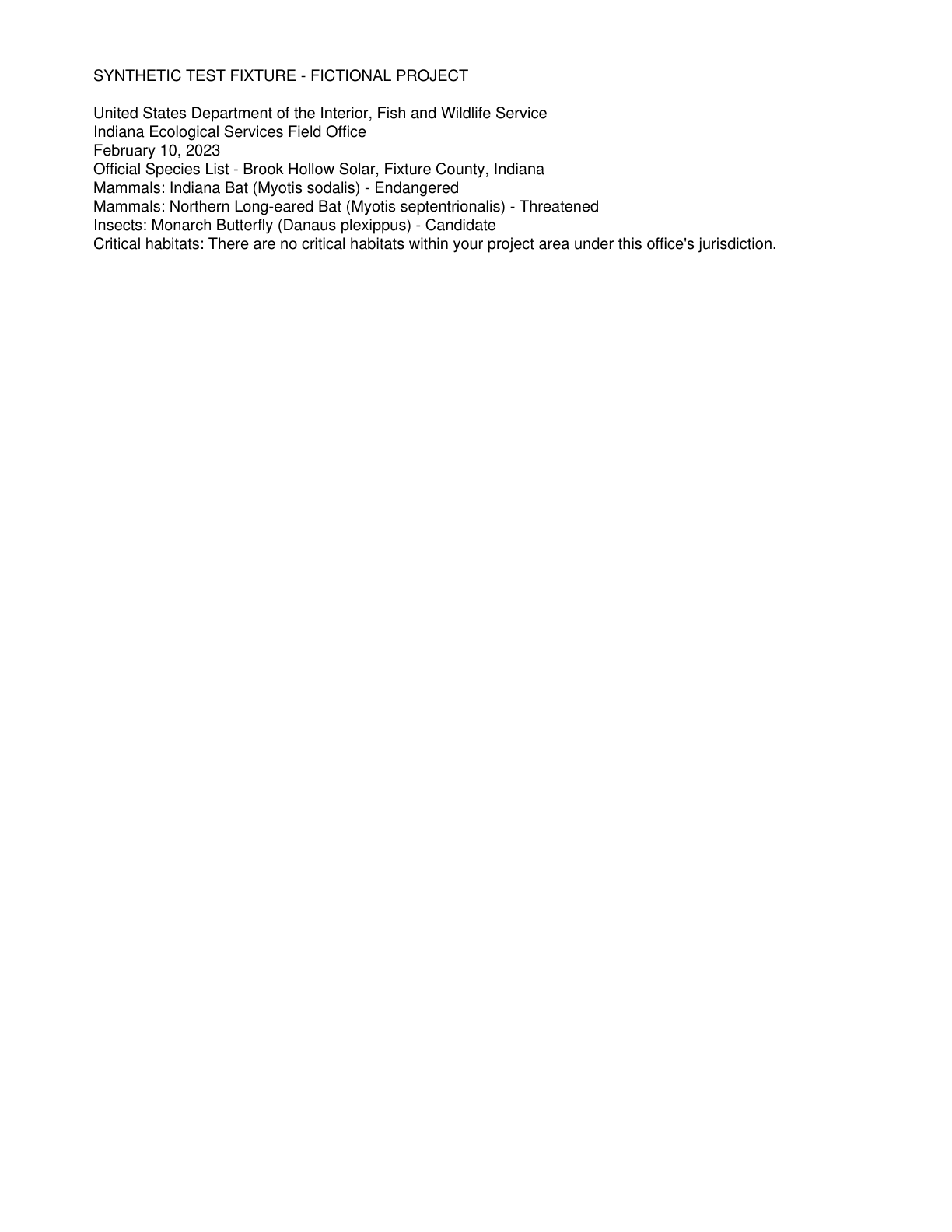
No critical habitats are within the project area under the Indiana Ecological Services Field Office's jurisdiction.
Quote check Exact · Placed verbatim · The quote occurs on the page exactly as written. · Read as native
SYNTHETIC TEST FIXTURE - FICTIONAL PROJECT
United States Department of the Interior, Fish and Wildlife Service
Indiana Ecological Services Field Office
February 10, 2023
Official Species List - Brook Hollow Solar, Fixture County, Indiana
Mammals: Indiana Bat (Myotis sodalis) - Endangered
Mammals: Northern Long-eared Bat (Myotis septentrionalis) - Threatened
Insects: Monarch Butterfly (Danaus plexippus) - Candidate
Quote starts. Critical habitats: There are no critical habitats within your project area under this office's jurisdiction. Quote ends.
The outline marks where the quote begins on the page.
C-00290ee736
No critical habitats are within the project area under the Indiana Ecological Services Field Office's jurisdiction.
Quoted from page 1
Critical habitats: There are no critical habitats within your project area under this office's jurisdiction.
The requirements the assessor tied to this row, by level. Each quote from dated law is shown with its source.
Engine 0.1.0, which made this run, wrote no timelines or citations of law.
Federal
Section 7 consultation (with a federal nexus) or Section 10 incidental take permit and habitat conservation plan
F-ESA · U.S. Fish and Wildlife Service (NMFS for marine and anadromous species)
Applicability
Conditional
Instrument
Endangered Species Act Sections 7 and 10 (16 U.S.C. 1536, 1539); 50 CFR Parts 17 and 402
Trigger
Listed species or critical habitat may be affected by construction or tree clearing.
Description
Federal actions must not jeopardize listed species or adversely modify critical habitat; without a federal nexus, take of listed species is prohibited unless authorized under Section 10.
As of the cut-off
As of the cut-off: Tricolored bat proposed for listing as endangered. (2022-09-14) Northern long-eared bat reclassification from threatened to endangered took effect. (2023-03-31) Changed after the cut-off (not applied): Monarch butterfly proposed for listing as threatened. (2024-12-12)
Environmental review request for state endangered and threatened species
S-05 · Indiana DNR Division of Fish & Wildlife / Nature Preserves; USFWS Bloomington field office
Applicability
Likely
Instrument
Natural Heritage Database review and state-listed species review (IC 14-31, 312 IAC 9)
Trigger
Always for screening; tree clearing and stream work raise risk
Description
Request a DNR Environmental Review for state-listed species and natural heritage. Indiana bat and northern long-eared bat tree clearing windows are commonly recommended.
As of the cut-off
As of 2023-08-15. NLEB was reclassified as federally endangered effective March 2023.
Provide the state natural heritage database review or state wildlife agency letter for the project area, or confirm none exists.
Missing evidence
State natural heritage database review or state wildlife agency letter
Consequence
Threatened and Endangered Species is rated on partial evidence without it.
Blocks the decision
No
Raised by
completeness
IR-b30a17fd04 · Medium priority
Provide the habitat assessment or species survey (e.g., bat acoustic or mist-net) for the project area, or confirm none exists.
Missing evidence
Habitat assessment or species survey (e.g., bat acoustic or mist-net)
Consequence
Threatened and Endangered Species is rated on partial evidence without it.
Blocks the decision
No
Raised by
completeness
Next steps
Commission bat habitat assessment of woodlots along Sugar Run and survey if warranted.
Request Indiana DNR environmental review and USFWS technical assistance.
Site to avoid tree clearing or limit it to seasonal windows.
Agencies
USFWS
Indiana DNR
Cost and impact
Impact
C, S
Potential cost level
L-M
Why
Likely costs are bat habitat assessment or surveys and seasonal clearing restrictions. Habitat appears limited to scattered woodlots, so exposure is modest.
Impact: C = cost, S = schedule. Potential cost level: L, L-M, M, M-H, H (relative to a utility-scale solar budget).
Comments
IPaC list (2023-02-10) identifies Indiana bat (endangered), northern long-eared bat (threatened) and monarch butterfly (candidate). No critical habitat in project area. Scattered woodlots along Sugar Run. No habitat assessment or state heritage review is in the data room.