The page text exactly as the engine read it, with the quote marked.
Placed normalised · The quote matches the page once line breaks, hyphenation, case and punctuation are set aside, as the engine's matcher compares text. The marked words are the page's own.
Bat Habitat Assessment and Vegetation Survey - Tamsin Ridge
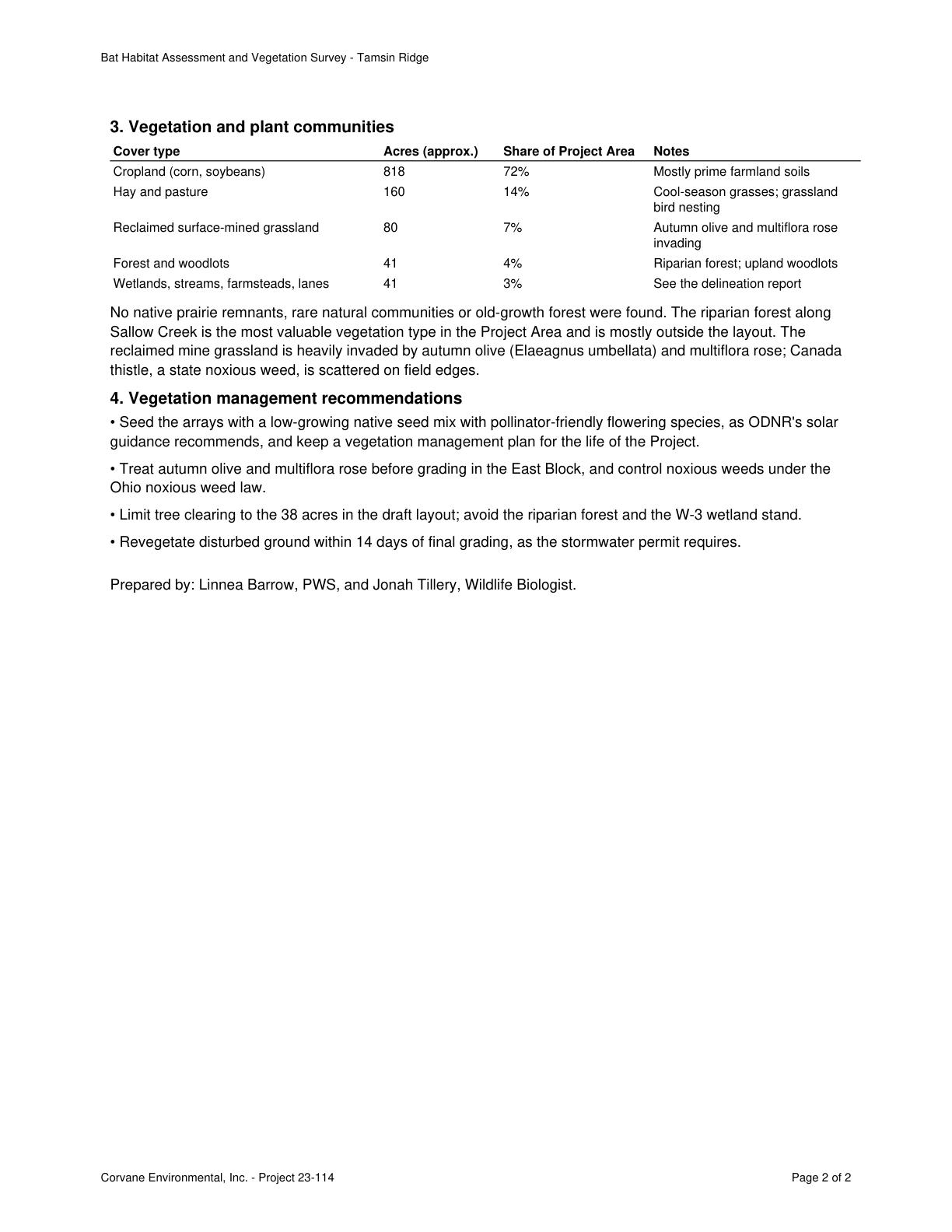
3. Vegetation and plant communities
Cover type Acres (approx.) Share of Project Area Notes
Cropland (corn, soybeans) 818 72% Mostly prime farmland soils
Hay and pasture 160 14% Cool-season grasses; grassland
bird nesting
Reclaimed surface-mined grassland 80 7% Autumn olive and multiflora rose
invading
Forest and woodlots 41 4% Riparian forest; upland woodlots
Wetlands, streams, farmsteads, lanes 41 3% See the delineation report
No native prairie remnants, rare natural communities or old-growth forest were found. The riparian forest along
Sallow Creek is the most valuable vegetation type in the Project Area and is mostly outside the layout. The
reclaimed mine grassland is heavily invaded by autumn olive (Elaeagnus umbellata) and multiflora rose; Quote starts. Canada
thistle, a state noxious weed, is scattered on field edges. Quote ends.
4. Vegetation management recommendations
• Seed the arrays with a low-growing native seed mix with pollinator-friendly flowering species, as ODNR's solar
guidance recommends, and keep a vegetation management plan for the life of the Project.
• Treat autumn olive and multiflora rose before grading in the East Block, and control noxious weeds under the
Ohio noxious weed law.
• Limit tree clearing to the 38 acres in the draft layout; avoid the riparian forest and the W-3 wetland stand.
• Revegetate disturbed ground within 14 days of final grading, as the stormwater permit requires.
Prepared by: Linnea Barrow, PWS, and Jonah Tillery, Wildlife Biologist.
Corvane Environmental, Inc. - Project 23-114 Page 2 of 2
The page
The outline marks where the quote begins on the page.