Skip to content

Battery Energy Storage System Fire Safety Narrative - Tamsin Ridge

C-5162b7c0aa · Page 1 of 2 · DR-0014 · 2023-06-28

The claim, in the assessor's words

Design follows NFPA 855 (2020 edition) and the Ohio Fire Code energy storage provisions as adopted by the State Fire Marshal.

Quoted from page 1
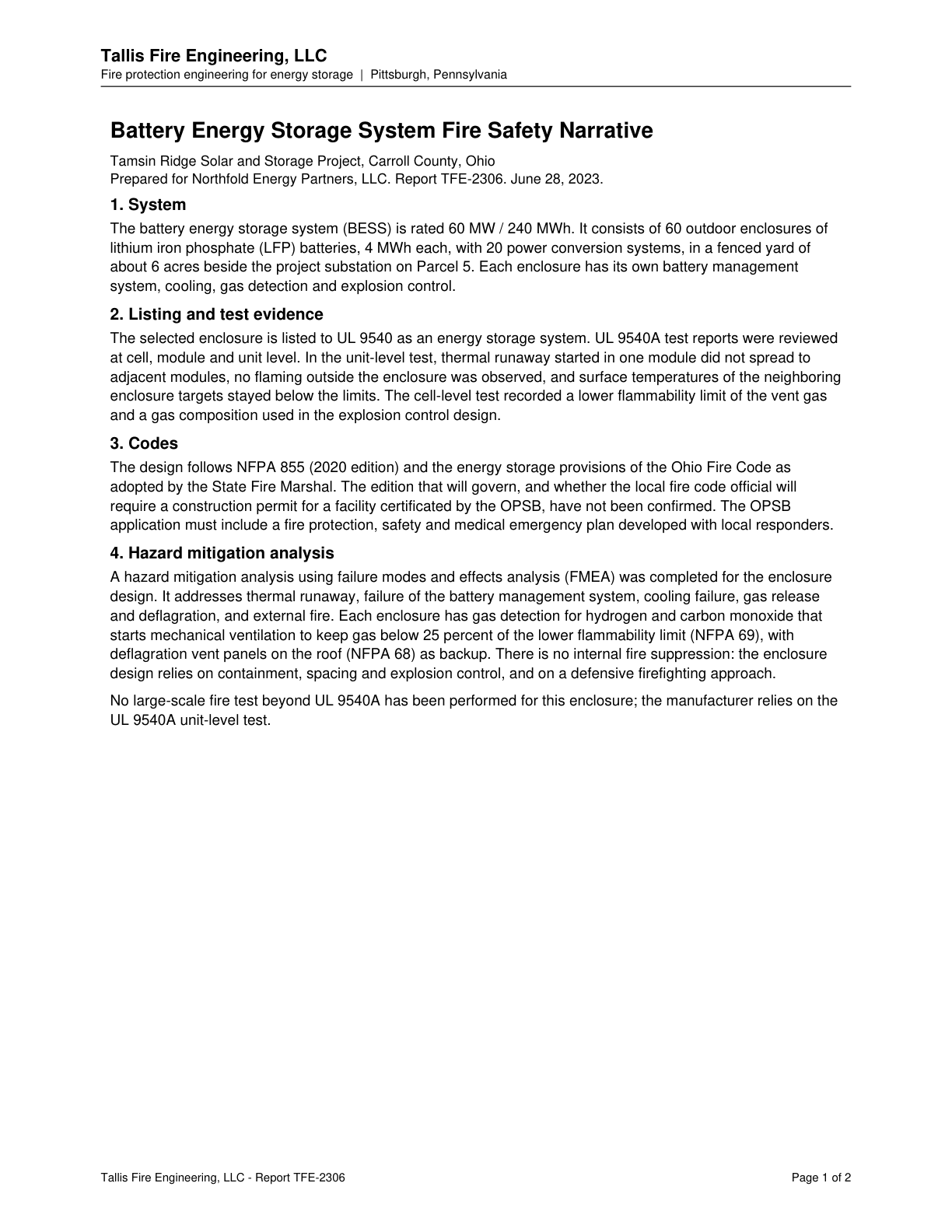
The design follows NFPA 855 (2020 edition) and the energy storage provisions of the Ohio Fire Code as adopted by the State Fire Marshal.

Source consultant_memo · Claim type regulatory · Polarity neutral · Confidence high · Quote check exact, 100 of 100

Cited by EG-04 Battery Storage Fire Safety · Filed under EG-04

On the page

The page text exactly as the engine read it, with the quote marked.

Placed normalised · The quote matches the page once line breaks, hyphenation, case and punctuation are set aside, as the engine's matcher compares text. The marked words are the page's own.

Read as native

Go to the marked quote

Tallis Fire Engineering, LLC Fire protection engineering for energy storage | Pittsburgh, Pennsylvania Battery Energy Storage System Fire Safety Narrative Tamsin Ridge Solar and Storage Project, Carroll County, Ohio Prepared for Northfold Energy Partners, LLC. Report TFE-2306. June 28, 2023. 1. System The battery energy storage system (BESS) is rated 60 MW / 240 MWh. It consists of 60 outdoor enclosures of lithium iron phosphate (LFP) batteries, 4 MWh each, with 20 power conversion systems, in a fenced yard of about 6 acres beside the project substation on Parcel 5. Each enclosure has its own battery management system, cooling, gas detection and explosion control. 2. Listing and test evidence The selected enclosure is listed to UL 9540 as an energy storage system. UL 9540A test reports were reviewed at cell, module and unit level. In the unit-level test, thermal runaway started in one module did not spread to adjacent modules, no flaming outside the enclosure was observed, and surface temperatures of the neighboring enclosure targets stayed below the limits. The cell-level test recorded a lower flammability limit of the vent gas and a gas composition used in the explosion control design. 3. Codes Quote starts. The design follows NFPA 855 (2020 edition) and the energy storage provisions of the Ohio Fire Code as adopted by the State Fire Marshal. Quote ends. The edition that will govern, and whether the local fire code official will require a construction permit for a facility certificated by the OPSB, have not been confirmed. The OPSB application must include a fire protection, safety and medical emergency plan developed with local responders. 4. Hazard mitigation analysis A hazard mitigation analysis using failure modes and effects analysis (FMEA) was completed for the enclosure design. It addresses thermal runaway, failure of the battery management system, cooling failure, gas release and deflagration, and external fire. Each enclosure has gas detection for hydrogen and carbon monoxide that starts mechanical ventilation to keep gas below 25 percent of the lower flammability limit (NFPA 69), with deflagration vent panels on the roof (NFPA 68) as backup. There is no internal fire suppression: the enclosure design relies on containment, spacing and explosion control, and on a defensive firefighting approach. No large-scale fire test beyond UL 9540A has been performed for this enclosure; the manufacturer relies on the UL 9540A unit-level test. Tallis Fire Engineering, LLC - Report TFE-2306 Page 1 of 2

The page

The outline marks where the quote begins on the page.
Page 1 of Battery Energy Storage System Fire Safety Narrative - Tamsin Ridge

Other claims quoted on this page

  • C-5e6f39a39c

    The selected enclosure is listed to UL 9540 as an energy storage system.

  • C-ce7cc27a08

    In the UL 9540A unit-level test, thermal runaway in one module did not spread to adjacent modules and no flaming occurred outside the enclosure.

  • C-e96c5bf196

    The governing code edition and whether the local fire code official will require a construction permit for an OPSB-certificated facility have not been confirmed.

  • C-6bf1273c36

    The OPSB application must include a fire protection, safety and medical emergency plan developed with local responders.

  • C-00c5859e81

    A hazard mitigation analysis using FMEA was completed for the enclosure design.

  • C-9775cc58ba

    There is no internal fire suppression in the enclosures; design relies on containment, spacing, explosion control and defensive firefighting.

  • C-b6407da087

    No large-scale fire test beyond UL 9540A has been performed for this enclosure.

Lumerian Labs 2026