Code computed the rating from the assessor's inputs:
pathway=individual -> 3
Set by the rule
Decision
Released with flags
The engine's reasons
Agencies not in the register or the evidence: SFM, Carroll County
Evidence state
Reported · desktop, consultant or developer record
Worst case
The same rule on the worst case gives no rating above the point.
Scenario
The volunteer fire department finds its response capacity inadequate, and OPSB or the fire official requires large-scale testing, added separation and on-site water tanks that govern the layout of the whole yard amid contested fire-risk opposition.
Step still pending
Fire department and county EMA review of the design and response plan, and OPSB review
The inputs and the category 3 result follow the evidence. The weaknesses are an unsupported 'NFPA 855 (2020)' edition, an unsupported SFM agency, and an overstated 'main concern'. Fixing these would not change the category.
Revised once after the first critique. Rating unchanged.
The five inputs
Present: yes
Project includes battery storage: BESS yard proposed on Parcel 5 (C-0caa870c61) with a UL 9540-listed enclosure selected (C-5e6f39a39c). The zoning verification (C-8041623932) says no local zoning or setback standard applies; this does not remove fire code or OPSB requirements.
BESS is a defined yard 150 feet from the nearest property line, with heat flux below 12.6 kW per square meter at the fence and adjacent rows (C-76f3e4d772, C-d757c50e61), so room for code distances appears available. Water and response gaps (C-04a3f6e338, C-08b9d4306e) are not shown to make the whole area unbuildable. The yard cannot sit over the undermined area (C-f29a379025).
UL 9540 listing, a unit-level test showing no module-to-module propagation and an FMEA hazard mitigation analysis exist (C-5e6f39a39c, C-ce7cc27a08, C-00c5859e81). But no hydrants nearby (C-04a3f6e338), no internal suppression (C-9775cc58ba), no large-scale test beyond UL 9540A (C-b6407da087), a fire department that has not reviewed the design (C-08b9d4306e) and an unconfirmed governing code edition (C-e96c5bf196) mean measures beyond standard design are likely. Design cites NFPA 855 (2020) and the Ohio Fire Code (C-5162b7c0aa).
OPSB staff treats the BESS as part of the generating facility and expects a fire protection, safety and medical emergency plan with local responders (C-e7f77313ec, C-05d57cf46e, C-6bf1273c36). Opponents raised battery fire risk and volunteer fire department response capacity (C-6bdcc9fa85), and fire department review is outstanding (C-08b9d4306e). A state-level review with documented fire-risk opposition fits individual. Whether the local fire official requires a permit is unconfirmed (C-e96c5bf196).
No hydrants in the area and nearest pressurized water about 4 miles away (C-04a3f6e338); design relies on defensive firefighting with no internal suppression (C-9775cc58ba), so on-site water storage or similar physical measures are likely. No large-scale fire test beyond UL 9540A exists (C-b6407da087).
UL 9540-listed enclosure with unit-level test data and an FMEA hazard analysis. Design follows NFPA 855 (2020) and the Ohio Fire Code, but the governing edition is unconfirmed. No hydrants (nearest water about 4 miles), no internal suppression, no large-scale test. Fire department has not reviewed the design.
Critique
Verdict
upheld
Suggested direction for the rating
same
Summary
The assessment is largely supported by the cited quotes. The pathway, inputs and category 3 are reasonable. Only minor wording problems remain: 'committed' overstates a recommendation, the county agency role is unclear, and the room-for-code-distances inference is unquoted.
Critic model
Luminol
Issues
Severity minor · Kind unsupported_statement
The cost note says the developer 'has committed to fund' fire department training and equipment. C-2b046d39ca is typed as a recommendation ('Meet the ... agency ... fund training and equipment'), so it shows a proposed action, not a commitment. Say 'proposes' or 'recommends', unless a binding commitment is documented.
The agency list names 'Carroll County', but the evidence shows no county permitting role. C-8041623932 says no local approval applies, and C-e96c5bf196 says the local fire official's permit role is unconfirmed. The county fits only as EMA or fire responder. The worst case mentions 'county EMA' but does not cite C-2b046d39ca, the claim that supports it.
'Room for code distances appears available' is an inference from the 12.6 kW/m2 heat-flux result and the 150 ft setback. No cited quote states the NFPA 855 separation distances or the yard dimensions, so the peripheral extent call is a judgment. A site layout showing the yard footprint against the undermined area would settle it.
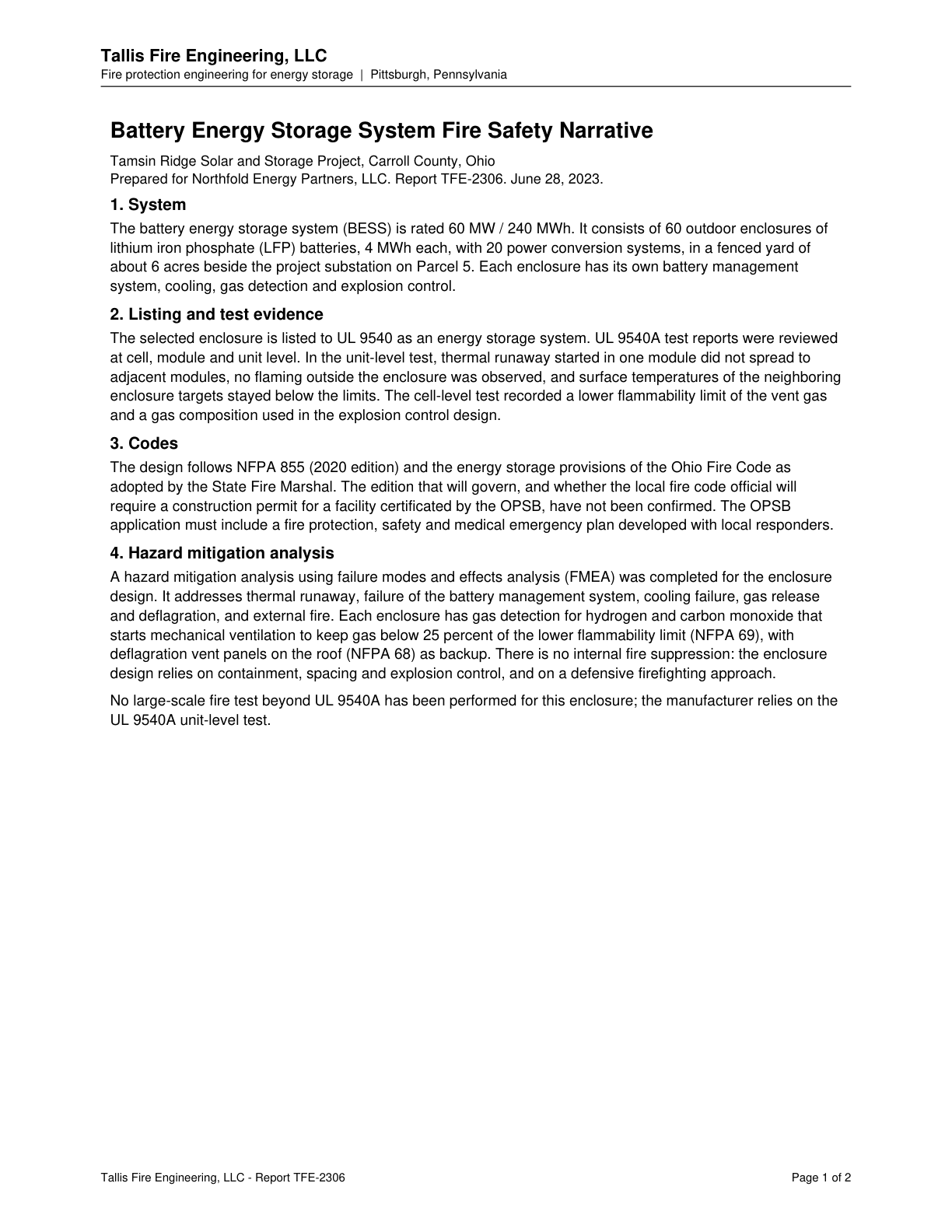
A hazard mitigation analysis using FMEA was completed for the enclosure design.
Quote check Exact · Placed normalised · The quote matches the page once line breaks, hyphenation, case and punctuation are set aside, as the engine's matcher compares text. The marked words are the page's own. · Read as native
Tallis Fire Engineering, LLC
Fire protection engineering for energy storage | Pittsburgh, Pennsylvania
Battery Energy Storage System Fire Safety Narrative
Tamsin Ridge Solar and Storage Project, Carroll County, Ohio
Prepared for Northfold Energy Partners, LLC. Report TFE-2306. June 28, 2023.
1. System
The battery energy storage system (BESS) is rated 60 MW / 240 MWh. It consists of 60 outdoor enclosures of
lithium iron phosphate (LFP) batteries, 4 MWh each, with 20 power conversion systems, in a fenced yard of
about 6 acres beside the project substation on Parcel 5. Each enclosure has its own battery management
system, cooling, gas detection and explosion control.
2. Listing and test evidence
The selected enclosure is listed to UL 9540 as an energy storage system. UL 9540A test reports were reviewed
at cell, module and unit level. In the unit-level test, thermal runaway started in one module did not spread to
adjacent modules, no flaming outside the enclosure was observed, and surface temperatures of the neighboring
enclosure targets stayed below the limits. The cell-level test recorded a lower flammability limit of the vent gas
and a gas composition used in the explosion control design.
3. Codes
The design follows NFPA 855 (2020 edition) and the energy storage provisions of the Ohio Fire Code as
adopted by the State Fire Marshal. The edition that will govern, and whether the local fire code official will
require a construction permit for a facility certificated by the OPSB, have not been confirmed. The OPSB
application must include a fire protection, safety and medical emergency plan developed with local responders.
4. Hazard mitigation analysis
Quote starts. A hazard mitigation analysis using failure modes and effects analysis (FMEA) was completed for the enclosure
design. Quote ends. It addresses thermal runaway, failure of the battery management system, cooling failure, gas release
and deflagration, and external fire. Each enclosure has gas detection for hydrogen and carbon monoxide that
starts mechanical ventilation to keep gas below 25 percent of the lower flammability limit (NFPA 69), with
deflagration vent panels on the roof (NFPA 68) as backup. There is no internal fire suppression: the enclosure
design relies on containment, spacing and explosion control, and on a defensive firefighting approach.
No large-scale fire test beyond UL 9540A has been performed for this enclosure; the manufacturer relies on the
UL 9540A unit-level test.
Tallis Fire Engineering, LLC - Report TFE-2306 Page 1 of 2
The outline marks where the quote begins on the page.
C-00c5859e81
A hazard mitigation analysis using FMEA was completed for the enclosure design.
Quoted from page 1
A hazard mitigation analysis using failure modes and effects analysis (FMEA) was completed for the enclosure
design.
The first-due volunteer fire department, about 5 miles away with two engines and one tanker, has not yet reviewed the design or response plan.
Quoted from page 2
The first-due
fire department is a volunteer department about 5 miles away with two engines and one tanker. It has not yet
reviewed the design or the response plan.
No local zoning, conditional use, variance or site plan approval is required, and no local setback, height or screening standard applies to the proposed facility.
Quoted from page 1
No local zoning permit, conditional use permit, variance or
site plan approval is therefore required for the proposed facility, and no local setback, height or screening
standard applies to it.
There is no internal fire suppression in the enclosures; design relies on containment, spacing, explosion control and defensive firefighting.
Quoted from page 1
There is no internal fire suppression: the enclosure
design relies on containment, spacing and explosion control, and on a defensive firefighting approach.
The governing code edition and whether the local fire code official will require a construction permit for an OPSB-certificated facility have not been confirmed.
Quoted from page 1
The edition that will govern, and whether the local fire code official will
require a construction permit for a facility certificated by the OPSB, have not been confirmed.
The requirements the assessor tied to this row, by level. Each quote from dated law is shown with its source.
No requirement is tied to this row.
Information requests
IR-5947855eaa · High priority
Provide the ul 9540 listing and ul 9540a test reports (cell, module, unit and installation level) for the project area, or confirm none exists.
Missing evidence
UL 9540 listing and UL 9540A test reports (cell, module, unit and installation level)
Consequence
Battery Storage Fire Safety is rated on partial evidence without it.
Blocks the decision
No
Raised by
completeness
IR-debe8f99e4 · High priority
Provide the hazard mitigation analysis, fire risk assessment or explosion control study for the project area, or confirm none exists.
Missing evidence
Hazard mitigation analysis, fire risk assessment or explosion control study
Consequence
Battery Storage Fire Safety is rated on partial evidence without it.
Blocks the decision
No
Raised by
completeness
IR-03be7e4172 · High priority
Provide the emergency response plan or fire department and fire marshal correspondence for the project area, or confirm none exists.
Missing evidence
Emergency response plan or fire department and fire marshal correspondence
Consequence
Battery Storage Fire Safety is rated on partial evidence without it.
Blocks the decision
No
Raised by
completeness
IR-eb247a9fcd · High priority
Provide the bess ordinance, moratorium or fire code adoption record for the project area, or confirm none exists.
Missing evidence
BESS ordinance, moratorium or fire code adoption record
Consequence
Battery Storage Fire Safety is rated on partial evidence without it.
Blocks the decision
No
Raised by
completeness
Next steps
Confirm governing fire code edition and whether the local fire official requires a permit for the OPSB-certificated facility.
Meet the volunteer fire department and county EMA early; finalize the emergency response plan and plan on-site water storage.
Evaluate need for large-scale fire testing.
Agencies
OPSB
SFM
Carroll County
Cost and impact
Impact
C, S
Potential cost level
M-H
Why
Likely on-site fire water supply and possible large-scale testing; the developer has committed to fund fire department training and equipment (C-2b046d39ca). Schedule exposure from OPSB review amid fire-risk opposition.
Impact: C = cost, S = schedule. Potential cost level: L, L-M, M, M-H, H (relative to a utility-scale solar budget).
Comments
UL 9540-listed enclosure with unit-level test data and an FMEA hazard analysis. Design follows NFPA 855 (2020) and the Ohio Fire Code, but the governing edition is unconfirmed. No hydrants (nearest water about 4 miles), no internal suppression, no large-scale test. Fire department has not reviewed the design.