Nearby residences and farmsteads rely on private wells in the shale and sandstone aquifer (C-ae204b1b36). Ohio EPA mapping shows no source water protection area within the parcels (C-afa9ffa993), which does not conflict: private wells are nearby, not protection areas. No hydrants exist and the nearest pressurized water is about 4 miles away (C-04a3f6e338), so fire water will need tanks or hauling.
Private wells are described as nearby, and no protection area lies within the parcels (C-afa9ffa993, C-ae204b1b36). No document places wells within the buildable area, so no protected resource governs the layout.
Offsets from wells, a pre-construction testing offer (C-5a262c9439) and hauled or tank-stored fire water (C-04a3f6e338) can remove the exposure. No documented limit on the aquifer or the water supply.
Well testing offer for private wells within 1,000 feet of pile driving (C-5a262c9439) and routine well or water-use registration if an on-site source is chosen. No contested approval is documented.
Wells are nearby but none is documented inside normal pile-driving offsets, and no protection area exists on the parcels (C-ae204b1b36, C-afa9ffa993). Solar pile driving and a hauled fire water supply are unlikely to affect neighbouring supplies. Testing is pathway and cost, not impact.
Nearby residences and farmsteads rely on private wells in the shale and sandstone aquifer. Ohio EPA mapping shows no source water protection area within the parcels. No fire hydrants in the area; nearest pressurized water is in Carrollton, about 4 miles away. No well survey is in the data room.
Critique
Verdict
upheld
Suggested direction for the rating
same
Summary
The assessment is largely supported by the cited quotes. Present, peripheral and category 1 are reasonable. Minor issues: the impact 'no' call rests on silence about well locations, an unsupported registration claim, questionable agency list, and construction water omitted. The worst case is acceptable.
Critic model
Luminol
Issues
Severity minor · Kind unsupported_statement
The impact_likely rationale says no well is documented inside pile-driving offsets. The data room is silent on well locations, and the 1,000 ft testing recommendation hints that some wells may be close. The 'no' call is a professional judgment resting on silence. A well survey would settle it.
'Routine well or water-use registration' is not in any cited quote or requirement. The pathway rationale also treats a consultant testing recommendation as the regulatory pathway.
The agency list names SFM, whose fire-code role is rated in EG-04, and Ohio EPA, which is not the permitting body for private wells. Ohio DNR Division of Water Resources and the Carroll County health department are more apt for well logs and private water systems.
Construction and panel-washing water supply is not addressed, though no hydrants and distant pressurized water are documented. Next steps cover only fire water.
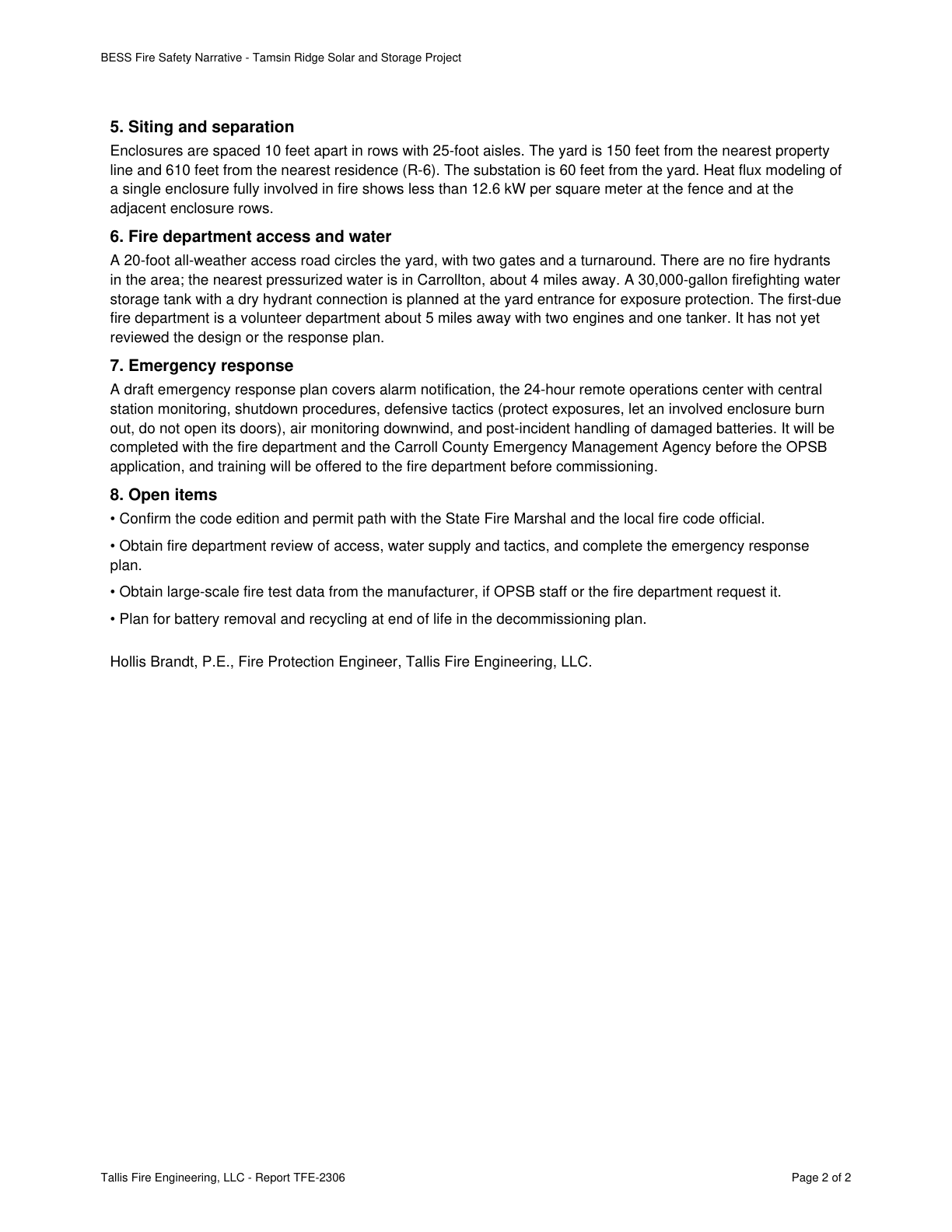
There are no fire hydrants near the yard; the nearest pressurized water is in Carrollton, about 4 miles away.
Quote check Exact · Placed normalised · The quote matches the page once line breaks, hyphenation, case and punctuation are set aside, as the engine's matcher compares text. The marked words are the page's own. · Read as native
BESS Fire Safety Narrative - Tamsin Ridge Solar and Storage Project
5. Siting and separation
Enclosures are spaced 10 feet apart in rows with 25-foot aisles. The yard is 150 feet from the nearest property
line and 610 feet from the nearest residence (R-6). The substation is 60 feet from the yard. Heat flux modeling of
a single enclosure fully involved in fire shows less than 12.6 kW per square meter at the fence and at the
adjacent enclosure rows.
6. Fire department access and water
A 20-foot all-weather access road circles the yard, with two gates and a turnaround. Quote starts. There are no fire hydrants
in the area; the nearest pressurized water is in Carrollton, about 4 miles away. Quote ends. A 30,000-gallon firefighting water
storage tank with a dry hydrant connection is planned at the yard entrance for exposure protection. The first-due
fire department is a volunteer department about 5 miles away with two engines and one tanker. It has not yet
reviewed the design or the response plan.
7. Emergency response
A draft emergency response plan covers alarm notification, the 24-hour remote operations center with central
station monitoring, shutdown procedures, defensive tactics (protect exposures, let an involved enclosure burn
out, do not open its doors), air monitoring downwind, and post-incident handling of damaged batteries. It will be
completed with the fire department and the Carroll County Emergency Management Agency before the OPSB
application, and training will be offered to the fire department before commissioning.
8. Open items
• Confirm the code edition and permit path with the State Fire Marshal and the local fire code official.
• Obtain fire department review of access, water supply and tactics, and complete the emergency response
plan.
• Obtain large-scale fire test data from the manufacturer, if OPSB staff or the fire department request it.
• Plan for battery removal and recycling at end of life in the decommissioning plan.
Hollis Brandt, P.E., Fire Protection Engineer, Tallis Fire Engineering, LLC.
Tallis Fire Engineering, LLC - Report TFE-2306 Page 2 of 2
The outline marks where the quote begins on the page.
C-04a3f6e338
There are no fire hydrants near the yard; the nearest pressurized water is in Carrollton, about 4 miles away.
Quoted from page 2
There are no fire hydrants
in the area; the nearest pressurized water is in Carrollton, about 4 miles away.
The requirements the assessor tied to this row, by level. Each quote from dated law is shown with its source.
No requirement is tied to this row.
Information requests
IR-e0cf50bd46 · Low priority
Provide the wellhead or source-water protection area map, sole-source aquifer map or state drinking-water program determination for the project area, or confirm none exists.
Missing evidence
Wellhead or source-water protection area map, sole-source aquifer map or state drinking-water program determination
Consequence
Groundwater and Water Supply is rated on partial evidence without it.
Blocks the decision
No
Raised by
completeness
IR-5b67c80546 · Low priority
Provide the private well survey, water well records or hydrogeologic desktop study for the project area, or confirm none exists.
Missing evidence
Private well survey, water well records or hydrogeologic desktop study
Consequence
Groundwater and Water Supply is rated on partial evidence without it.
Blocks the decision
No
Raised by
completeness
IR-6b1d8f8529 · Low priority
Provide the water supply plan, will-serve letter or water withdrawal permit (construction, panel washing, fire water) for the project area, or confirm none exists.
Missing evidence
Water supply plan, will-serve letter or water withdrawal permit (construction, panel washing, fire water)
Consequence
Groundwater and Water Supply is rated on partial evidence without it.
Blocks the decision
No
Raised by
completeness
Next steps
Complete a private well survey and offer pre-construction testing within 1,000 feet of pile driving.
Set pile and trenching offsets from wells.
Confirm the construction and BESS fire water source (hauled, tanks or well) and any permit.
Agencies
Ohio EPA
Carroll County
SFM
Cost and impact
Impact
C
Potential cost level
L
Why
Well survey, testing offer and offsets are low cost. Fire water tanks or hauling add a modest cost.
Impact: C = cost, S = schedule. Potential cost level: L, L-M, M, M-H, H (relative to a utility-scale solar budget).
Comments
Nearby residences and farmsteads rely on private wells in the shale and sandstone aquifer. Ohio EPA mapping shows no source water protection area within the parcels. No fire hydrants in the area; nearest pressurized water is in Carrollton, about 4 miles away. No well survey is in the data room.