Skip to content

Threatened and Endangered Species

EC-01 · Matrix · Ecological Resources

Rating
2Impacts likely but may be easily resolved
Why
Impact likely
Worst case
Up to3Resource is present, likely difficult to address
Evidence
Verified
Cited claims
21
Requirements
3
Requests
0

Rating

2Impacts likely but may be easily resolved

up to3Resource is present, likely difficult to address

The engine shows this rating as 2-3

The rule

Code computed the rating from the assessor's inputs:

impact_likely=yes -> 2

Set by the rule

Decision
Released with flags
The engine's reasons
  • Mostly well supported and the category 2 holds. One major problem: the 100-foot riparian buffer appears in no cited quote. Minor issues: extent 'peripheral' is arguable when about 38 of 41 forest acres are cleared, 'summer' and 'complete' are unquoted, and a few next steps are missing.
Evidence state
Verified · field study or agency determination

Worst case

If what is pending at the cut-off went badly, the same rule gives a higher rating.

Scenario

Summer clearing becomes necessary or surveys detect listed bats in the woodlots, and USFWS requires formal Section 7 consultation or incidental take authorization with added conditions; extent stays peripheral because forest is about 41 acres of the site.

Step still pending
Bat presence/absence survey and USFWS consultation, including any tricolored bat listing before construction
Inputs in the worst case
Extent peripheral · Avoidable partly · Pathway individual · Impact likely yes
The rule on the worst case
worst case: pathway=individual -> 3

Revision

First verdict
weakened
First critique

Presence, extent and the category 2 result are broadly supported. The assessment relies on an unsupported consultant NLAA expectation for the pathway and avoidability. It also has a flawed critical-habitat/no-prohibition inference, an untraced 'moderate density' claim, and omits federal-nexus and state take next steps.

Revised once after the first critique. Rating unchanged.

The five inputs

Comments

Project is within range of Indiana, northern long-eared and tricolored bats; summer habitat rated suitable. No hibernacula within 5 miles; no critical habitat. Draft layout clears about 38 acres of trees. No bat presence/absence survey done. Winter clearing recommended; tricolored listing could add conditions.

Critique

Verdict
weakened
Suggested direction for the rating
same
Summary

Mostly well supported and the category 2 holds. One major problem: the 100-foot riparian buffer appears in no cited quote. Minor issues: extent 'peripheral' is arguable when about 38 of 41 forest acres are cleared, 'summer' and 'complete' are unquoted, and a few next steps are missing.

Critic model
Luminol

Issues

  1. Severity major · Kind unsupported_statement

    The 100-foot Sallow Creek riparian buffer appears in no cited quote. C-ffa524ccb3 and C-07bc294f85 support only the Oct 1 to Mar 31 cutting window. The avoidable rationale and the first next step rely on the buffer. Cite a source or drop the number.

    Cites C-ffa524ccb3, C-07bc294f85

  2. Severity minor · Kind overstatement

    Extent 'peripheral' is argued against 780 buildable acres. The affected resource is the roughly 41 acres of forest, and the draft layout clears about 38 of them (about 93%). That makes the habitat loss close to total, so 'peripheral' is a judgment call. The bat survey and the final layout would settle it.

    Cites C-c0e63f6881, C-9d4b1ab8e4

  3. Severity minor · Kind unsupported_statement

    The rationale says 'summer habitat' was rated suitable and the cost note says the 'habitat assessment is complete'. C-f8376d7958 says only 'rated suitable for all three species'. Neither 'summer' nor 'complete' is quoted.

    Cites C-f8376d7958

  4. Severity minor · Kind missing_next_step

    The next steps leave out the monarch (candidate) and the ODNR solar condition to give 24-hour notice if listed species are found during construction. They also do not say how the 38 acres of clearing could be reduced.

    Cites C-d3be22d493, C-c0e63f6881

Checks

  • Passed

    rating_has_evidence · blocking

  • Passed

    presence_is_evidenced · not blocking

  • Passed

    counter_evidence_considered · not blocking

  • Passed

    numbers_grounded · not blocking

  • Passed

    agencies_grounded · not blocking

  • Passed

    cutoff_respected · blocking

  • Passed

    critic_not_refuted · blocking

  • Failed

    critic_weakened · not blocking

    Mostly well supported and the category 2 holds. One major problem: the 100-foot riparian buffer appears in no cited quote. Minor issues: extent 'peripheral' is arguable when about 38 of 41 forest acres are cleared, 'summer' and 'complete' are unquoted, and a few next steps are missing.

Evidence (21)

Each claim the row cites: the statement in the assessor's words, then the quote the engine found on the page.

Arrow keys move the selection. A middle-click opens the claim's own page.

  1. ODNR comments on wildlife, wetlands and mines are typically made conditions of the certificate.OPSB Pre-Application Conference Summary - Tamsin Ridge Solar and Storage Project · Page 2Exact
  2. The Division recommends cutting trees only October 1 through March 31, with a presence or absence survey first if summer clearing is needed.ODNR Environmental Review - Tamsin Ridge Solar and Storage Project (ODNR 23-0477) · Page 1Exact
  3. Northern Long-eared Bat is listed Endangered on the species list for the project.Official Species List - Tamsin Ridge Solar and Storage · Page 1Exact
  4. A search of Division records found no state-listed animal or plant records within one mile of the project boundary.ODNR Environmental Review - Tamsin Ridge Solar and Storage Project (ODNR 23-0477) · Page 1Exact
  5. A USACE nationwide permit is expected for one access road crossing of an ephemeral stream.Tamsin Ridge Solar and Storage Project - Project Description · Page 1Exact
  6. No presence or absence survey (acoustic or mist net) has been done for bats.Bat Habitat Assessment and Vegetation Survey - Tamsin Ridge Solar and Storage Project · Page 1Exact
  7. Suitable roost trees occur at moderate density, about 6 per acre in riparian forest and 3 per acre in woodlots.Bat Habitat Assessment and Vegetation Survey - Tamsin Ridge Solar and Storage Project · Page 1Exact
  8. Tricolored Bat is listed as Proposed Endangered on the species list.Official Species List - Tamsin Ridge Solar and Storage · Page 1Exact
  9. No critical habitats are within the project area under this office's jurisdiction.Official Species List - Tamsin Ridge Solar and Storage · Page 1Exact
  10. The project is within the range of four state-endangered bat species: Indiana, northern long-eared, little brown and tricolored.ODNR Environmental Review - Tamsin Ridge Solar and Storage Project (ODNR 23-0477) · Page 1Exact
  11. No caves are present, and the two collapsed Elsby No. 2 Mine entries on Parcel 10 are sealed with no opening usable by bats.Bat Habitat Assessment and Vegetation Survey - Tamsin Ridge Solar and Storage Project · Page 1Exact
  12. Staff expects ecological surveys coordinated with ODNR and USFWS, wetland delineation before filing, and ODNR buffers for Category 3 wetlands.OPSB Pre-Application Conference Summary - Tamsin Ridge Solar and Storage Project · Page 1Exact
  13. Land cover is cropland and hay with woodlots along Sallow Creek and on reclaimed surface-mined ground in the East Block.Tamsin Ridge Solar and Storage Project - Project Description · Page 1Exact
  14. With winter clearing the project would likely be found not likely to adversely affect listed bats, but the tricolored bat's proposed listing could add conditions.Bat Habitat Assessment and Vegetation Survey - Tamsin Ridge Solar and Storage Project · Page 1Exact
  15. Forest covers about 41 acres and the draft layout clears about 38 acres of trees.Bat Habitat Assessment and Vegetation Survey - Tamsin Ridge Solar and Storage Project · Page 1Exact
  16. Monarch Butterfly is a Candidate species on the species list.Official Species List - Tamsin Ridge Solar and Storage · Page 1Exact
  17. Northern long-eared and Indiana bats are federally endangered; tree clearing should be coordinated with USFWS and potential roost tree cutting limited to October 1 to March 31.ODNR Environmental Review - Tamsin Ridge Solar and Storage Project (ODNR 23-0477) · Page 2Exact
  18. Indiana Bat is listed Endangered on the official species list for the project area.Official Species List - Tamsin Ridge Solar and Storage · Page 1Exact
  19. No hibernacula are known within 5 miles.Bat Habitat Assessment and Vegetation Survey - Tamsin Ridge Solar and Storage Project · Page 1Exact
  20. Summer bat habitat for Indiana, northern long-eared and tricolored bats was assessed June 5 to 9, 2023, and rated suitable for all three species.Bat Habitat Assessment and Vegetation Survey - Tamsin Ridge Solar and Storage Project · Page 1Exact
  21. Cut trees only from October 1 to March 31, leave riparian forest within 100 feet of Sallow Creek standing, and survey first if summer clearing is needed.Bat Habitat Assessment and Vegetation Survey - Tamsin Ridge Solar and Storage Project · Page 1Exact

OPSB Pre-Application Conference Summary - Tamsin Ridge Solar and Storage Project

C-03c910d4d1 · Page 2 of 2 · DR-0026

Open the claim, C-03c910d4d1

ODNR comments on wildlife, wetlands and mines are typically made conditions of the certificate.

Quote check Exact · Placed normalised · The quote matches the page once line breaks, hyphenation, case and punctuation are set aside, as the engine's matcher compares text. The marked words are the page's own. · Read as native

OPSB Pre-Application Conference Summary - Tamsin Ridge 4. Process and timing The pre-application notification letter must be filed at least 15 days before the public informational meeting, which must be held in the project area no more than 90 days before the application. After the application is filed, the chairman accepts it as complete or rejects it within 60 days, and the hearing is set 60 to 90 days after a complying application is received. Staff indicated that solar cases with active local opposition have recently taken 9 to 14 months from filing to decision. Planned sequence: county public meeting in May 2023; public informational meeting after the 90-day period that follows the county meeting; application filing in the third quarter of 2023; decision expected in 2024. 5. State permits outside the certificate Staff reminded the team that Ohio EPA construction stormwater coverage, any Section 401 certification or isolated wetland permit, and ODOT hauling and access permits are obtained separately, and that Quote starts. ODNR comments on wildlife, wetlands and mines are typically made conditions of the certificate. Quote ends. 6. Action items • Northfold: schedule and notice the county public meeting under ORC 303.61. • Northfold: complete the noise study, the geotechnical mine investigation plan and the emergency plan before the public informational meeting. • Whitlock Ames: prepare the pre-application notification letter and the public notices. • Whitlock Ames: monitor the Board of County Commissioners' agenda for any ORC 303.58 or 303.62 resolution. Prepared by Whitlock Ames LLP for its client. Privileged and confidential. Whitlock Ames LLP - privileged Page 2 of 2

The outline marks where the quote begins on the page.
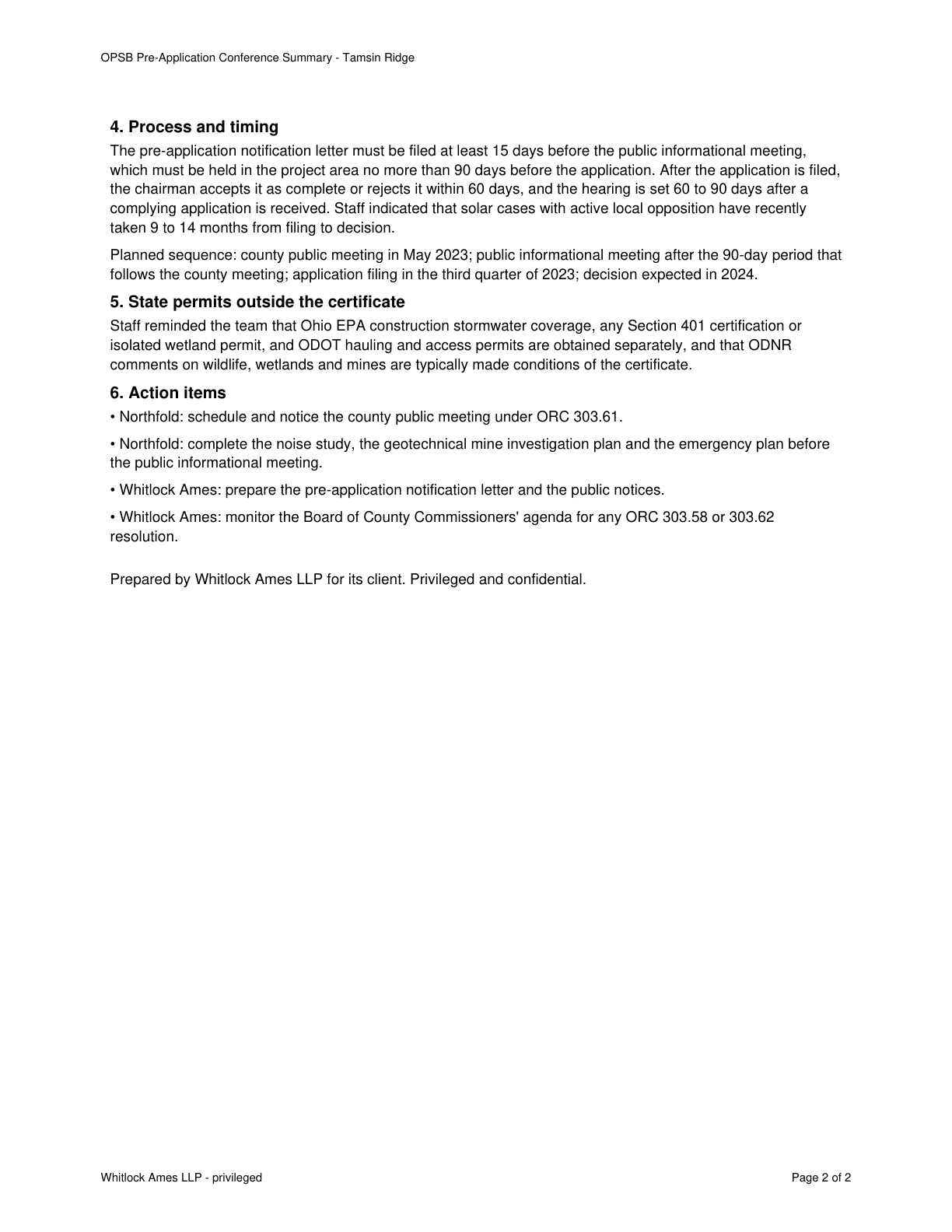
Page 2 of OPSB Pre-Application Conference Summary - Tamsin Ridge Solar and Storage Project
  1. C-03c910d4d1

    ODNR comments on wildlife, wetlands and mines are typically made conditions of the certificate.

    Quoted from page 2
    ODNR comments on wildlife, wetlands and mines are typically made conditions of the certificate.

    OPSB Pre-Application Conference Summary - Tamsin Ridge Solar and Storage Project · DR-0026 · Page 2 · 2023-03-28

    Source agency_determination · Claim type agency_position · Polarity neutral · Confidence high · Quote check exact, 100 of 100

    Cited by EN-02 · Filed under AQ-01, EC-01, EN-02, PE-02

  2. C-07bc294f85

    The Division recommends cutting trees only October 1 through March 31, with a presence or absence survey first if summer clearing is needed.

    Quoted from page 1
    The Division recommends that trees be cut only from October 1 through March 31.

    ODNR Environmental Review - Tamsin Ridge Solar and Storage Project (ODNR 23-0477) · DR-0011 · Page 1 · 2023-05-02

    Source agency_determination · Claim type recommendation · Polarity neutral · Confidence high · Quote check exact, 100 of 100

  3. C-1fc496d3e7

    Northern Long-eared Bat is listed Endangered on the species list for the project.

    Quoted from page 1
    Northern Long-eared Bat (Myotis septentrionalis) Endangered

    Official Species List - Tamsin Ridge Solar and Storage · DR-0010 · Page 1 · 2023-04-12

    Source agency_determination · Claim type presence · Polarity presence · Confidence high · Quote check exact, 100 of 100

  4. C-2a17c48d5e

    A search of Division records found no state-listed animal or plant records within one mile of the project boundary.

    Quoted from page 1
    found no records within one mile of the project boundary.

    ODNR Environmental Review - Tamsin Ridge Solar and Storage Project (ODNR 23-0477) · DR-0011 · Page 1 · 2023-05-02

    Source agency_determination · Claim type absence · Polarity absence · Confidence high · Quote check exact, 100 of 100

  5. C-441acfa155

    A USACE nationwide permit is expected for one access road crossing of an ephemeral stream.

    Quoted from page 1
    A U.S. Army Corps of Engineers nationwide permit is expected for one access road crossing of an ephemeral stream.

    Tamsin Ridge Solar and Storage Project - Project Description · DR-0001 · Page 1 · 2023-06-12

    Source developer_document · Claim type presence · Polarity presence · Confidence high · Quote check exact, 100 of 100

    Cited by AQ-01, PE-03 · Filed under AQ-01, PE-03

  6. C-555c53eecb

    No presence or absence survey (acoustic or mist net) has been done for bats.

    Quoted from page 1
    No presence or absence survey (acoustic or mist net) has been done.

    Bat Habitat Assessment and Vegetation Survey - Tamsin Ridge Solar and Storage Project · DR-0007 · Page 1 · 2023-06-20

    Source field_study · Claim type data_gap · Polarity neutral · Confidence high · Quote check exact, 100 of 100

  7. C-67b64c9a6d

    Suitable roost trees occur at moderate density, about 6 per acre in riparian forest and 3 per acre in woodlots.

    Quoted from page 1
    Suitable roost trees (shagbark hickory, dead and dying ash with exfoliating bark, snags with cavities) occur at

    Bat Habitat Assessment and Vegetation Survey - Tamsin Ridge Solar and Storage Project · DR-0007 · Page 1 · 2023-06-20

    Source field_study · Claim type presence · Polarity presence · Confidence medium · Quote check exact, 100 of 100

  8. C-6a977dc2fc

    Tricolored Bat is listed as Proposed Endangered on the species list.

    Quoted from page 1
    Tricolored Bat (Perimyotis subflavus) Proposed Endangered

    Official Species List - Tamsin Ridge Solar and Storage · DR-0010 · Page 1 · 2023-04-12

    Source agency_determination · Claim type presence · Polarity presence · Confidence high · Quote check exact, 100 of 100

  9. C-6cce152aa1

    No critical habitats are within the project area under this office's jurisdiction.

    Quoted from page 1
    There are no critical habitats within your project area under this office's jurisdiction.

    Official Species List - Tamsin Ridge Solar and Storage · DR-0010 · Page 1 · 2023-04-12

    Source agency_determination · Claim type absence · Polarity absence · Confidence high · Quote check exact, 100 of 100

  10. C-834477b4bd

    The project is within the range of four state-endangered bat species: Indiana, northern long-eared, little brown and tricolored.

    Quoted from page 1
    The project is within the range of the Indiana bat, the northern long-eared bat, the little brown bat and the tricolored bat, all state endangered.

    ODNR Environmental Review - Tamsin Ridge Solar and Storage Project (ODNR 23-0477) · DR-0011 · Page 1 · 2023-05-02

    Source agency_determination · Claim type presence · Polarity presence · Confidence high · Quote check exact, 100 of 100

  11. C-8cc28ff616

    No caves are present, and the two collapsed Elsby No. 2 Mine entries on Parcel 10 are sealed with no opening usable by bats.

    Quoted from page 1
    both are sealed with rubble and soil and have no opening a bat could use.

    Bat Habitat Assessment and Vegetation Survey - Tamsin Ridge Solar and Storage Project · DR-0007 · Page 1 · 2023-06-20

    Source field_study · Claim type absence · Polarity absence · Confidence high · Quote check exact, 100 of 100

  12. C-92da5f14af

    Staff expects ecological surveys coordinated with ODNR and USFWS, wetland delineation before filing, and ODNR buffers for Category 3 wetlands.

    Quoted from page 1
    Ecological surveys coordinated with ODNR and the U.S. Fish and Wildlife Service, wetland delineation before

    OPSB Pre-Application Conference Summary - Tamsin Ridge Solar and Storage Project · DR-0026 · Page 1 · 2023-03-28

    Source agency_determination · Claim type regulatory · Polarity presence · Confidence high · Quote check exact, 100 of 100

    Filed under AQ-01, EC-01, EC-02

  13. C-9d4b1ab8e4

    Land cover is cropland and hay with woodlots along Sallow Creek and on reclaimed surface-mined ground in the East Block.

    Quoted from page 1
    Land cover is cropland and hay with woodlots along Sallow Creek and on reclaimed surface-mined ground in the East Block.

    Tamsin Ridge Solar and Storage Project - Project Description · DR-0001 · Page 1 · 2023-06-12

    Source developer_document · Claim type presence · Polarity presence · Confidence high · Quote check exact, 100 of 100

    Cited by EC-03 · Filed under EC-03, EN-01, EN-03

  14. C-b99793a4d2

    With winter clearing the project would likely be found not likely to adversely affect listed bats, but the tricolored bat's proposed listing could add conditions.

    Quoted from page 1
    the tricolored bat's proposed listing could add conditions if it is listed before construction.

    Bat Habitat Assessment and Vegetation Survey - Tamsin Ridge Solar and Storage Project · DR-0007 · Page 1 · 2023-06-20

    Source consultant_memo · Claim type study_finding · Polarity presence · Confidence medium · Quote check exact, 100 of 100

  15. C-c0e63f6881

    Forest covers about 41 acres and the draft layout clears about 38 acres of trees.

    Quoted from page 1
    The draft layout clears about 38 acres of trees.

    Bat Habitat Assessment and Vegetation Survey - Tamsin Ridge Solar and Storage Project · DR-0007 · Page 1 · 2023-06-20

    Source field_study · Claim type extent · Polarity presence · Confidence medium · Quote check exact, 100 of 100

    Cited by EC-02, EC-03 · Filed under EC-01, EC-03

  16. C-d3be22d493

    Monarch Butterfly is a Candidate species on the species list.

    Quoted from page 1
    Monarch Butterfly (Danaus plexippus) Candidate

    Official Species List - Tamsin Ridge Solar and Storage · DR-0010 · Page 1 · 2023-04-12

    Source agency_determination · Claim type presence · Polarity presence · Confidence high · Quote check exact, 100 of 100

  17. C-dc1be8d04f

    Northern long-eared and Indiana bats are federally endangered; tree clearing should be coordinated with USFWS and potential roost tree cutting limited to October 1 to March 31.

    Quoted from page 2
    The northern long-eared bat and the Indiana bat are federally endangered. Coordinate tree clearing with the U.S. Fish and Wildlife Service.

    ODNR Environmental Review - Tamsin Ridge Solar and Storage Project (ODNR 23-0477) · DR-0011 · Page 2 · 2023-05-02

    Source agency_determination · Claim type presence · Polarity presence · Confidence high · Quote check exact, 100 of 100

    Filed under EC-01, PE-03

  18. C-df791cc2b9

    Indiana Bat is listed Endangered on the official species list for the project area.

    Quoted from page 1
    Indiana Bat (Myotis sodalis) Endangered

    Official Species List - Tamsin Ridge Solar and Storage · DR-0010 · Page 1 · 2023-04-12

    Source agency_determination · Claim type presence · Polarity presence · Confidence high · Quote check exact, 100 of 100

  19. C-e9d6f2913d

    No hibernacula are known within 5 miles.

    Quoted from page 1
    No hibernacula are known within 5 miles.

    Bat Habitat Assessment and Vegetation Survey - Tamsin Ridge Solar and Storage Project · DR-0007 · Page 1 · 2023-06-20

    Source field_study · Claim type absence · Polarity absence · Confidence medium · Quote check exact, 100 of 100

  20. C-f8376d7958

    Summer bat habitat for Indiana, northern long-eared and tricolored bats was assessed June 5 to 9, 2023, and rated suitable for all three species.

    Quoted from page 1
    The habitat is rated suitable for all three species.

    Bat Habitat Assessment and Vegetation Survey - Tamsin Ridge Solar and Storage Project · DR-0007 · Page 1 · 2023-06-20

    Source field_study · Claim type presence · Polarity presence · Confidence high · Quote check exact, 100 of 100

  21. C-ffa524ccb3

    Cut trees only from October 1 to March 31, leave riparian forest within 100 feet of Sallow Creek standing, and survey first if summer clearing is needed.

    Quoted from page 1
    cut trees only from October 1 to March 31, as ODNR and the Service recommend;

    Bat Habitat Assessment and Vegetation Survey - Tamsin Ridge Solar and Storage Project · DR-0007 · Page 1 · 2023-06-20

    Source consultant_memo · Claim type recommendation · Polarity neutral · Confidence high · Quote check exact, 100 of 100

    Cited by EC-03 · Filed under EC-01, EC-03

Requirements and permits

The requirements the assessor tied to this row, by level. Each quote from dated law is shown with its source.

Federal

  • Section 7 consultation (with a federal nexus) or Section 10 incidental take permit and habitat conservation plan

    F-ESA · U.S. Fish and Wildlife Service (NMFS for marine and anadromous species)

    Applicability
    Conditional
    Instrument
    Endangered Species Act Sections 7 and 10 (16 U.S.C. 1536, 1539); 50 CFR Parts 17 and 402
    Trigger
    Listed species or critical habitat may be affected by construction or tree clearing.
    Description

    Federal actions must not jeopardize listed species or adversely modify critical habitat; without a federal nexus, take of listed species is prohibited unless authorized under Section 10.

    Typical timeline

    Formal consultation concludes within 90 days after its initiation unless extended, and the Service delivers its biological opinion within 45 days after concluding formal consultation (50 CFR 402.14(e)): 90 + 45 days from initiation when not extended. An extension involving an applicant cannot exceed 60 days without the applicant's consent. Typical: 12 to 24 months for a Section 10 incidental take permit with a habitat conservation plan (basis: practice, not stated in the sources).

    As of the cut-off

    As of the cut-off: FWS found that listing the monarch butterfly is warranted but precluded by higher priority actions. (2020-12-17) Tricolored bat proposed for listing as endangered. (2022-09-14) FWS published the final rule reclassifying the northern long-eared bat as endangered (87 FR 73488), effective 2023-01-30; a delay notice of 2023-01-26 (88 FR 4908) moved the effective date to 2023-03-31. (2022-11-30) FWS issued the Interim Consultation Framework for the northern long-eared bat, valid from 2023-03-31 through 2024-04-01. (2023-03-21) Northern long-eared bat reclassification from threatened to endangered took effect. (2023-03-31)

    Verification
    PACK_PENDING_QUALIFIED_REVIEW
    Source
    pack:federal
    In the permit matrix
    F-ESA
    Legal basis: 3 quotes from dated law
    Quoted from the law, page 1
    Each Federal agency shall review its actions at the earliest possible time to determine whether any action may affect listed species or critical habitat. If such a determination is made, formal consultation is required, except as noted in paragraph (b) of this section.

    Source 50CFR402 · page 1 · version 2023-08-01

    Cited for requirement and trigger

    In force from 2019-10-28 to 2024-04-04

    eCFR versioner: 50 CFR part 402, same text on 2021-10-15, 2022-05-20, 2022-09-12, 2023-04-22, 2023-08-01 and on every amendment date between them; amendment dates 2017-01-01, 2019-08-27, 2019-09-25, 2019-09-26, 2019-10-28, 2021-12-08, 2024-04-05, 2024-05-06

    May be cited on the cut-off date.

    Quoted from the law, page 1
    Formal consultation concludes within 90 days after its initiation unless extended as provided below.

    Source 50CFR402 · page 1 · version 2023-08-01

    Cited for timeline: formal consultation period

    In force from 2019-10-28 to 2024-04-04

    eCFR versioner: 50 CFR part 402, same text on 2021-10-15, 2022-05-20, 2022-09-12, 2023-04-22, 2023-08-01 and on every amendment date between them; amendment dates 2017-01-01, 2019-08-27, 2019-09-25, 2019-09-26, 2019-10-28, 2021-12-08, 2024-04-05, 2024-05-06

    May be cited on the cut-off date.

    Quoted from the law, page 1
    A consultation involving an applicant cannot be extended for more than 60 days without the consent of the applicant. Within 45 days after concluding formal consultation, the Service shall deliver a biological opinion to the Federal agency and any applicant.

    Source 50CFR402 · page 1 · version 2023-08-01

    Cited for timeline: extension limit and biological opinion period

    In force from 2019-10-28 to 2024-04-04

    eCFR versioner: 50 CFR part 402, same text on 2021-10-15, 2022-05-20, 2022-09-12, 2023-04-22, 2023-08-01 and on every amendment date between them; amendment dates 2017-01-01, 2019-08-27, 2019-09-25, 2019-09-26, 2019-10-28, 2021-12-08, 2024-04-05, 2024-05-06

    May be cited on the cut-off date.

State

  • Protection of state-listed wildlife and plants: no take of endangered wildlife without a Division of Wildlife permit; ODNR Environmental Review and any species surveys, including bat surveys and tree-clearing windows

    OH-ESA · Ohio Department of Natural Resources (ODNR): Division of Wildlife (state-listed wildlife and its part of the Environmental Review) and Division of Natural Areas and Preserves (state-listed plants)

    Applicability
    Conditional
    Instrument
    ORC 1531.25; OAC 1501:31-23-01 (effective 2022-07-01); ORC 1518.02; OAC 1501:18-1-03 (effective 2022-11-01); ODNR Environmental Review; ODNR Division of Wildlife and U.S. Fish and Wildlife Service (USFWS) joint guidance for bat surveys and tree clearing (May 2022)
    Trigger
    Work that could take a state-listed endangered animal or destroy a listed plant, including tree clearing from April through September or near potential bat hibernacula, on a project that will be submitted to the OPSB.
    Description

    Ohio protects endangered wildlife by rule (OAC 1501:31-23-01, under ORC 1531.25); the list includes the Indiana, northern long-eared, little brown and tricolored bats. Taking or possessing a listed animal without a written permit is generally unlawful. The statute directs the rules to provide permits for zoological, educational, scientific and propagation purposes, and the sources describe no incidental-take permit for a solar project. Endangered and threatened plants are covered by ORC 1518.02, which bars willful destruction or removal without the written permission of the owner, lessee or person entitled to possession, so its direct reach is limited where that permission exists. ODNR asks that a project going to the Ohio Power Siting Board (OPSB) use its Environmental Review. ORC 4906.13(B) bars public agencies from requiring approvals or permits for a facility authorized by an OPSB certificate; whether that displaces a Division of Wildlife take permit is not addressed in the sources.

    Typical timeline

    Tree clearing, as the joint ODNR Division of Wildlife and USFWS guidance (May 2022) states it: for a project outside a known bat record buffer that proposes tree clearing between April 1 and September 31 (sic, the guidance's wording), a presence/probable absence survey may be conducted between June 1 and August 15, and if none is performed presence of listed bats is assumed. Where a desktop assessment finds potential hibernacula, the guidance says to assume bats are using them and refrain from clearing trees from March 15 to November 15, or to conduct a field habitat assessment. The library holds the May 2022 edition of the guidance, the latest archived before 2023-08-01; a later edition may have replaced it before that date but could not be verified. No statutory period for ODNR's Environmental Review appears in the sources.

    Version of the law on the cut-off
    OAC 1501:31-23-01 as effective 2022-07-01 (the library text)
    As of the cut-off

    As of the cut-off: USFWS reclassification of the northern long-eared bat from threatened to endangered took effect (final rule 87 FR 73488, effective date delayed to 2023-03-31 by 88 FR 4908). The May 2022 joint guidance and ODNR's July 2022 listed-species publication still describe it as federally threatened, and the guidance refers to the 4(d) rule. (2023-03-31)

    Verification
    PACK_PENDING_QUALIFIED_REVIEW
    Source
    pack:oh.json
    In the permit matrix
    OH-ESA
    Legal basis: 8 quotes from dated law
    Quoted from the law, page 9
    The rules shall provide for the taking of species threatened with statewide extinction, for zoological, educational, and scientific purposes, and for propagation in captivity to preserve the species, under written permits from the chief.

    Source ORC 1531.08 1531.25 1518 endangered species · page 9 · version 2023-08-01

    In force from 1988-07-20 to 2026-10-03, section 1531.25

    1531.25: version effective 1988-07-20, still the current version when the page map was checked (2026-10-03)

    May be cited on the cut-off date.

    Quoted from the law, page 1
    the following native species and subspecies of wild animals shall be designated as endangered in accordance with section 1531.25 of the Revised Code: (1) Mammals Indiana bat, Myotis sodalis Allegheny woodrat, Neotoma magister Black bear, Ursus americanus Little brown bat, Myotis lucifugus Tricolored bat, Perimyotis subflavus Northern long-eared bat, Myotis septentrionalis

    Source OAC 1501 31 23 01 endangered wild animals · page 1 · version 2023-08-01

    In force from 2022-07-01 to 2023-12-31, section 1501:31-23-01

    1501:31-23-01: version effective 2022-07-01; first change after it 2024-01-01 (ODNR Division of Wildlife amendment (endangered wild animals list). Register of Ohio final-filed item named 1501$31-23-01_PH_FF_A_RU_20231011_0813 (filed 2023-10-11 per file name; content not retrievable)), from codes.ohio.gov version history in archive captures (one_source)

    May be cited on the cut-off date.

    Quoted from the law, page 14
    unlawful for any person to take, transport, sell, offer for sale or possess any of the native endangered species of wild animals, applying to endangered wild animals that are either resident within or migrate into or through Ohio, or hides or parts thereof listed in this rule or any other wildlife order without first obtaining a written permit

    Source OAC 1501 31 23 01 endangered wild animals · page 14 · version 2023-08-01

    In force from 2022-07-01 to 2023-12-31, section 1501:31-23-01

    1501:31-23-01: version effective 2022-07-01; first change after it 2024-01-01 (ODNR Division of Wildlife amendment (endangered wild animals list). Register of Ohio final-filed item named 1501$31-23-01_PH_FF_A_RU_20231011_0813 (filed 2023-10-11 per file name; content not retrievable)), from codes.ohio.gov version history in archive captures (one_source)

    May be cited on the cut-off date.

    Quoted from the law, page 2
    No person shall willfully root up, injure, destroy, remove, or carry away on or from public highways, public property, or waters of the state, or on or from the property of another, without the written permission of the owner, lessee, or other person entitled to possession, any endangered or threatened plant

    Source ORC 1531.08 1531.25 1518 endangered species · page 2 · version 2023-08-01

    In force from 1978-08-23 to 2026-10-03, section 1518.02

    1518.02: version effective 1978-08-23, still the current version when the page map was checked (2026-10-03)

    May be cited on the cut-off date.

    Quoted from the law, page 20
    (B) No public agency or political subdivision of this state may require any approval, consent, permit, certificate, or other condition for the construction or operation of a major utility facility or economically significant wind farm authorized by a certificate issued pursuant to Chapter 4906. of the Revised Code.

    Source ORC 4906 Power Siting Board · page 20 · version 2023-08-01

    In force from 2019-10-22 to 2026-10-03, section 4906.13

    4906.13: version effective 2019-10-22, still the current version when the page map was checked (2026-10-03)

    May be cited on the cut-off date.

    Quoted from the law, page 1
    If your project meets any of the following criteria, or you are interested in a more comprehensive review, please submit for an Environmental Review. Project requires coordination with ODNR to fulfill NEPA, ESA, FWCA, or CWA requirements. Project will be submitted to Ohio Power Siting Board.

    Source ODNR DOW environmental review and natural heritage requests page · page 1 · version 2023-02-03

    May be cited on the cut-off date.

    Quoted from the law, page 6
    Any Ohio project that is not within a known bat record buffer, and tree clearing between April 1 and September 31 is being proposed, may have a presence/probable absence survey conducted between June 1 and August 15 following the range-wide guidance. If a presence/probable absence survey is not performed, presence of listed bats is assumed.

    Source ODNR DOW USFWS joint bat survey and tree clearing guidance 2022 · page 6 · version 2022-05

    May be cited on the cut-off date.

    Quoted from the law, page 4
    If potential hibernacula are found during the desktop assessment: - Assume bats are using these hibernacula and refrain from clearing trees from March 15-November 15 -Or- - Conduct a field habitat assessment to determine if a potential hibernaculum(a) is present within the action area.

    Source ODNR DOW USFWS joint bat survey and tree clearing guidance 2022 · page 4 · version 2022-05

    May be cited on the cut-off date.

  • ODNR conditions for solar facilities, applied through OPSB review: environmental resource surveys, wildlife-permeable fencing, pollinator vegetation, mowing season and listed-species reporting

    OH-ODNR-SOLAR · Ohio Department of Natural Resources (ODNR), whose conditions are applied through the Ohio Power Siting Board (OPSB) certificate review

    Applicability
    Likely
    Instrument
    ODNR Guidance for Proposed Solar Energy Facilities in Ohio (updated 2022-04-07), agency guidance; Ohio Solar Site Pollinator Habitat Planning and Assessment Form (version March 2018)
    Trigger
    Any proposed solar energy facility subject to Ohio Power Siting Board regulation, for which ODNR expects these conditions in the site development plan.
    Description

    ODNR's solar guidance sets conditions it expects in the site development plan of every solar facility under OPSB regulation; it is guidance applied through OPSB review, and the sources show no separate permit. Surveys: resource surveys as in ODNR's Environmental Review, delineation of wetlands and streams before the OPSB application is filed, and recommended minimum buffers of 120 feet (Category 1 and 2 wetlands) and 300 feet (Category 3). Fencing: gaps of at least 6 by 6 inches for small mammals. Vegetation: at least 70% of the developed project area in beneficial vegetation, scoring at least 80 points on the pollinator form (which rewards staggered mowing), with routine mowing limited to fall and spring; the guidance says the requirement does not apply to sites committed to alternative agricultural uses to control vegetation. Listed species found in construction: 24-hour notice to OPSB staff, ODNR's Division of Wildlife and USFWS; work halted.

    Typical timeline

    Before the OPSB application is filed: environmental resource surveys and delineation of wetlands and streams. During construction: notice to OPSB staff, ODNR Division of Wildlife and USFWS within 24 hours of any state or federal listed species encountered, with work that could adversely impact it halted until a course of action is agreed. During operation: routine mowing limited to fall and spring seasons, as needed.

    Version of the law on the cut-off
    As in force from 2023-06-13 (the library text)
    As of the cut-off

    As of the cut-off: OPSB adopted revised rules in OAC Chapters 4906-1 to 4906-7 that add solar-facility requirements, including small-wildlife-permeable perimeter fencing and noxious-weed control. They were subject to rehearing and JCARR review and were not in effect on 2023-08-01. (2023-07-20)

    Verification
    PACK_PENDING_QUALIFIED_REVIEW
    Source
    pack:oh.json
    In the permit matrix
    OH-ODNR-SOLAR
    Legal basis: 8 quotes from dated law
    Quoted from the law, page 1
    Disclaimer: The guidance document is non-exhaustive. Project recommendations are made on a site-specific basis and may include additional considerations. It is ODNR’s expectation that the conditions below are incorporated into the site development plan for all proposed solar energy facilities in Ohio which are subject to Ohio Power Siting Board regulation.

    Source ODNR guidance for proposed solar energy facilities · page 1 · version 2022-04-07

    May be cited on the cut-off date.

    Quoted from the law, page 1
    Conduct environmental resource surveys as described in the ODNR Environmental Review process. Delineate wetlands and streams, prior to OPSB application submission.

    Source ODNR guidance for proposed solar energy facilities · page 1 · version 2022-04-07

    May be cited on the cut-off date.

    Quoted from the law, page 1
    Avoid existing wetlands and adjacent woodlands. A minimum 120-foot buffer should be maintained on Category 1 and 2 wetlands. A minimum 300-foot buffer should be maintained on Category 3 wetlands to preserve ecological integrity.

    Source ODNR guidance for proposed solar energy facilities · page 1 · version 2022-04-07

    May be cited on the cut-off date.

    Quoted from the law, page 2
    Fencing around panels should incorporate gaps or spaces of at least 6 inches x 6 inches to allow passage of small mammals.

    Source ODNR guidance for proposed solar energy facilities · page 2 · version 2022-04-07

    May be cited on the cut-off date.

    Quoted from the law, page 2
    Solar development sites are required to plant a minimum of 70% of the developed project area in beneficial vegetation, utilizing plant species as described in Attachment A (or other suitable species as approved) and follow the Ohio Solar Site Pollinator Habitat Planning and Assessment Form with a minimum score of 80 points.

    Source ODNR guidance for proposed solar energy facilities · page 2 · version 2022-04-07

    May be cited on the cut-off date.

    Quoted from the law, page 2
    Routine mowing will be limited to fall/spring seasons, as needed, to allow for natural reseeding of plantings and reduce impacts to ground-nesting birds. These requirements are intended to provide wildlife habitat, encourage water infiltration, and reduce erosion. This requirement not applicable to sites committed to alternative agricultural uses to control vegetation, as described in the vegetation management plan.

    Source ODNR guidance for proposed solar energy facilities · page 2 · version 2022-04-07

    May be cited on the cut-off date.

    Quoted from the law, page 2
    The Applicant shall contact OPSB staff, ODNR DOW, and USFWS within 24 hours if state or federal listed species are encountered during construction activities. Construction activities that could adversely impact the identified plants or animals shall be immediately halted until an appropriate course of action has been agreed upon by the Applicant, OPSB staff, and the appropriate agencies.

    Source ODNR guidance for proposed solar energy facilities · page 2 · version 2022-04-07

    May be cited on the cut-off date.

    Quoted from the law, page 1
    Planned management practices for areas designated as part of the pollinator habitat site. Check all that apply. Detailed establishment and management plan developed for site 10 points Mowing Follows OPHI mowing schedule for monarchs each year 5 points Mowing is staggered over a 2 week period 5 points

    Source ODNR Ohio solar site pollinator habitat planning and assessment form · page 1 · version 2023-06-13

    May be cited on the cut-off date.

Information requests

No information request for this row.

Next steps

  • Limit tree clearing to October 1 to March 31 and keep Sallow Creek riparian forest standing.
  • Coordinate with USFWS and ODNR; confirm whether a federal nexus exists (Section 7 versus Section 10) and whether any state take authorization applies.
  • Survey for bats if summer clearing is needed; track tricolored bat listing.

Agencies

  • USFWS
  • ODNR Division of Wildlife
  • OPSB

Cost and impact

Impact
C, S
Potential cost level
L-M
Why

Habitat assessment is complete; winter clearing and USFWS/ODNR coordination add limited cost and scheduling constraints. Survey or added conditions possible if summer clearing is needed or tricolored bat is listed.

Impact: C = cost, S = schedule. Potential cost level: L, L-M, M, M-H, H (relative to a utility-scale solar budget).

Lumerian Labs 2026