Skip to content

Non-RTE Species

EC-02 · Matrix · Ecological Resources

Rating
2Impacts likely but may be easily resolved
Why
Impact likely
Worst case
Up to3Resource is present, likely difficult to address
Evidence
Verified
Cited claims
10
Requirements
3
Requests
2

Rating

2Impacts likely but may be easily resolved

up to3Resource is present, likely difficult to address

The engine shows this rating as 2-3

The rule

Code computed the rating from the assessor's inputs:

impact_likely=yes -> 2

Set by the rule

Decision
Released
Evidence state
Verified · field study or agency determination

Worst case

If what is pending at the cut-off went badly, the same rule gives a higher rating.

Scenario

Mapping places the hayfield and grassland nesting habitat within the buildable area, so grassland bird habitat is lost despite timing restrictions.

Step still pending
Habitat mapping of hayfield and grassland against the final layout, and nesting bird surveys
Inputs in the worst case
Extent core · Avoidable partly · Pathway standard · Impact likely yes
The rule on the worst case
worst case: extent=core, avoidable=partly -> 3
Claims that make it plausible
C-a6b564438f, C-86e65362cd, C-a6c169a2d9

Revision

First verdict
weakened
First critique

Point inputs and category 2 are well supported. The worst case claims hayfields cover much of the buildable area, which no claim supports and the 80-acre (7%) grassland figure undercuts. Minor gaps: truncated hawk quote, eagle window, missing survey next step.

Revised once after the first critique. Rating unchanged.

The five inputs

Comments

ODNR identifies hayfields and reclaimed mine grasslands in the eastern site as MBTA grassland bird nesting habitat. Bobolink and eastern meadowlark were observed in Parcels 12 to 14. An active bald eagle nest lies about 0.9 mile east of the boundary. Clear and mow outside April 15 to July 31.

Critique

Verdict
upheld
Suggested direction for the rating
same
Summary

The assessment is well supported. Quotes back the presence, timing windows and eagle buffer, and extent is correctly left unknown. Minor points: the tree-clearing acreage belongs to EC-03, and the hawk-nest quote is truncated.

Critic model
Luminol

Issues

  1. Severity minor · Kind other

    The 38 acres of tree clearing (C-c0e63f6881) is used in the avoidable and impact_likely rationales. Forest clearing is rated under EC-03. The quote also says nothing about woodland bird habitat. The impact call stands on the grassland evidence alone, so drop or reword this.

    Cites C-c0e63f6881

  2. Severity minor · Kind unsupported_statement

    The quote for the red-tailed hawk nesting is cut off at 'nest in', so it does not show where they nest. The rationale cannot treat it as nesting on the site or in the hayfields. The eagle nest is also outside the site, so it supports regional context, not on-site presence.

    Cites C-86e65362cd, C-4108f1157c

Checks

  • Passed

    rating_has_evidence · blocking

  • Passed

    presence_is_evidenced · not blocking

  • Passed

    counter_evidence_considered · not blocking

  • Passed

    numbers_grounded · not blocking

  • Passed

    agencies_grounded · not blocking

  • Passed

    cutoff_respected · blocking

  • Passed

    critic_not_refuted · blocking

Evidence (10)

Each claim the row cites: the statement in the assessor's words, then the quote the engine found on the page.

Arrow keys move the selection. A middle-click opens the claim's own page.

  1. The Division has a record of an active bald eagle nest about 0.9 mile east of the project boundary.ODNR Environmental Review - Tamsin Ridge Solar and Storage Project (ODNR 23-0477) · Page 2Exact
  2. Service recommends scheduling vegetation clearing outside the primary nesting season where possible.Official Species List - Tamsin Ridge Solar and Storage · Page 1Exact
  3. ODNR records an active bald eagle nest about 0.9 mile east of the East Block, beyond the 660-foot disturbance buffer.Bat Habitat Assessment and Vegetation Survey - Tamsin Ridge Solar and Storage Project · Page 1Exact
  4. Mow and clear outside April 15 to July 31 to protect nesting migratory birds, and recheck eagle nest location before construction.Bat Habitat Assessment and Vegetation Survey - Tamsin Ridge Solar and Storage Project · Page 1Exact
  5. Bobolink and eastern meadowlark were seen in hayfields of Parcels 12 to 14, and red-tailed hawks nest in the West Block woodlots.Bat Habitat Assessment and Vegetation Survey - Tamsin Ridge Solar and Storage Project · Page 1Exact
  6. Hayfields and reclaimed mine grasslands in the eastern site provide nesting habitat for MBTA-protected grassland birds; mow and clear outside nesting season.ODNR Environmental Review - Tamsin Ridge Solar and Storage Project (ODNR 23-0477) · Page 2Exact
  7. About 80 acres (7%) of the Project Area is reclaimed surface-mined grassland.Bat Habitat Assessment and Vegetation Survey - Tamsin Ridge Solar and Storage Project · Page 2Exact
  8. Forest covers about 41 acres and the draft layout clears about 38 acres of trees.Bat Habitat Assessment and Vegetation Survey - Tamsin Ridge Solar and Storage Project · Page 1Exact
  9. Keep tree clearing and construction more than 660 feet from the eagle nest during January 15 through July 31.ODNR Environmental Review - Tamsin Ridge Solar and Storage Project (ODNR 23-0477) · Page 2Exact
  10. Bald eagles nest in the area; avoid clearing or disturbance near active nests.Official Species List - Tamsin Ridge Solar and Storage · Page 1Exact

ODNR Environmental Review - Tamsin Ridge Solar and Storage Project (ODNR 23-0477)

C-4108f1157c · Page 2 of 2 · DR-0011

Open the claim, C-4108f1157c

The Division has a record of an active bald eagle nest about 0.9 mile east of the project boundary.

Quote check Exact · Placed verbatim · The quote occurs on the page exactly as written. · Read as ocr · OCR confidence 0.9600969870098038

ODNR 23-0477 - Tamsin Ridge Solar and Storage Project - page 2 Division of Wildlife (continued) Bald eagle. Quote starts. The Division has a record of an active bald eagle nest about 0.9 mile east of the project boundary. Quote ends. Keep tree clearing and construction more than 660 feet from the nest during the nesting season, January 15 through July 31. Bats. The northern long-eared bat and the Indiana bat are federally endangered. Coordinate tree clearing with the U.S. Fish and Wildlife Service. Cutting of potential roost trees should be limited to the October 1 to March 31 window. Two collapsed mine entries on the eastern parcels should be checked for openings that bats could use as hibernacula before any work near them. Grassland birds. Hayfields and reclaimed mine grasslands in the eastern part of the site provide nesting habitat for grassland birds protected under the Migratory Bird Treaty Act. Mow and clear outside the nesting season. This letter is valid for one year from its date. Changes to the project area or the layout should be submitted for further review. Sincerely, (signed) Environmental Review Manager, Office of Real Estate Ohio Department of Natural Resources cc: Ohio Power Siting Board staff; ODNR Division of Wildlife, District Three

This page has no position for the quote: it was found in the page text only.
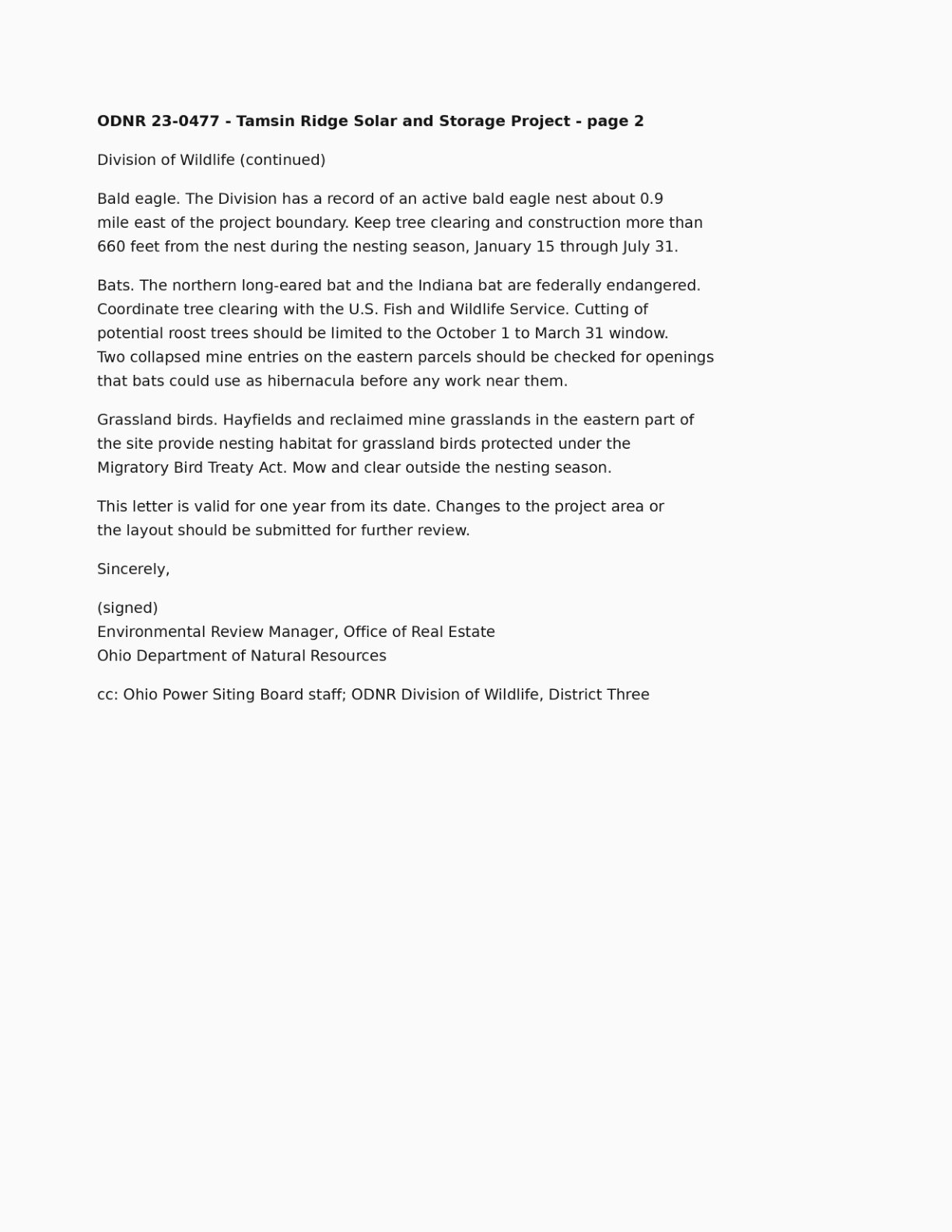
Page 2 of ODNR Environmental Review - Tamsin Ridge Solar and Storage Project (ODNR 23-0477)
  1. C-4108f1157c

    The Division has a record of an active bald eagle nest about 0.9 mile east of the project boundary.

    Quoted from page 2
    The Division has a record of an active bald eagle nest about 0.9 mile east of the project boundary.

    ODNR Environmental Review - Tamsin Ridge Solar and Storage Project (ODNR 23-0477) · DR-0011 · Page 2 · 2023-05-02

    Source agency_determination · Claim type presence · Polarity presence · Confidence high · Quote check exact, 100 of 100

  2. C-4e22698f2d

    Service recommends scheduling vegetation clearing outside the primary nesting season where possible.

    Quoted from page 1
    schedule vegetation clearing outside the primary nesting season where possible.

    Official Species List - Tamsin Ridge Solar and Storage · DR-0010 · Page 1 · 2023-04-12

    Source agency_determination · Claim type recommendation · Polarity neutral · Confidence medium · Quote check exact, 100 of 100

    Cited by EC-03 · Filed under EC-02, EC-03

  3. C-7366342eed

    ODNR records an active bald eagle nest about 0.9 mile east of the East Block, beyond the 660-foot disturbance buffer.

    Quoted from page 1
    ODNR records an active bald eagle nest about 0.9 mile east of the East Block, beyond the 660-foot disturbance buffer.

    Bat Habitat Assessment and Vegetation Survey - Tamsin Ridge Solar and Storage Project · DR-0007 · Page 1 · 2023-06-20

    Source consultant_memo · Claim type presence · Polarity presence · Confidence high · Quote check exact, 100 of 100

  4. C-76760b5938

    Mow and clear outside April 15 to July 31 to protect nesting migratory birds, and recheck eagle nest location before construction.

    Quoted from page 1
    mow and clear outside April 15 to July 31 to protect nesting migratory birds; recheck the eagle nest location before construction.

    Bat Habitat Assessment and Vegetation Survey - Tamsin Ridge Solar and Storage Project · DR-0007 · Page 1 · 2023-06-20

    Source consultant_memo · Claim type recommendation · Polarity neutral · Confidence high · Quote check exact, 100 of 100

  5. C-86e65362cd

    Bobolink and eastern meadowlark were seen in hayfields of Parcels 12 to 14, and red-tailed hawks nest in the West Block woodlots.

    Quoted from page 1
    Bobolink and eastern meadowlark were seen in the hayfields of Parcels 12 to 14, and red-tailed hawks nest in

    Bat Habitat Assessment and Vegetation Survey - Tamsin Ridge Solar and Storage Project · DR-0007 · Page 1 · 2023-06-20

    Source field_study · Claim type presence · Polarity presence · Confidence high · Quote check exact, 100 of 100

  6. C-a6b564438f

    Hayfields and reclaimed mine grasslands in the eastern site provide nesting habitat for MBTA-protected grassland birds; mow and clear outside nesting season.

    Quoted from page 2
    Hayfields and reclaimed mine grasslands in the eastern part of the site provide nesting habitat for grassland birds protected under the Migratory Bird Treaty Act.

    ODNR Environmental Review - Tamsin Ridge Solar and Storage Project (ODNR 23-0477) · DR-0011 · Page 2 · 2023-05-02

    Source agency_determination · Claim type presence · Polarity presence · Confidence high · Quote check exact, 100 of 100

    Filed under EC-02, EC-03

  7. C-a6c169a2d9

    About 80 acres (7%) of the Project Area is reclaimed surface-mined grassland.

    Quoted from page 2
    Reclaimed surface-mined grassland 80 7%

    Bat Habitat Assessment and Vegetation Survey - Tamsin Ridge Solar and Storage Project · DR-0007 · Page 2 · 2023-06-20

    Source field_study · Claim type extent · Polarity presence · Confidence medium · Quote check exact, 100 of 100

    Cited by EC-03 · Filed under EC-03, EN-01

  8. C-c0e63f6881

    Forest covers about 41 acres and the draft layout clears about 38 acres of trees.

    Quoted from page 1
    The draft layout clears about 38 acres of trees.

    Bat Habitat Assessment and Vegetation Survey - Tamsin Ridge Solar and Storage Project · DR-0007 · Page 1 · 2023-06-20

    Source field_study · Claim type extent · Polarity presence · Confidence medium · Quote check exact, 100 of 100

    Cited by EC-01, EC-03 · Filed under EC-01, EC-03

  9. C-cb44061226

    Keep tree clearing and construction more than 660 feet from the eagle nest during January 15 through July 31.

    Quoted from page 2
    Keep tree clearing and construction more than 660 feet from the nest during the nesting season, January 15 through July 31.

    ODNR Environmental Review - Tamsin Ridge Solar and Storage Project (ODNR 23-0477) · DR-0011 · Page 2 · 2023-05-02

    Source agency_determination · Claim type recommendation · Polarity neutral · Confidence high · Quote check exact, 100 of 100

  10. C-fb295f9d24

    Bald eagles nest in the area; avoid clearing or disturbance near active nests.

    Quoted from page 1
    Bald eagles nest in the area. Avoid clearing or disturbance near active nests

    Official Species List - Tamsin Ridge Solar and Storage · DR-0010 · Page 1 · 2023-04-12

    Source agency_determination · Claim type presence · Polarity presence · Confidence high · Quote check exact, 100 of 100

Requirements and permits

The requirements the assessor tied to this row, by level. Each quote from dated law is shown with its source.

Federal

  • Compliance through avoidance (no incidental take permit program)

    F-MBTA · U.S. Fish and Wildlife Service

    Applicability
    Conditional
    Instrument
    Migratory Bird Treaty Act (16 U.S.C. 703-712); 50 CFR Parts 10 and 21
    Trigger
    Vegetation clearing or construction where migratory birds nest.
    Description

    Prohibits take of migratory birds, nests and eggs. Managed by clearing vegetation outside the nesting season and avoiding active nests.

    Typical timeline

    No permit applies, so there is no agency processing time; compliance is by avoidance. The Service's Nationwide Standard Conservation Measures call for scheduling vegetation removal outside the peak bird breeding season and, where that is not possible, nest surveys generally no more than five days before the activity.

    Version of the law on the cut-off
    with the Service's Nationwide Standard Conservation Measures
    As of the cut-off

    As of the cut-off: An FWS rule (86 FR 1134) took effect defining the Act's prohibitions as applying only to actions directed at migratory birds, so incidental take was not prohibited. (2021-03-08) FWS revoked the January 2021 rule (86 FR 54642); the Service again treats incidental take as prohibited by the Act. (2021-12-03)

    Verification
    PACK_PENDING_QUALIFIED_REVIEW
    Source
    pack:federal
    In the permit matrix
    F-MBTA
    Legal basis: 3 quotes from dated law
    Quoted from the law, page 5
    The MBTA (16 U.S.C. 703-712), prohibits the taking of any migratory bird or any part, nest, or egg, except as permitted by regulation.

    Source National Bald Eagle Management Guidelines 2007 · page 5 · version undated

    Cited for requirement

    May be cited on the cut-off date.

    Quoted from the law, page 2
    Stressor: Vegetation Removal Conservation Goal: Avoid direct take of adults, chicks, or eggs. Conservation Measure 1: Schedule all vegetation removal, trimming, and grading of vegetated areas outside of the peak bird breeding season to the maximum extent practicable.

    Source Nationwide Standard Conservation Measures birds · page 2 · version 2022-12

    Cited for trigger and avoidance timing

    May be cited on the cut-off date.

    Quoted from the law, page 2
    Conservation Measure 2: When project activities cannot occur outside the bird nesting season, conduct surveys prior to scheduled activity to determine if active nests are present within the area of impact and buffer any nesting locations found during surveys. 1) Generally, the surveys should be conducted no more than five days prior to scheduled activity.

    Source Nationwide Standard Conservation Measures birds · page 2 · version 2022-12

    Cited for timeline: pre-clearing nest survey

    May be cited on the cut-off date.

  • Eagle nest buffers; eagle incidental take permit if disturbance cannot be avoided

    F-BGEPA · U.S. Fish and Wildlife Service

    Applicability
    Conditional
    Instrument
    Bald and Golden Eagle Protection Act (16 U.S.C. 668-668d); 50 CFR Part 22 (incidental take permits at 50 CFR 22.80 since the January 2022 redesignation)
    Trigger
    Eagle nests or concentration areas near construction.
    Description

    Protects bald and golden eagles, their nests and eggs from take, including disturbance.

    Typical timeline

    No regulatory processing time: the Service declined to put permit issuance timeframes in the eagle regulations because the time varies enormously with the scale and complexity of the activity, any NEPA analysis and the quality of the applicant's data (81 FR 91494, response to comments). Typical: 12 to 24 months for an eagle incidental take permit; nest buffers and seasonal avoidance can remove the need (basis: practice, not stated in the sources).

    Version of the law on the cut-off
    50 CFR Part 22 as redesignated in January 2022
    As of the cut-off

    As of the cut-off: Revised eagle permit regulations took effect (81 FR 91494), including incidental take permits of up to 30 years. (2017-01-17) 50 CFR Part 22 was redesignated (87 FR 884); the permit for eagle take associated with, but not the purpose of, an activity is now 50 CFR 22.80. (2022-01-07)

    Verification
    PACK_PENDING_QUALIFIED_REVIEW
    Source
    pack:federal
    In the permit matrix
    F-BGEPA
    Legal basis: 3 quotes from dated law
    Quoted from the law, page 1
    This permit authorizes take of bald eagles and golden eagles where the take is compatible with the preservation of the bald eagle and the golden eagle; is necessary to protect an interest in a particular locality; is associated with, but not the purpose of, the activity; and cannot practicably be avoided.

    Source 50CFR22 · page 1 · version 2023-08-01

    Cited for requirement: permit for eagle take associated with, but not the purpose of, an activity

    In force from 2022-02-07 to 2024-02-11

    eCFR versioner: 50 CFR part 22, same text on 2022-05-20, 2022-09-12, 2023-04-22, 2023-08-01 and on every amendment date between them; amendment dates 2016-12-16, 2017-01-17, 2020-03-26, 2020-04-02, 2022-01-07, 2022-02-07, 2024-02-12, 2024-04-12, 2024-10-17, 2024-12-31

    May be cited on the cut-off date.

    Quoted from the law, page 1
    Disturb means to agitate or bother a bald or golden eagle to a degree that causes, or is likely to cause, based on the best scientific information available, (1) injury to an eagle, (2) a decrease in its productivity, by substantially interfering with normal breeding, feeding, or sheltering behavior, or (3) nest abandonment

    Source 50CFR22 · page 1 · version 2023-08-01

    Cited for trigger: disturbance of eagles

    In force from 2022-02-07 to 2024-02-11

    eCFR versioner: 50 CFR part 22, same text on 2022-05-20, 2022-09-12, 2023-04-22, 2023-08-01 and on every amendment date between them; amendment dates 2016-12-16, 2017-01-17, 2020-03-26, 2020-04-02, 2022-01-07, 2022-02-07, 2024-02-12, 2024-04-12, 2024-10-17, 2024-12-31

    May be cited on the cut-off date.

    Quoted from the law, page 42
    We are not including permit issuance timeframes in the regulations because the time it takes to issue a permit varies enormously depending on the scale and complexity of the activity that will result in take, the need to prepare an analysis under NEPA, the quality and completeness of the data and other information provided by the applicant

    Source 81FR91494 · page 42 · version 2016-12-16

    Cited for timeline: no regulatory processing time

    May be cited on the cut-off date.

State

  • ODNR conditions for solar facilities, applied through OPSB review: environmental resource surveys, wildlife-permeable fencing, pollinator vegetation, mowing season and listed-species reporting

    OH-ODNR-SOLAR · Ohio Department of Natural Resources (ODNR), whose conditions are applied through the Ohio Power Siting Board (OPSB) certificate review

    Applicability
    Likely
    Instrument
    ODNR Guidance for Proposed Solar Energy Facilities in Ohio (updated 2022-04-07), agency guidance; Ohio Solar Site Pollinator Habitat Planning and Assessment Form (version March 2018)
    Trigger
    Any proposed solar energy facility subject to Ohio Power Siting Board regulation, for which ODNR expects these conditions in the site development plan.
    Description

    ODNR's solar guidance sets conditions it expects in the site development plan of every solar facility under OPSB regulation; it is guidance applied through OPSB review, and the sources show no separate permit. Surveys: resource surveys as in ODNR's Environmental Review, delineation of wetlands and streams before the OPSB application is filed, and recommended minimum buffers of 120 feet (Category 1 and 2 wetlands) and 300 feet (Category 3). Fencing: gaps of at least 6 by 6 inches for small mammals. Vegetation: at least 70% of the developed project area in beneficial vegetation, scoring at least 80 points on the pollinator form (which rewards staggered mowing), with routine mowing limited to fall and spring; the guidance says the requirement does not apply to sites committed to alternative agricultural uses to control vegetation. Listed species found in construction: 24-hour notice to OPSB staff, ODNR's Division of Wildlife and USFWS; work halted.

    Typical timeline

    Before the OPSB application is filed: environmental resource surveys and delineation of wetlands and streams. During construction: notice to OPSB staff, ODNR Division of Wildlife and USFWS within 24 hours of any state or federal listed species encountered, with work that could adversely impact it halted until a course of action is agreed. During operation: routine mowing limited to fall and spring seasons, as needed.

    Version of the law on the cut-off
    As in force from 2023-06-13 (the library text)
    As of the cut-off

    As of the cut-off: OPSB adopted revised rules in OAC Chapters 4906-1 to 4906-7 that add solar-facility requirements, including small-wildlife-permeable perimeter fencing and noxious-weed control. They were subject to rehearing and JCARR review and were not in effect on 2023-08-01. (2023-07-20)

    Verification
    PACK_PENDING_QUALIFIED_REVIEW
    Source
    pack:oh.json
    In the permit matrix
    OH-ODNR-SOLAR
    Legal basis: 8 quotes from dated law
    Quoted from the law, page 1
    Disclaimer: The guidance document is non-exhaustive. Project recommendations are made on a site-specific basis and may include additional considerations. It is ODNR’s expectation that the conditions below are incorporated into the site development plan for all proposed solar energy facilities in Ohio which are subject to Ohio Power Siting Board regulation.

    Source ODNR guidance for proposed solar energy facilities · page 1 · version 2022-04-07

    May be cited on the cut-off date.

    Quoted from the law, page 1
    Conduct environmental resource surveys as described in the ODNR Environmental Review process. Delineate wetlands and streams, prior to OPSB application submission.

    Source ODNR guidance for proposed solar energy facilities · page 1 · version 2022-04-07

    May be cited on the cut-off date.

    Quoted from the law, page 1
    Avoid existing wetlands and adjacent woodlands. A minimum 120-foot buffer should be maintained on Category 1 and 2 wetlands. A minimum 300-foot buffer should be maintained on Category 3 wetlands to preserve ecological integrity.

    Source ODNR guidance for proposed solar energy facilities · page 1 · version 2022-04-07

    May be cited on the cut-off date.

    Quoted from the law, page 2
    Fencing around panels should incorporate gaps or spaces of at least 6 inches x 6 inches to allow passage of small mammals.

    Source ODNR guidance for proposed solar energy facilities · page 2 · version 2022-04-07

    May be cited on the cut-off date.

    Quoted from the law, page 2
    Solar development sites are required to plant a minimum of 70% of the developed project area in beneficial vegetation, utilizing plant species as described in Attachment A (or other suitable species as approved) and follow the Ohio Solar Site Pollinator Habitat Planning and Assessment Form with a minimum score of 80 points.

    Source ODNR guidance for proposed solar energy facilities · page 2 · version 2022-04-07

    May be cited on the cut-off date.

    Quoted from the law, page 2
    Routine mowing will be limited to fall/spring seasons, as needed, to allow for natural reseeding of plantings and reduce impacts to ground-nesting birds. These requirements are intended to provide wildlife habitat, encourage water infiltration, and reduce erosion. This requirement not applicable to sites committed to alternative agricultural uses to control vegetation, as described in the vegetation management plan.

    Source ODNR guidance for proposed solar energy facilities · page 2 · version 2022-04-07

    May be cited on the cut-off date.

    Quoted from the law, page 2
    The Applicant shall contact OPSB staff, ODNR DOW, and USFWS within 24 hours if state or federal listed species are encountered during construction activities. Construction activities that could adversely impact the identified plants or animals shall be immediately halted until an appropriate course of action has been agreed upon by the Applicant, OPSB staff, and the appropriate agencies.

    Source ODNR guidance for proposed solar energy facilities · page 2 · version 2022-04-07

    May be cited on the cut-off date.

    Quoted from the law, page 1
    Planned management practices for areas designated as part of the pollinator habitat site. Check all that apply. Detailed establishment and management plan developed for site 10 points Mowing Follows OPHI mowing schedule for monarchs each year 5 points Mowing is staggered over a 2 week period 5 points

    Source ODNR Ohio solar site pollinator habitat planning and assessment form · page 1 · version 2023-06-13

    May be cited on the cut-off date.

Also in the permit matrix for this row: OH-ESA

Information requests

  • IR-c5e9053166 · Medium priority

    Provide the eagle nest review or avian survey for the project area, or confirm none exists.

    Missing evidence
    Eagle nest review or avian survey
    Consequence
    Non-RTE Species is rated on partial evidence without it.
    Blocks the decision
    No
    Raised by
    completeness
  • IR-8469920792 · Medium priority

    Provide the wildlife agency correspondence for the project area, or confirm none exists.

    Missing evidence
    Wildlife agency correspondence
    Consequence
    Non-RTE Species is rated on partial evidence without it.
    Blocks the decision
    No
    Raised by
    completeness

Next steps

  • Schedule clearing and mowing outside April 15 to July 31; recheck eagle nest before construction, keeping the 660-foot buffer (January 15 to July 31).
  • Conduct nesting bird survey and map hayfield and grassland acreage against the layout.
  • Coordinate with ODNR and USFWS through the OPSB process, including ODNR mowing and pollinator conditions.

Agencies

  • USFWS
  • ODNR Division of Wildlife
  • OPSB

Cost and impact

Impact
S
Potential cost level
L
Why

Seasonal restrictions mainly affect schedule. Cost is limited to pre-construction nest checks and seasonal mowing.

Impact: C = cost, S = schedule. Potential cost level: L, L-M, M, M-H, H (relative to a utility-scale solar budget).

Lumerian Labs 2026