Code computed the rating from the assessor's inputs:
impact_likely=yes -> 2
Set by the rule
Decision
Released
Evidence state
Reported · desktop, consultant or developer record
Worst case
The same rule on the worst case gives no rating above the point.
Scenario
Selected mitigation only partly closes the R-6 and R-7 exceedances, so OPSB staff or Linnet Road neighbors press for further BESS cooling or transformer changes or relocation of the BESS yard, adding cost and review time.
Step still pending
Mitigation selection and modeling for R-6 and R-7, and OPSB staff review of the noise information
Category 2 is reasonable. However, the claim that the design goal is proposed as a certificate condition is unsupported by its cited quote. The R-7 2 dBA figure is not in the quotes. The worst case's 'contested exception' is inconsistent with there being no numeric limit.
Revised once after the first critique. Rating unchanged.
The five inputs
Present: yes
Noise-sensitive residences are documented near the site: 23 residences within 1,000 feet of the fence (C-ffd9a025a0), nearest non-participating home 260 feet from the array fence (C-0a6e65688e). OH-NOISE applies to the OPSB application (C-b46e7e0088, C-ef25cbb708).
Predicted exceedances of the design goal are limited to two non-participating residences, R-6 (610 feet west of the BESS yard) and R-7 (a possible transformer tone) (C-597c5c8469, C-a188dcc65e, C-a559672e76). 23 homes lie within 1,000 feet of the fence (C-ffd9a025a0), but their spread along the boundary is not documented. Noise is not shown as a site-wide layout driver.
The study reports the design goal exceeded at two non-participating residences, including R-6 by 3 dBA, with a possible 120 Hz transformer tone at R-7; no mitigation option had been selected (C-597c5c8469, C-a559672e76, C-e87269852b). Mitigation such as low-noise equipment, enclosures or relocation is likely to be needed (professional judgment). No numeric local or OPSB solar limit applies (C-28e17ecd77), and Northfold committed to model and mitigate battery yard noise (C-20dcb5e601).
OH-NOISE requires noise modeling, a day and night background study and mitigation information in the OPSB application (C-b46e7e0088, C-ef25cbb708). No numeric limit applies locally or under OPSB rules for solar (C-28e17ecd77), so no variance is needed. The consultant applies a design goal of background Leq plus 5 dBA at non-participating residences (C-11157696c9). Neighbor concern was raised at the public meeting (C-ec66acfa65), but no intervenor, complaint or contested record is documented.
The study predicts sound above the design goal at two non-participating residences; the night level at R-6 is 43 dBA, about 14 dBA above background, attributed to battery cooling equipment. A transformer tone may be audible at R-7. Pile driving would reach about 80 to 87 dBA for several days at R-2, 260 feet away (C-597c5c8469, C-a188dcc65e, C-a559672e76, C-0a6e65688e).
Noise assessment predicts operating sound above its design goal at two non-participating homes (R-6 by 3 dBA, 44 against 41 dBA), with a possible 120 Hz transformer tone at R-7. Pile driving would reach about 80 to 87 dBA at R-2, 260 feet away. No numeric solar limit applies; mitigation not yet selected.
Critique
Verdict
upheld
Suggested direction for the rating
same
Summary
The assessment is mostly well supported. The inputs and the OPSB pathway follow the evidence. The minor problems are an unsupported attribution to battery cooling, R-7 treated as an exceedance, 'committed' overstating a recommendation, and unsupported vibration monitoring. The category stays the same.
Critic model
Luminol
Issues
Severity minor · Kind unsupported_statement
The assessment says the R-6 night level is 'attributed to battery cooling equipment'. No cited quote says that. C-597c5c8469 only places R-6 610 feet from the BESS yard. A quote linking the exceedance to the cooling equipment would settle it.
The quote for the second exceedance is truncated. The assessment names R-7 as that second residence, but C-a559672e76 only says a transformer tone 'may' be audible at R-7. R-7 is not shown as exceeding the goal.
The assessment says Northfold 'committed' to model and mitigate and to share the study. C-20dcb5e601 is a recommendation-type line in a developer document, which is weaker than a commitment. The next step 'as committed' repeats this.
The next step on vibration monitoring is not supported by any cited quote. C-25d20304cf supports the construction hours, and C-fd52f76b29 supports 'blasting is not expected' but is not cited.
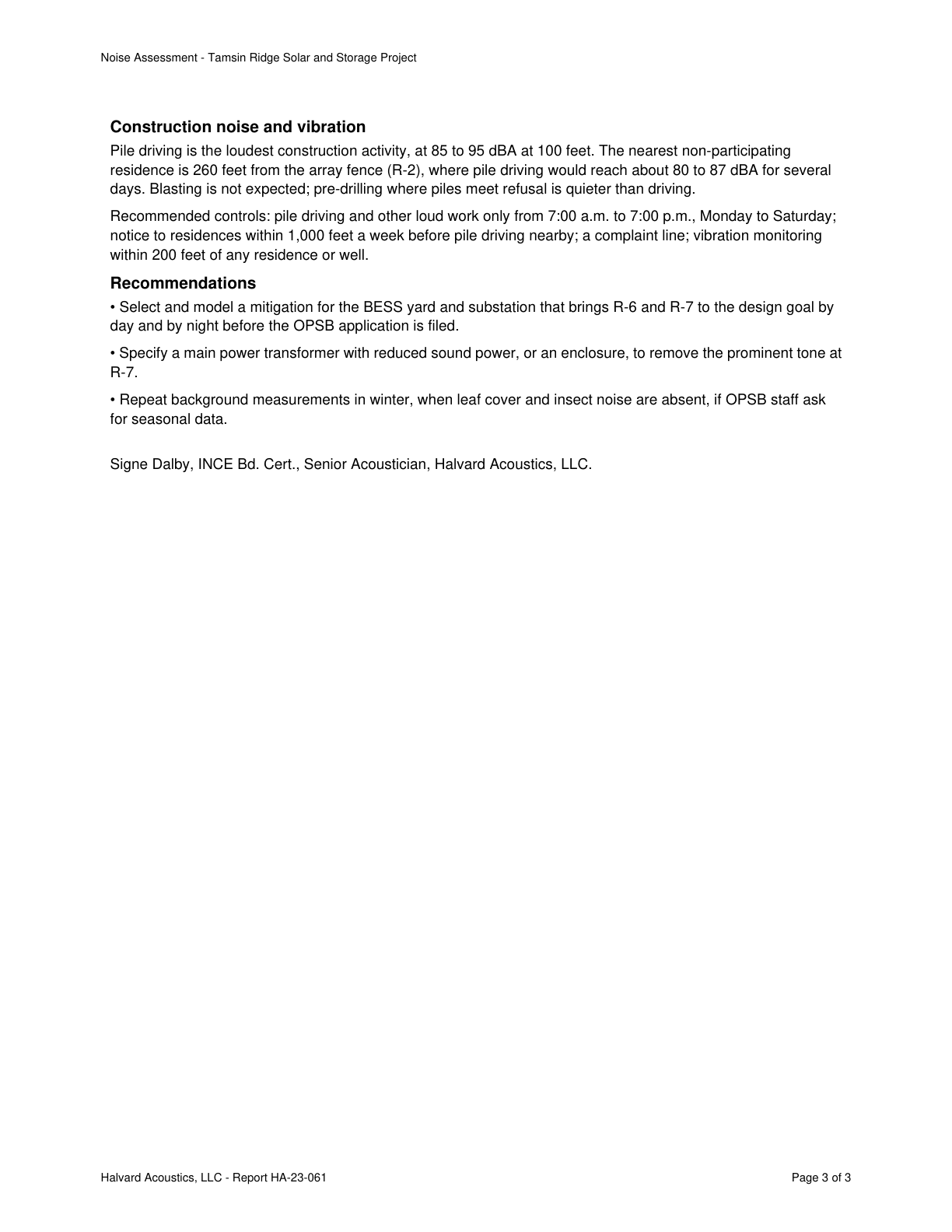
Pile driving would reach about 80 to 87 dBA for several days at the nearest non-participating residence, 260 feet from the array fence (R-2).
Quote check Exact · Placed normalised · The quote matches the page once line breaks, hyphenation, case and punctuation are set aside, as the engine's matcher compares text. The marked words are the page's own. · Read as native
Noise Assessment - Tamsin Ridge Solar and Storage Project
Construction noise and vibration
Pile driving is the loudest construction activity, at 85 to 95 dBA at 100 feet. Quote starts. The nearest non-participating
residence is 260 feet from the array fence (R-2), where pile driving would reach about 80 to 87 dBA for several
days. Quote ends. Blasting is not expected; pre-drilling where piles meet refusal is quieter than driving.
Recommended controls: pile driving and other loud work only from 7:00 a.m. to 7:00 p.m., Monday to Saturday;
notice to residences within 1,000 feet a week before pile driving nearby; a complaint line; vibration monitoring
within 200 feet of any residence or well.
Recommendations
• Select and model a mitigation for the BESS yard and substation that brings R-6 and R-7 to the design goal by
day and by night before the OPSB application is filed.
• Specify a main power transformer with reduced sound power, or an enclosure, to remove the prominent tone at
R-7.
• Repeat background measurements in winter, when leaf cover and insect noise are absent, if OPSB staff ask
for seasonal data.
Signe Dalby, INCE Bd. Cert., Senior Acoustician, Halvard Acoustics, LLC.
Halvard Acoustics, LLC - Report HA-23-061 Page 3 of 3
The outline marks where the quote begins on the page.
C-0a6e65688e
Pile driving would reach about 80 to 87 dBA for several days at the nearest non-participating residence, 260 feet from the array fence (R-2).
Quoted from page 3
The nearest non-participating residence is 260 feet from the array fence (R-2), where pile driving would reach about 80 to 87 dBA for several days.
Recommended construction controls: loud work 7 a.m. to 7 p.m. Monday to Saturday, notice, complaint line, and vibration monitoring within 200 feet of residences or wells.
Quoted from page 3
pile driving and other loud work only from 7:00 a.m. to 7:00 p.m., Monday to Saturday;
Neither Carroll County nor Harrison Township has a numeric noise limit ordinance applying to the Project, and OPSB rules set no numeric operating noise limit for solar.
Quoted from page 1
Neither Carroll County nor Harrison Township has a noise ordinance with a numeric sound level limit
The OPSB application must report construction and operating noise at each residence by day and night, with a preconstruction background noise study.
Quoted from page 1
The
OPSB application must report construction and operating noise at each residence by day and by night, with a
preconstruction background noise study.
The requirements the assessor tied to this row, by level. Each quote from dated law is shown with its source.
State
Noise information in the OPSB certificate application: construction and operating noise at the nearest property boundary, levels at sensitive receptors within one mile, a day and night background study, and mitigation including construction hours
An OPSB certificate application for a generating facility of 50 MW or more, including a solar facility.
Description
The application must describe construction noise and operating noise expected at the nearest property boundary, locate noise-sensitive areas within one mile of the facility and give the operating noise level at each habitable residence, school, church and other sensitive receptor (any occupied building) by day and by night, describe equipment and procedures to mitigate noise, including limits on the time of day for construction, and include a preconstruction background noise study with day and night measurements. The rules in force set no numeric noise limit for a solar facility: the operating limit and construction hours in OAC 4906-4-09 then applied to wind farms only (rule title 'Regulations associated with wind farms').
Typical timeline
Part of the OPSB application (see OH-OPSB); the background noise study needs day and night measurements before filing.
Version of the law on the cut-off
OAC 4906-4-08(A)(3) as in force before 2024-05-30
As of the cut-off
As of the cut-off: The OPSB adopted revised rules effective 2024-05-30. OAC 4906-4-09 becomes 'Regulations associated with renewable energy generation facilities', with an operating noise limit for solar and wind (the greater of 40 dBA or the ambient L50 plus 5 dBA at non-participating sensitive receptors within one mile of the project boundary), construction hours, and minimum setbacks from solar modules (50 ft from non-participating parcel boundaries, 300 ft from non-participating residences, 150 ft from the edge of road pavement). Amendments apply only to applications filed after the rule's effective date. Not in force on 2023-08-01. (2023-07-20)
In force from 2018-04-26 to 2024-05-29, section 4906-4-08
4906-4-08: version effective 2018-04-26; first change after it 2024-05-30 (OPSB Case 21-902-GE-BRO (determination 2023-07-20)), from codes.ohio.gov version history in archive captures (confirmed_two_sources)
May be cited on the cut-off date.
Quoted from the law, page 20
Describe the operational noise levels expected at the nearest property boundary.
In force from 2018-04-26 to 2024-05-29, section 4906-4-08
4906-4-08: version effective 2018-04-26; first change after it 2024-05-30 (OPSB Case 21-902-GE-BRO (determination 2023-07-20)), from codes.ohio.gov version history in archive captures (confirmed_two_sources)
May be cited on the cut-off date.
Quoted from the law, page 20
Indicate the location of any noise-sensitive areas within one mile of the facility
In force from 2018-04-26 to 2024-05-29, section 4906-4-08
4906-4-08: version effective 2018-04-26; first change after it 2024-05-30 (OPSB Case 21-902-GE-BRO (determination 2023-07-20)), from codes.ohio.gov version history in archive captures (confirmed_two_sources)
May be cited on the cut-off date.
Quoted from the law, page 20
including limits on the time of day at which construction activities may occur
In force from 2018-04-26 to 2024-05-29, section 4906-4-08
4906-4-08: version effective 2018-04-26; first change after it 2024-05-30 (OPSB Case 21-902-GE-BRO (determination 2023-07-20)), from codes.ohio.gov version history in archive captures (confirmed_two_sources)
May be cited on the cut-off date.
Quoted from the law, page 21
Submit a preconstruction background noise study of the project area
In force from 2018-04-26 to 2024-05-29, section 4906-4-08
4906-4-08: version effective 2018-04-26; first change after it 2024-05-30 (OPSB Case 21-902-GE-BRO (determination 2023-07-20)), from codes.ohio.gov version history in archive captures (confirmed_two_sources)
In force from 2020-12-21 to 2024-05-29, section 4906-4-09
4906-4-09: version effective 2020-12-21; first change after it 2024-05-30 (OPSB Case 21-902-GE-BRO (determination 2023-07-20); new solar requirements in 4906-4-09 per Bricker), from codes.ohio.gov version history in archive captures (confirmed_two_sources)
May be cited on the cut-off date.
Information requests
IR-701f687e7f · Medium priority
Provide the noise ordinance, state noise standard or permit condition for the project area, or confirm none exists.
Missing evidence
Noise ordinance, state noise standard or permit condition
Consequence
Noise is rated on partial evidence without it.
Blocks the decision
No
Raised by
completeness
IR-38364f5c1f · Medium priority
Provide the receptor map or table of homes and noise-sensitive uses for the project area, or confirm none exists.
Missing evidence
Receptor map or table of homes and noise-sensitive uses
Consequence
Noise is rated on partial evidence without it.
Blocks the decision
No
Raised by
completeness
IR-da0e177ed0 · Medium priority
Provide the construction noise, pile driving or blasting plan for the project area, or confirm none exists.
Missing evidence
Construction noise, pile driving or blasting plan
Consequence
Noise is rated on partial evidence without it.
Blocks the decision
No
Raised by
completeness
Next steps
Select and model mitigation for R-6 and R-7 (BESS cooling, transformer tone, siting).
Adopt the recommended construction hours (7 a.m. to 7 p.m., Monday to Saturday) and vibration monitoring in the OPSB application; blasting is not expected.
Share the noise study with Linnet Road neighbors as committed.
Agencies
OPSB
Cost and impact
Impact
C, S
Potential cost level
L-M
Why
Equipment selection, enclosures or relocation of BESS cooling and the transformer, and construction controls (hours, vibration monitoring) are likely. The noise study is already done and the predicted exceedances are small and at few receptors.
Impact: C = cost, S = schedule. Potential cost level: L, L-M, M, M-H, H (relative to a utility-scale solar budget).
Comments
Noise assessment predicts operating sound above its design goal at two non-participating homes (R-6 by 3 dBA, 44 against 41 dBA), with a possible 120 Hz transformer tone at R-7. Pile driving would reach about 80 to 87 dBA at R-2, 260 feet away. No numeric solar limit applies; mitigation not yet selected.