Skip to content

State Jurisdiction

PE-02 · Matrix · Additional Permitting

Rating
2Impacts likely but may be easily resolved
Why
Impact likely
Worst case
Up to4Potential fatal flaw
Evidence
Reported
Cited claims
15
Requirements
7
Requests
0

Rating

2Impacts likely but may be easily resolved

up to4Potential fatal flaw

The engine shows this rating as 2-4

The rule

Code computed the rating from the assessor's inputs:

impact_likely=yes -> 2

Set by the rule

Decision
Released with flags
The engine's reasons
  • Agencies not in the register or the evidence: ODNR, Carroll County
Evidence state
Reported · desktop, consultant or developer record

Worst case

If what is pending at the cut-off went badly, the same rule gives a higher rating.

Scenario

With the SB 52 exemption unavailable, the county prohibits the facility or limits its boundaries, or designates a restricted area, blocking or cutting back the OPSB application.

Step still pending
Carroll County commissioners' 90-day review following the May 11, 2023 county public meeting
Inputs in the worst case
Extent core · Avoidable no · Pathway prohibition · Impact likely yes
The rule on the worst case
worst case: pathway=prohibition -> 4 potential fatal flaw
Claims that make it plausible
C-8eeb60aa11, C-4126d05ae5, C-e47c04e3b2

Revision

Not revised.

The five inputs

Comments

OPSB certificate required (major utility facility, 50 MW or more); standard process confirmed at the March 2023 pre-application conference. SB 52 queue exemption appears unavailable, so the county process applies. Ohio EPA stormwater coverage and ODOT superload hauling permit are obtained separately. Filing planned Q3 2023, decision expected 2024.

Critique

Verdict
upheld
Suggested direction for the rating
same
Summary

Category 2 is well supported: OPSB, Ohio EPA and ODOT approvals are required. Only minor problems: a few uncited qualifiers, unsupported ODNR, avoidable left 'unknown', and wording about the county 90-day window, which was still open at the cut-off.

Critic model
Luminol

Issues

  1. Severity minor · Kind unsupported_statement

    The rationale calls the 9 to 14 month figure a 'statewide trend, not site friction'. The quote only says solar cases with active local opposition took 9 to 14 months. 'Standard' process confirmed at pre-application conference is also not in the cited quote (C-0f5beca55f is truncated).

    Cites C-b61135956d, C-0f5beca55f

  2. Severity minor · Kind unsupported_statement

    ODNR is listed as an agency but no cited claim supports it. The dam-permit claims (C-ebc49abde3) show basins below the size threshold, which weakens any ODNR dam role.

    Cites C-ebc49abde3, C-41d7bff0bb

  3. Severity minor · Kind wrong_input

    Avoidable is 'unknown', yet the OPSB certificate, stormwater coverage and hauling permit are all required by statute. Avoidable 'no' fits better. It does not change the category. Settle it by confirming county restricted-area status.

    Cites C-0f5beca55f, C-4bf6e9a178, C-c4d1481145

  4. Severity minor · Kind as_of_error

    The county's 90-day window after May 11, 2023 ends about Aug 9, 2023, after the Aug 1 cut-off. The window is still open, so the next step should say to monitor it, not to confirm 'resulted from' it.

    Cites C-4126d05ae5

Checks

  • Passed

    rating_has_evidence · blocking

  • Passed

    presence_is_evidenced · not blocking

  • Passed

    counter_evidence_considered · not blocking

  • Passed

    numbers_grounded · not blocking

  • Failed

    agencies_grounded · not blocking

    Agencies not in the register or the evidence: ODNR, Carroll County

  • Passed

    cutoff_respected · blocking

  • Passed

    critic_not_refuted · blocking

Evidence (15)

Each claim the row cites: the statement in the assessor's words, then the quote the engine found on the page.

Arrow keys move the selection. A middle-click opens the claim's own page.

  1. OPSB staff agreed the project is a major utility facility needing an OPSB certificate before construction under the standard process.OPSB Pre-Application Conference Summary - Tamsin Ridge Solar and Storage Project · Page 1Exact
  2. Wetland W-5 has no surface connection to a stream and may be an isolated wetland regulated by Ohio EPA alone.Wetland and Stream Delineation Report - Tamsin Ridge Solar and Storage Project · Page 1Exact
  3. Ohio EPA construction stormwater coverage, any Section 401 or isolated wetland permit, and ODOT hauling and access permits are obtained separately from the certificate.OPSB Pre-Application Conference Summary - Tamsin Ridge Solar and Storage Project · Page 2Exact
  4. OPSB pre-application conference was held March 21, 2023, and the county public meeting May 11, 2023.Tamsin Ridge Solar and Storage Project - Project Description · Page 1Exact
  5. Stormwater basins with embankments may need a dam permit if they exceed statutory size thresholds.ODNR Environmental Review - Tamsin Ridge Solar and Storage Project (ODNR 23-0477) · Page 1Exact
  6. Disturbance over one acre requires Ohio EPA construction stormwater general permit OHC000006 coverage, including an SWP3 and Notice of Intent.Stormwater, Floodplain and Drainage Memo - Tamsin Ridge Solar and Storage Project · Page 1Exact
  7. Planned sequence: county meeting May 2023, application filing third quarter 2023, decision expected 2024.OPSB Pre-Application Conference Summary - Tamsin Ridge Solar and Storage Project · Page 2Exact
  8. The Project needs an OPSB certificate of environmental compatibility and public need.Tamsin Ridge Solar and Storage Project - Project Description · Page 1Exact
  9. SB 52 Section 4 queue exemption appears unavailable because no PJM system impact study was complete for AH1-931 as of October 11, 2021.OPSB Pre-Application Conference Summary - Tamsin Ridge Solar and Storage Project · Page 1Exact
  10. The facility is understood to be an electric generating plant of more than 50 megawatts needing an Ohio Power Siting Board certificate.Zoning Verification - Tamsin Ridge Solar and Storage Project · Page 1Exact
  11. Staff indicated solar cases with active local opposition have recently taken 9 to 14 months from filing to decision.OPSB Pre-Application Conference Summary - Tamsin Ridge Solar and Storage Project · Page 2Exact
  12. The main power transformer is a superload needing an ODOT special hauling permit with a route survey.Traffic and Access Memo - Tamsin Ridge Solar and Storage Project · Page 1Exact
  13. OPSB public informational meeting will be held after the county's 90-day period.Summary of the County Public Meeting under ORC 303.61 - Tamsin Ridge · Page 1Exact
  14. Staff will treat the battery system as part of the generating facility.OPSB Pre-Application Conference Summary - Tamsin Ridge Solar and Storage Project · Page 1Exact
  15. Basins have embankments no higher than 6 feet and about 9 acre-feet each, below the size requiring an ODNR dam construction permit.Stormwater, Floodplain and Drainage Memo - Tamsin Ridge Solar and Storage Project · Page 1Exact

OPSB Pre-Application Conference Summary - Tamsin Ridge Solar and Storage Project

C-0f5beca55f · Page 1 of 2 · DR-0026

Open the claim, C-0f5beca55f

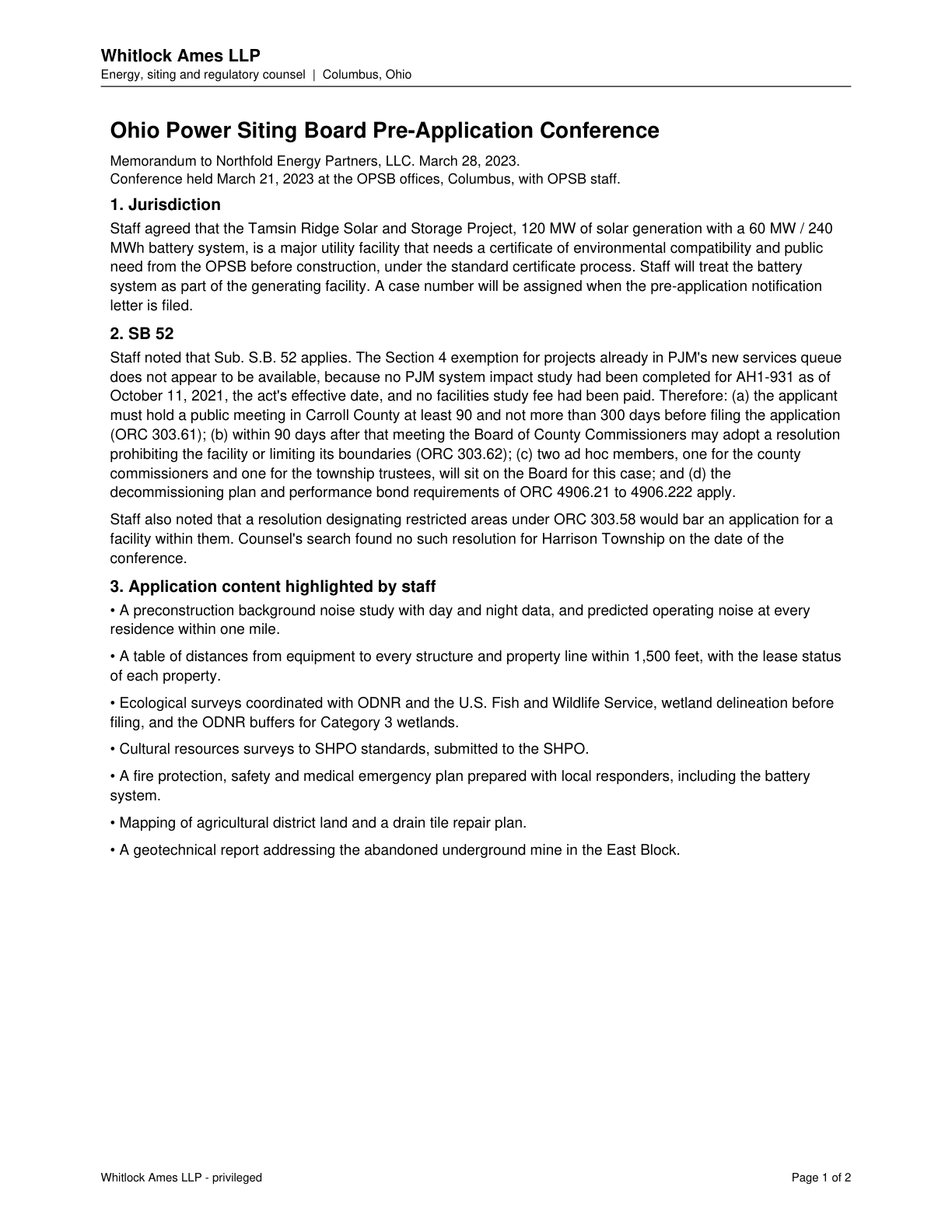
OPSB staff agreed the project is a major utility facility needing an OPSB certificate before construction under the standard process.

Quote check Exact · Placed verbatim · The quote occurs on the page exactly as written. · Read as native

Whitlock Ames LLP Energy, siting and regulatory counsel | Columbus, Ohio Ohio Power Siting Board Pre-Application Conference Memorandum to Northfold Energy Partners, LLC. March 28, 2023. Conference held March 21, 2023 at the OPSB offices, Columbus, with OPSB staff. 1. Jurisdiction Staff agreed that the Tamsin Ridge Solar and Storage Project, 120 MW of solar generation with a 60 MW / 240 Quote starts. MWh battery system, is a major utility facility that needs a certificate of environmental compatibility and public Quote ends. need from the OPSB before construction, under the standard certificate process. Staff will treat the battery system as part of the generating facility. A case number will be assigned when the pre-application notification letter is filed. 2. SB 52 Staff noted that Sub. S.B. 52 applies. The Section 4 exemption for projects already in PJM's new services queue does not appear to be available, because no PJM system impact study had been completed for AH1-931 as of October 11, 2021, the act's effective date, and no facilities study fee had been paid. Therefore: (a) the applicant must hold a public meeting in Carroll County at least 90 and not more than 300 days before filing the application (ORC 303.61); (b) within 90 days after that meeting the Board of County Commissioners may adopt a resolution prohibiting the facility or limiting its boundaries (ORC 303.62); (c) two ad hoc members, one for the county commissioners and one for the township trustees, will sit on the Board for this case; and (d) the decommissioning plan and performance bond requirements of ORC 4906.21 to 4906.222 apply. Staff also noted that a resolution designating restricted areas under ORC 303.58 would bar an application for a facility within them. Counsel's search found no such resolution for Harrison Township on the date of the conference. 3. Application content highlighted by staff • A preconstruction background noise study with day and night data, and predicted operating noise at every residence within one mile. • A table of distances from equipment to every structure and property line within 1,500 feet, with the lease status of each property. • Ecological surveys coordinated with ODNR and the U.S. Fish and Wildlife Service, wetland delineation before filing, and the ODNR buffers for Category 3 wetlands. • Cultural resources surveys to SHPO standards, submitted to the SHPO. • A fire protection, safety and medical emergency plan prepared with local responders, including the battery system. • Mapping of agricultural district land and a drain tile repair plan. • A geotechnical report addressing the abandoned underground mine in the East Block. Whitlock Ames LLP - privileged Page 1 of 2

The outline marks where the quote begins on the page.
Page 1 of OPSB Pre-Application Conference Summary - Tamsin Ridge Solar and Storage Project
  1. C-0f5beca55f

    OPSB staff agreed the project is a major utility facility needing an OPSB certificate before construction under the standard process.

    Quoted from page 1
    MWh battery system, is a major utility facility that needs a certificate of environmental compatibility and public

    OPSB Pre-Application Conference Summary - Tamsin Ridge Solar and Storage Project · DR-0026 · Page 1 · 2023-03-28

    Source agency_determination · Claim type regulatory · Polarity presence · Confidence high · Quote check exact, 100 of 100

  2. C-1d56a9d4b8

    Wetland W-5 has no surface connection to a stream and may be an isolated wetland regulated by Ohio EPA alone.

    Quoted from page 1
    Wetland W-5 has no surface connection to a stream and may be an isolated wetland regulated by Ohio EPA alone.

    Wetland and Stream Delineation Report - Tamsin Ridge Solar and Storage Project · DR-0013 · Page 1 · 2023-05-22

    Source consultant_memo · Claim type regulatory · Polarity presence · Confidence high · Quote check exact, 100 of 100

    Filed under AQ-01, PE-02

  3. C-1f7f13bfbe

    Ohio EPA construction stormwater coverage, any Section 401 or isolated wetland permit, and ODOT hauling and access permits are obtained separately from the certificate.

    Quoted from page 2
    Ohio EPA construction stormwater coverage, any Section 401 certification or isolated wetland permit, and ODOT hauling and access permits are obtained separately

    OPSB Pre-Application Conference Summary - Tamsin Ridge Solar and Storage Project · DR-0026 · Page 2 · 2023-03-28

    Source agency_determination · Claim type regulatory · Polarity presence · Confidence high · Quote check exact, 100 of 100

    Filed under AQ-01, EG-02, EG-03, PE-02

  4. C-4126d05ae5

    OPSB pre-application conference was held March 21, 2023, and the county public meeting May 11, 2023.

    Quoted from page 1
    The pre-application conference with OPSB staff was held on March 21, 2023, and the county public meeting required by ORC 303.61 was held on May 11, 2023.

    Tamsin Ridge Solar and Storage Project - Project Description · DR-0001 · Page 1 · 2023-06-12

    Source developer_document · Claim type schedule · Polarity neutral · Confidence high · Quote check exact, 100 of 100

    Filed under PE-01, PE-02

  5. C-41d7bff0bb

    Stormwater basins with embankments may need a dam permit if they exceed statutory size thresholds.

    Quoted from page 1
    Stormwater basins with embankments may need a dam permit if they exceed the statutory size thresholds.

    ODNR Environmental Review - Tamsin Ridge Solar and Storage Project (ODNR 23-0477) · DR-0011 · Page 1 · 2023-05-02

    Source agency_determination · Claim type regulatory · Polarity presence · Confidence high · Quote check exact, 100 of 100

    Cited by EG-02 · Filed under EG-02, PE-02

  6. C-4bf6e9a178

    Disturbance over one acre requires Ohio EPA construction stormwater general permit OHC000006 coverage, including an SWP3 and Notice of Intent.

    Quoted from page 1
    Construction will disturb more than one acre, so the Project needs coverage under Ohio EPA's construction

    Stormwater, Floodplain and Drainage Memo - Tamsin Ridge Solar and Storage Project · DR-0019 · Page 1 · 2023-06-05

    Source consultant_memo · Claim type regulatory · Polarity presence · Confidence high · Quote check exact, 100 of 100

    Cited by EN-08, EG-02 · Filed under EG-02, PE-02

  7. C-785b75ec77

    Planned sequence: county meeting May 2023, application filing third quarter 2023, decision expected 2024.

    Quoted from page 2
    application filing in the third quarter of 2023; decision expected in 2024.

    OPSB Pre-Application Conference Summary - Tamsin Ridge Solar and Storage Project · DR-0026 · Page 2 · 2023-03-28

    Source developer_document · Claim type schedule · Polarity neutral · Confidence medium · Quote check exact, 100 of 100

  8. C-857993e699

    The Project needs an OPSB certificate of environmental compatibility and public need.

    Quoted from page 1
    The Project needs a certificate of environmental compatibility and public need from the Ohio Power Siting Board (OPSB).

    Tamsin Ridge Solar and Storage Project - Project Description · DR-0001 · Page 1 · 2023-06-12

    Source developer_document · Claim type regulatory · Polarity presence · Confidence high · Quote check exact, 100 of 100

  9. C-8eeb60aa11

    SB 52 Section 4 queue exemption appears unavailable because no PJM system impact study was complete for AH1-931 as of October 11, 2021.

    Quoted from page 1
    does not appear to be available, because no PJM system impact study had been completed for AH1-931 as of

    OPSB Pre-Application Conference Summary - Tamsin Ridge Solar and Storage Project · DR-0026 · Page 1 · 2023-03-28

    Source agency_determination · Claim type agency_position · Polarity presence · Confidence high · Quote check exact, 100 of 100

    Filed under PE-02, PE-04

  10. C-acf07ebdee

    The facility is understood to be an electric generating plant of more than 50 megawatts needing an Ohio Power Siting Board certificate.

    Quoted from page 1
    We understand the facility is an electric generating plant of more than 50 megawatts that will need a certificate from the Ohio Power Siting Board.

    Zoning Verification - Tamsin Ridge Solar and Storage Project · DR-0022 · Page 1 · 2023-02-14

    Source agency_determination · Claim type regulatory · Polarity presence · Confidence high · Quote check exact, 100 of 100

  11. C-b61135956d

    Staff indicated solar cases with active local opposition have recently taken 9 to 14 months from filing to decision.

    Quoted from page 2
    Staff indicated that solar cases with active local opposition have recently taken 9 to 14 months from filing to decision.

    OPSB Pre-Application Conference Summary - Tamsin Ridge Solar and Storage Project · DR-0026 · Page 2 · 2023-03-28

    Source agency_determination · Claim type schedule · Polarity neutral · Confidence high · Quote check exact, 100 of 100

    Cited by CO-02, PE-01 · Filed under PE-01, PE-02

  12. C-c4d1481145

    The main power transformer is a superload needing an ODOT special hauling permit with a route survey.

    Quoted from page 1
    is a superload and will need an ODOT special hauling permit with a route survey.

    Traffic and Access Memo - Tamsin Ridge Solar and Storage Project · DR-0020 · Page 1 · 2023-06-19

    Source consultant_memo · Claim type constraint · Polarity presence · Confidence medium · Quote check exact, 100 of 100

    Cited by EG-03 · Filed under EG-03, PE-02

  13. C-e47c04e3b2

    OPSB public informational meeting will be held after the county's 90-day period.

    Quoted from page 1
    Hold the OPSB public informational meeting after the county's 90-day period.

    Summary of the County Public Meeting under ORC 303.61 - Tamsin Ridge · DR-0023 · Page 1 · 2023-05-12

    Source developer_document · Claim type schedule · Polarity neutral · Confidence high · Quote check exact, 100 of 100

    Filed under PE-01, PE-02

  14. C-e7f77313ec

    Staff will treat the battery system as part of the generating facility.

    Quoted from page 1
    Staff will treat the battery system as part of the generating facility.

    OPSB Pre-Application Conference Summary - Tamsin Ridge Solar and Storage Project · DR-0026 · Page 1 · 2023-03-28

    Source agency_determination · Claim type agency_position · Polarity neutral · Confidence medium · Quote check exact, 100 of 100

    Cited by EG-04 · Filed under EG-04, PE-02

  15. C-ebc49abde3

    Basins have embankments no higher than 6 feet and about 9 acre-feet each, below the size requiring an ODNR dam construction permit.

    Quoted from page 1
    The basins have embankments no higher than 6 feet and hold about 9 acre-feet each, below the size at which

    Stormwater, Floodplain and Drainage Memo - Tamsin Ridge Solar and Storage Project · DR-0019 · Page 1 · 2023-06-05

    Source consultant_memo · Claim type absence · Polarity absence · Confidence high · Quote check exact, 100 of 100

    Cited by EN-08, EG-02 · Filed under EG-02, PE-02

Requirements and permits

The requirements the assessor tied to this row, by level. Each quote from dated law is shown with its source.

Federal

  • NPDES Construction Stormwater General Permit coverage and SWPPP

    F-CWA402 · State NPDES permitting authority (EPA where not delegated)

    Applicability
    Required
    Instrument
    Clean Water Act Section 402 (33 U.S.C. 1342); 40 CFR 122.26
    Trigger
    Construction disturbing one acre or more, or part of a larger common plan of development.
    Description

    Coverage under the construction stormwater general permit with a Stormwater Pollution Prevention Plan for land disturbance of one acre or more.

    Typical timeline

    Typical: 2 to 4 weeks for general-permit coverage after a complete registration or notice of intent, plus 1 to 3 months to prepare the stormwater pollution prevention plan and any state or local erosion-control plan before land disturbance (basis: practice, not stated in the sources).

    Version of the law on the cut-off
    with the 2023 rule's statement of state NPDES programs
    Verification
    PACK_PENDING_QUALIFIED_REVIEW
    Source
    pack:federal
    Legal basis: 3 quotes from dated law
    Quoted from the law, page 1
    Section 402 of the Clean Water Act authorizes EPA to issue permits under procedures established to implement the National Pollutant Discharge Elimination System (NPDES) program. The administration of this program can be, and in most cases has been, delegated to individual states.

    Source 33CFR320 · page 1 · version 2023-08-01

    Cited for requirement and authority (EPA, delegated to states)

    In force from 2022-03-21 to 2025-07-02

    eCFR versioner: 33 CFR part 320, same text on 2022-05-20, 2022-09-12, 2023-04-22, 2023-08-01 and on every amendment date between them; amendment dates 2016-12-15, 2022-03-07, 2022-03-21, 2025-07-03

    May be cited on the cut-off date.

    Quoted from the law, page 6
    Currently 47 States and one territory have authority to administer all or portions of the section 402 NPDES program for ‘‘waters of the United States.’’

    Source 88FR3004 · page 6 · version 2023-01-18

    Cited for authority: state NPDES programs

    May be cited on the cut-off date.

    Quoted from the law, page 6
    For example, the Clean Water Act section 402 permit program regulates discharges of pollutants from ‘‘point sources’’ to ‘‘navigable waters’’ whether the pollutants reach jurisdictional waters directly or indirectly.

    Source 88FR3004 · page 6 · version 2023-01-18

    Cited for trigger: discharges of pollutants from point sources

    May be cited on the cut-off date.

State

  • Certificate of environmental compatibility and public need for a major utility facility (electric generating plant of 50 MW or more), standard certificate application

    OH-OPSB · Ohio Power Siting Board (OPSB)

    Applicability
    Required
    Instrument
    ORC 4906.01, 4906.04, 4906.06, 4906.07, 4906.10 and 4906.13; OAC 4906-2, 4906-3 and 4906-4
    Trigger
    Construction of an electric generating plant, including a solar plant, designed for or capable of operating at 50 MW or more.
    Description

    An electric generating plant designed for, or capable of, 50 MW or more is a major utility facility, and no one may commence to construct one without an OPSB certificate. The generation-facility application content rules (OAC 4906-4-08) include a fire protection, safety and medical emergency plan developed with local responders. The chairman accepts the application as complete or rejects it within 60 days of receipt, and the hearing is set 60 to 90 days after receipt of a complying application. The board may not grant a certificate, as proposed or as modified, unless it makes the findings in ORC 4906.10(A). Once certificated, no public agency or political subdivision may require any approval, consent, permit or other condition for construction or operation (PE-01); state worker-protection laws and municipal rules not about location or design still apply. Whether a state fire-code or building permit still applies is not settled by the library text.

    Typical timeline

    Law: the chairman accepts or rejects the application within 60 days of receipt (OAC 4906-3-06(A)); the public hearing is fixed not less than 60 nor more than 90 days after receipt of a complying application (ORC 4906.07(A)); the staff report is due 15 days before the hearing and OPSB says it typically comes 60 to 90 days after the completeness letter. The library sets no overall deadline for the Board's decision. Practice estimate: about a year or more from filing to a Board decision on a contested solar case, plus the pre-application public meetings that must come first (see OH-OPSB-PUBLIC and OH-SB52).

    Version of the law on the cut-off
    As in force from 2023-05-15 (the library text)
    As of the cut-off

    As of the cut-off: The OPSB adopted revised rules in OAC Chapters 4906-1 to 4906-7 after a review begun in 2020. They add requirements for solar facilities, including setbacks for panel modules of at least 50 feet from non-participating parcel boundaries, 300 feet from non-participating residences and 150 feet from the edge of pavement of roads. They took effect 2024-05-30 and apply to applications filed on or after that date. Not in force on 2023-08-01: the OAC 4906-4 text cited here is the 2015 to 2020 text. As of 2023-04-19 the OPSB's rule-review page showed the review still pending. (2023-07-20)

    Verification
    PACK_PENDING_QUALIFIED_REVIEW
    Source
    pack:oh.json
    In the permit matrix
    OH-OPSB
    Legal basis: 8 quotes from dated law
    Quoted from the law, page 1
    "Major utility facility" means: (a) Electric generating plant and associated facilities designed for, or capable of, operation at a capacity of fifty megawatts or more;

    Source ORC 4906 Power Siting Board · page 1 · version 2023-08-01

    In force from 2021-10-11 to 2025-08-13, section 4906.01

    4906.01: version effective 2021-10-11; first change after it 2025-08-14 (Am. Sub. H.B. 15, 136th GA), from codes.ohio.gov version history in archive captures (confirmed_two_sources)

    May be cited on the cut-off date.

    Quoted from the law, page 9
    No person shall commence to construct a major utility facility in this state without first having obtained a certificate for the facility.

    Source ORC 4906 Power Siting Board · page 9 · version 2023-08-01

    In force from 1981-11-15 to 2026-10-03, section 4906.04

    4906.04: version effective 1981-11-15, still the current version when the page map was checked (2026-10-03)

    May be cited on the cut-off date.

    Quoted from the law, page 13
    the power siting board shall promptly fix a date for a public hearing thereon, not less than sixty nor more than ninety days after such receipt, and shall conclude the proceeding as expeditiously as practicable.

    Source ORC 4906 Power Siting Board · page 13 · version 2023-08-01

    In force from 2012-09-10 to 2025-08-13, section 4906.07

    4906.07: version effective 2012-09-10; first change after it 2025-08-14 (Am. Sub. H.B. 15, 136th GA), from codes.ohio.gov version history in archive captures (confirmed_two_sources)

    May be cited on the cut-off date.

    Quoted from the law, page 16
    The board shall not grant a certificate for the construction, operation, and maintenance of a major utility facility, either as proposed or as modified by the board, unless it finds and determines all of the following:

    Source ORC 4906 Power Siting Board · page 16 · version 2023-08-01

    In force from 2021-10-11 to 2025-08-13, section 4906.10

    4906.10: version effective 2021-10-11; first change after it 2025-08-14 (Am. Sub. H.B. 15, 136th GA), from codes.ohio.gov version history in archive captures (confirmed_two_sources)

    May be cited on the cut-off date.

    Quoted from the law, page 20
    authorized by a certificate issued pursuant to Chapter 4906. of the Revised Code. Nothing herein shall prevent the application of state laws for the protection of employees engaged in the construction of such facility or wind farm nor of municipal regulations that do not pertain to the location or design of,

    Source ORC 4906 Power Siting Board · page 20 · version 2023-08-01

    In force from 2019-10-22 to 2026-10-03, section 4906.13

    4906.13: version effective 2019-10-22, still the current version when the page map was checked (2026-10-03)

    May be cited on the cut-off date.

    Quoted from the law, page 8
    the chairman shall examine the certificate application to determine compliance with Chapters 4906-1 to 4906-7 of the Administrative Code. Within sixty days following receipt, the chairman shall either:

    Source OAC 4906 3 OPSB application filing · page 8 · version 2023-08-01

    In force from 2015-12-11 to 2024-05-29, section 4906-3-06

    4906-3-06: version effective 2015-12-11; first change after it 2024-05-30 (OPSB Case 21-902-GE-BRO (determination 2023-07-20)), from codes.ohio.gov version history in archive captures (confirmed_two_sources)

    May be cited on the cut-off date.

    Quoted from the law, page 19
    Describe the fire protection, safety, and medical emergency plan(s) to be used during construction and operation of the facility, and how such plan(s) will be developed in consultation with local emergency responders.

    Source OAC 4906 4 OPSB generation facility applications · page 19 · version 2023-08-01

    In force from 2018-04-26 to 2024-05-29, section 4906-4-08

    4906-4-08: version effective 2018-04-26; first change after it 2024-05-30 (OPSB Case 21-902-GE-BRO (determination 2023-07-20)), from codes.ohio.gov version history in archive captures (confirmed_two_sources)

    May be cited on the cut-off date.

    Quoted from the law, page 1
    The staff report is due 15 days prior to the scheduled public hearing and typically is submitted between 60 and 90 days after the letter of completeness has been issued.

    Source OPSB standard application process · page 1 · version 2023-05-15

    May be cited on the cut-off date.

  • Pre-application conference, pre-application notification letter, public informational meeting and public notices for a standard certificate application

    OH-OPSB-PUBLIC · Ohio Power Siting Board (OPSB), board staff and the applicant

    Applicability
    Required
    Instrument
    OAC 4906-3-02, 4906-3-03 and 4906-3-09; ORC 4906.06(C)
    Trigger
    Any standard certificate application to the OPSB for a major utility facility, which must be preceded by a public informational meeting.
    Description

    Before filing, the applicant may request a pre-application conference with board staff. It must file a pre-application notification letter with the board at least 15 days before the public informational meeting, and hold at least one such meeting in the project area no more than 90 days before submitting the application. The meeting is advertised in a newspaper 7 to 21 days ahead and by letter to each property owner and affected tenant at least 21 days ahead; the applicant presents maps, solicits written comments and summarizes them in the application. After the application is accepted, a first written notice goes out within 15 days and a second notice is published 7 to 21 days before the public hearing. SB 52 adds a separate county public meeting 90 to 300 days before applying (see OH-SB52).

    Typical timeline

    Law: notification letter at least 15 days before the meeting; newspaper notice 7 to 21 days and owner and tenant letters at least 21 days before it; meeting no more than 90 days before filing; first notice within 15 days of the accepted application; second notice 7 to 21 days before the public hearing. The SB 52 county meeting must fall 90 to 300 days before filing, so the two windows differ and two meetings are the likely reading; the library does not address combining them. Practice estimate: allow roughly 2 to 4 months for the conference, notices and meeting before filing.

    Version of the law on the cut-off
    OPSB standard-process page as archived 2023-05-15; county meeting cited from ORC 303.61
    As of the cut-off

    As of the cut-off: The OPSB's adopted rule revisions require two public informational meetings for each standard certificate application: the first describes the scope of the project and the second, held at least 90 days before filing, covers the application specifics. They took effect 2024-05-30 for applications filed on or after that date. Not in force on 2023-08-01: OAC 4906-3-03 as cited here requires one meeting. (2023-07-20)

    Verification
    PACK_PENDING_QUALIFIED_REVIEW
    Source
    pack:oh.json
    In the permit matrix
    OH-OPSB-PUBLIC
    Legal basis: 8 quotes from dated law
    Quoted from the law, page 2
    An applicant considering construction of a major utility facility or economically significant wind farm may request a preapplication conference with the board staff prior to submitting an application.

    Source OAC 4906 3 OPSB application filing · page 2 · version 2023-08-01

    In force from 2015-12-11 to 2024-05-29, section 4906-3-02

    4906-3-02: version effective 2015-12-11; first change after it 2024-05-30 (OPSB five-year review, Case 21-902-GE-BRO (Ohio Adm. Code Chapters 4906-1 to 4906-7); OPSB determination 2023-07-20), from codes.ohio.gov version history in archive captures (confirmed_two_sources)

    May be cited on the cut-off date.

    Quoted from the law, page 3
    The applicant shall file a preapplication notification letter with the board at least fifteen days prior to the date of any public informational meeting(s) held pursuant to paragraph (B) of this rule.

    Source OAC 4906 3 OPSB application filing · page 3 · version 2023-08-01

    In force from 2015-12-11 to 2024-05-29, section 4906-3-03

    4906-3-03: version effective 2015-12-11; first change after it 2024-05-30 (OPSB Case 21-902-GE-BRO (determination 2023-07-20)), from codes.ohio.gov version history in archive captures (confirmed_two_sources)

    May be cited on the cut-off date.

    Quoted from the law, page 3
    No more than ninety days prior to submitting a standard certificate application to the board, the applicant shall conduct at least one informational meeting open to the public to be held in the area in which the project is located.

    Source OAC 4906 3 OPSB application filing · page 3 · version 2023-08-01

    In force from 2015-12-11 to 2024-05-29, section 4906-3-03

    4906-3-03: version effective 2015-12-11; first change after it 2024-05-30 (OPSB Case 21-902-GE-BRO (determination 2023-07-20)), from codes.ohio.gov version history in archive captures (confirmed_two_sources)

    May be cited on the cut-off date.

    Quoted from the law, page 1
    Between 21 to 7 days prior to the date of the public information meeting, public notice must be published in a locally circulated newspaper and address project need, schedule, design, and other pertinent data. At least 21 days prior to the public information meeting the applicant must send a letter to each affected property owner and tenant.

    Source OPSB standard application process · page 1 · version 2023-05-15

    May be cited on the cut-off date.

    Quoted from the law, page 5
    At the informational meeting, the applicant shall present maps showing the proposed facility at a scale that allows affected property owners to identify the location of their property in relation to the facility. The applicant shall solicit written comments from the attendees. The applicant shall summarize in its certificate application how many and what types of comments were received.

    Source OAC 4906 3 OPSB application filing · page 5 · version 2023-08-01

    In force from 2015-12-11 to 2024-05-29, section 4906-3-03

    4906-3-03: version effective 2015-12-11; first change after it 2024-05-30 (OPSB Case 21-902-GE-BRO (determination 2023-07-20)), from codes.ohio.gov version history in archive captures (confirmed_two_sources)

    May be cited on the cut-off date.

    Quoted from the law, page 13
    each owner of a property crossed and/or adjacent to the preferred and alternative routes for transmission lines and/or a new generation site within fifteen days of the filing of the accepted, complete application and shall contain the following information:

    Source OAC 4906 3 OPSB application filing · page 13 · version 2023-08-01

    In force from 2015-12-11 to 2024-05-29, section 4906-3-09

    4906-3-09: version effective 2015-12-11; first change after it 2024-05-30 (OPSB Case 21-902-GE-BRO (determination 2023-07-20)), from codes.ohio.gov version history in archive captures (confirmed_two_sources)

    May be cited on the cut-off date.

    Quoted from the law, page 14
    shall be published in newspapers of general circulation in those municipal corporations and counties in which the chief executive received service of a copy of the application pursuant to rule 4906-3-07 of the Administrative Code at least seven days but no more than twenty-one days before the public hearing.

    Source OAC 4906 3 OPSB application filing · page 14 · version 2023-08-01

    In force from 2015-12-11 to 2024-05-29, section 4906-3-09

    4906-3-09: version effective 2015-12-11; first change after it 2024-05-30 (OPSB Case 21-902-GE-BRO (determination 2023-07-20)), from codes.ohio.gov version history in archive captures (confirmed_two_sources)

    May be cited on the cut-off date.

    Quoted from the law, page 9
    At least ninety days, but not more than three hundred days, prior to applying for a certificate from the power siting board, or a material amendment to an existing certificate, for a utility facility, to be located in whole or in part in the unincorporated area of a county, the person intending to apply shall hold a public meeting in each county where the utility facility is to be located.

    Source ORC 303.57 to 303.62 county restricted areas · page 9 · version 2023-08-01

    In force from 2021-10-11 to 2026-10-03, section 303.61

    303.61: version effective 2021-10-11, still the current version when the page map was checked (2026-10-03)

    May be cited on the cut-off date.

  • SB 52 county controls on large solar facilities: restricted areas, the county public meeting and resolution, the two voting ad hoc board members, and the PJM exemption in Section 4

    OH-SB52 · Board of county commissioners and boards of township trustees (county controls); Ohio Power Siting Board (OPSB)

    Applicability
    Required
    Instrument
    Senate Bill 52, 134th General Assembly (effective 2021-10-11), including its uncodified Section 4; ORC 303.57 to 303.62, 4906.02, 4906.021 to 4906.025, 4906.101 to 4906.103, 4906.30 and 4906.31
    Trigger
    An application for a certificate for a large solar facility that is not exempt under Section 4 of SB 52.
    Description

    A board of county commissioners may designate all or part of the unincorporated county as a restricted area where large solar facilities are prohibited. The resolution takes effect 30 days after adoption unless a referendum petition is filed, and no one may file an application for a prohibited facility there. Otherwise the developer must hold a public meeting in each county 90 to 300 days before applying; within 90 days the commissioners may prohibit the facility or limit its boundaries. The board includes two voting ad hoc members for the township trustees and county commissioners. Section 4 exempts a large solar facility in the PJM new services queue if, as of the act's effective date, its application had been found to comply with the application requirements and accepted by the board, and the applicant had a completed PJM system impact study and had paid the facilities study fee. Whether the county has designated a restricted area, and whether the exemption is met, are facts to confirm with the county and PJM records.

    Typical timeline

    Law: the county meeting is held 90 to 300 days before the application, and the commissioners may act within 90 days of it, so a filing cannot sensibly come sooner than about 90 days after the meeting (a reading of the two periods). A restricted-area resolution takes effect 30 days after adoption unless a referendum petition is filed.

    Version of the law on the cut-off
    SB 52 as enacted (statute text only)
    As of the cut-off

    As of the cut-off: SB 52 took effect. This is the 'effective date' that Section 4 uses for the PJM test (completed system impact study and paid facilities study fee) and that Section 5 uses for ad hoc members on applications not yet accepted. (2021-10-11)

    Verification
    PACK_PENDING_QUALIFIED_REVIEW
    Source
    pack:oh.json
    In the permit matrix
    OH-SB52
    Legal basis: 11 quotes from dated law
    Quoted from the law, page 3
    The board of county commissioners may adopt a resolution designating all or part of the unincorporated area of a county as a restricted area, prohibiting the construction of any or all of the following: (1) An economically significant wind farm; (2) A large wind farm; (3) A large solar facility.

    Source ORC 303.57 to 303.62 county restricted areas · page 3 · version 2023-08-01

    In force from 2021-10-11 to 2025-04-08, section 303.58

    303.58: version effective 2021-10-11; first change after it 2025-04-09 (H.B. 497, 135th GA), from codes.ohio.gov version history in archive captures (confirmed_two_sources)

    May be cited on the cut-off date.

    Quoted from the law, page 6
    The act prohibits a person from filing an application for a certificate, or a material amendment to an existing certificate, to construct, operate, or maintain a utility facility in a restricted area, if such a facility is prohibited in that restricted area.

    Source SB 52 LSC Final Analysis · page 6 · version 2021-10-11

    May be cited on the cut-off date.

    Quoted from the law, page 7
    The act conditions the designation of a restricted area upon the right of referendum the act grants county voters. A resolution designating a restricted area becomes effective 30 days from the day it is adopted, unless a referendum petition is filed with the board of county commissioners.

    Source SB 52 LSC Final Analysis · page 7 · version 2021-10-11

    May be cited on the cut-off date.

    Quoted from the law, page 9
    At least ninety days, but not more than three hundred days, prior to applying for a certificate from the power siting board, or a material amendment to an existing certificate, for a utility facility, to be located in whole or in part in the unincorporated area of a county, the person intending to apply shall hold a public meeting in each county where the utility facility is to be located.

    Source ORC 303.57 to 303.62 county restricted areas · page 9 · version 2023-08-01

    In force from 2021-10-11 to 2026-10-03, section 303.61

    303.61: version effective 2021-10-11, still the current version when the page map was checked (2026-10-03)

    May be cited on the cut-off date.

    Quoted from the law, page 11
    Not later than ninety days after the public meeting described in section 303.61 of the Revised Code regarding an application for a certificate, or a material amendment to an existing certificate, for a utility facility, the board of county commissioners may adopt a resolution that does either of the following:

    Source ORC 303.57 to 303.62 county restricted areas · page 11 · version 2023-08-01

    In force from 2021-10-11 to 2026-10-03, section 303.62

    303.62: version effective 2021-10-11, still the current version when the page map was checked (2026-10-03)

    May be cited on the cut-off date.

    Quoted from the law, page 11
    (1) Prohibits the construction of the utility facility that is the subject of the certificate; (2) Limits the boundaries of the proposed utility facility to a smaller geographic area of the county, completely within what was proposed by the applicant. (B) If no resolution is adopted within the time required under this section, the application may proceed as filed with the power siting board.

    Source ORC 303.57 to 303.62 county restricted areas · page 11 · version 2023-08-01

    In force from 2021-10-11 to 2026-10-03, section 303.62

    303.62: version effective 2021-10-11, still the current version when the page map was checked (2026-10-03)

    May be cited on the cut-off date.

    Quoted from the law, page 24
    Whenever an application is made to the power siting board for a certificate or a material amendment to an existing certificate for a utility facility, the board shall include two voting ad hoc members to represent the interests of the residents of the area in which the utility facility is to be located.

    Source ORC 4906 Power Siting Board · page 24 · version 2023-08-01

    In force from 2021-10-11 to 2026-10-03, section 4906.021

    4906.021: version effective 2021-10-11, still the current version when the page map was checked (2026-10-03)

    May be cited on the cut-off date.

    Quoted from the law, page 24
    (C)(1) The ad hoc members shall be: (a) The chairperson of the board of township trustees of the township in which the utility facility is to be located or the chairperson's designee; (b) The president of the board of county commissioners of the county in which the utility facility is to be located or the president's designee

    Source ORC 4906 Power Siting Board · page 24 · version 2023-08-01

    In force from 2021-10-11 to 2026-10-03, section 4906.021

    4906.021: version effective 2021-10-11, still the current version when the page map was checked (2026-10-03)

    May be cited on the cut-off date.

    Quoted from the law, page 4
    States that applications for a certificate or material amendment to an existing certificate for a large solar facility are not subject to the act's provisions if, as of October 11, 2021: The facility is in the PJM Interconnection and Regional Transmission Organization, L.L.C. (PJM), New Services Queue;

    Source SB 52 LSC Final Analysis · page 4 · version 2021-10-11

    May be cited on the cut-off date.

    Quoted from the law, page 13
    if, as of the effective date of this section: (1) The applicant has received a completed system impact study from PJM for the large solar facility; and (2) The applicant has paid the fee for the facilities study to PJM.

    Source SB 52 134th GA as enrolled · page 13 · version 2021-10-11

    May be cited on the cut-off date.

    Quoted from the law, page 4
    The application has been found to be in compliance with the application requirements by the PSB Chairperson (or the Chairperson’s designee) and has been accepted by PSB;

    Source SB 52 LSC Final Analysis · page 4 · version 2021-10-11

    May be cited on the cut-off date.

  • Coverage under the construction stormwater general permit OHC000006 (Notice of Intent, SWP3 and post-construction controls)

    OH-SWM · Ohio Environmental Protection Agency (Ohio EPA), Division of Surface Water

    Applicability
    Required
    Instrument
    ORC 6111.03 and 6111.04; NPDES general permit OHC000006 (effective 2023-04-23)
    Trigger
    Construction that disturbs one or more acres of land, or less than one acre that is part of a larger common plan of development or sale that will ultimately disturb one or more acres.
    Description

    ORC Chapter 6111 authorizes Ohio to take part in the national pollutant discharge elimination system; Ohio EPA covers construction stormwater through general permit OHC000006. Construction disturbing one or more acres, including smaller work in a larger common plan of development or sale, is eligible for coverage. To obtain it, the operator prepares a Stormwater Pollution Prevention Plan (SWP3) and files a Notice of Intent with the fee; coverage is not effective until Ohio EPA's approval letter is received. At two or more acres of disturbance, post-construction practices must treat the water quality volume, the runoff from a 0.90-inch rainfall. For ground-mounted PV arrays, Ohio EPA's solar guidance (2022-04) says impervious surface disconnection over vegetated pervious ground may be an effective approach, but it cannot manage that volume over gravel or other hard surfaces, where piling disrupts sheet flow, or where runoff is collected in swales, ditches or storm sewers.

    Typical timeline

    Notice of Intent, SWP3 and fee at least 21 days before construction starts, or 45 days in the Big Darby Creek watershed and portions of the Olentangy watershed, where the SWP3 is attached to the NOI. Coverage is not effective until Ohio EPA's approval letter is received.

    Version of the law on the cut-off
    General permit OHC000006, effective 2023-04-23 (the library text)
    As of the cut-off

    As of the cut-off: Ohio EPA's construction stormwater general permit OHC000006 took effect (it expires 2028-04-22), replacing OHC000005, which was in force from 2018-04-23 to 2023-04-22. (2023-04-23)

    Verification
    PACK_PENDING_QUALIFIED_REVIEW
    Source
    pack:oh.json
    In the permit matrix
    OH-SWM
    Legal basis: 8 quotes from dated law
    Quoted from the law, page 15
    This chapter authorizes the state to participate in any national sludge management program and the national pollutant discharge elimination system, to administer and enforce the publicly owned treatment works pretreatment program, and to issue permits for the discharge of dredged or fill materials, in accordance with the Federal Water Pollution Control Act.

    Source ORC 6111 water pollution isolated wetlands 401 · page 15 · version 2023-08-01

    In force from 2019-10-17 to 2026-10-03, section 6111.03

    6111.03: version effective 2019-10-17, still the current version when the page map was checked (2026-10-03)

    May be cited on the cut-off date.

    Quoted from the law, page 3
    Construction activities disturbing one or more acres of total land or will disturb less than one acre of land but are part of a larger common plan of development or sale that will ultimately disturb one or more acres of land are eligible for coverage under this permit.

    Source OEPA NPDES Construction Stormwater General Permit OHC000006 final · page 3 · version 2023-04-23

    May be cited on the cut-off date.

    Quoted from the law, page 7
    If more than one operator, as defined in Part VII of this general permit, will be engaged at a site, each operator shall seek coverage under this general permit prior to engaging in construction activities. Coverage under this permit is not effective until an approval letter granting coverage from the director of Ohio EPA is received by the applicant.

    Source OEPA NPDES Construction Stormwater General Permit OHC000006 final · page 7 · version 2023-04-23

    May be cited on the cut-off date.

    Quoted from the law, page 1
    develop a stormwater pollution prevention plan (SWP3) and submit a complete Notice of Intent (NOI) form and appropriate application fee prior to the commencement of construction activity. These shall occur at least 45 days prior for sites within the Big Darby Creek and portions of the Olentangy River watersheds (including attaching SWP3 to NOI); and at least 21 days elsewhere.

    Source OEPA OHC000006 Fact Sheet final · page 1 · version 2023-04

    May be cited on the cut-off date.

    Quoted from the law, page 20
    For all construction activities that will disturb two or more acres of land or will disturb less than two acres that are part of a larger common plan of development or sale which will disturb two or more acres of land, the post construction BMP(s) chosen shall be able to manage stormwater runoff

    Source OEPA NPDES Construction Stormwater General Permit OHC000006 final · page 20 · version 2023-04-23

    May be cited on the cut-off date.

    Quoted from the law, page 21
    The BMP(s) chosen must be sized to treat the water quality volume (WQv) and ensure compliance with Ohio’s Water Quality Standards in OAC Chapter 3745-1. The WQv shall be equivalent to the volume of runoff from a 0.90-inch rainfall

    Source OEPA NPDES Construction Stormwater General Permit OHC000006 final · page 21 · version 2023-04-23

    May be cited on the cut-off date.

    Quoted from the law, page 1
    Large arrays of ground-mounted, elevated solar or photovoltaic (PV) panels are often installed with vegetated pervious ground around, between, and under them. In this case, impervious surface disconnection may be an effective approach to managing post-construction stormwater runoff shed from the PV panels.

    Source OEPA Guidance Post Construction Stormwater Management for Solar Panel Fields · page 1 · version 2022-04

    May be cited on the cut-off date.

    Quoted from the law, page 2
    Impervious surface disconnection cannot be used to manage the WQv for PV panels installed over gravel or other hard surfaces, where structural support (piling) will disrupt sheet flow, or where stormwater is to be collected in swales, ditches, or storm sewers.

    Source OEPA Guidance Post Construction Stormwater Management for Solar Panel Fields · page 2 · version 2022-04

    May be cited on the cut-off date.

  • Special hauling permits for oversize or overweight loads, ODOT right-of-way and access permits, and county approval of obstructions in highways outside the state system

    OH-ROAD · Ohio Department of Transportation (ODOT) for state highways; local authorities for hauling permits on highways under their jurisdiction; board of county commissioners (obstructions in highways outside the state system)

    Applicability
    Likely
    Instrument
    ORC 4513.34; ORC 5515.01 and 5515.02; ORC 5547.04; ODOT State Highway Access Management Manual; OAC 4906-4-06(F)
    Trigger
    Hauling heavy or overweight loads to the site, or placing a site entrance, culvert, utility crossing or other facility in a public highway or its right-of-way.
    Description

    ODOT, for the state highway system, and local authorities, for highways under their jurisdiction, issue special regional heavy hauling permits on written application; a local authority may require a mutual agreement to compensate for or repair excess roadway damage as a condition of an overweight permit. ODOT right-of-way permits cover work in state right-of-way such as field driveways, utility work, pipeline installation and soil boring; the director may permit use or occupancy of the state highway system, and a permit holder must relocate its property if the director considers it an obstruction. Outside the state system, an obstruction in a highway needs the approval of the board of county commissioners. The OPSB application must describe road and bridge impacts and repairs and list all transportation permits.

    Typical timeline

    ODOT's access management manual says decisions on an access request are generally provided within 30 calendar days after all necessary application information is provided and correct (State Highway Access Management Manual, section 2.3).

    Version of the law on the cut-off
    As in force from 2023-06-30 (the library text)
    Verification
    PACK_PENDING_QUALIFIED_REVIEW
    Source
    pack:oh.json
    In the permit matrix
    OH-ROAD
    Legal basis: 8 quotes from dated law
    Quoted from the law, page 1
    The director of transportation with respect to all highways that are a part of the state highway system and local authorities with respect to highways under their jurisdiction, upon application in writing, shall issue a special regional heavy hauling permit authorizing the applicant to operate or move a vehicle or combination of vehicles as follows:

    Source ORC 4513.34 5515 5547.04 5571.16 roads · page 1 · version 2023-08-01

    In force from 2023-06-30 to 2026-10-03, section 4513.34

    4513.34: version effective 2023-06-30, still the current version when the page map was checked (2026-10-03)

    May be cited on the cut-off date.

    Quoted from the law, page 3
    In addition, a local authority, as a condition of issuance of an overweight permit, may require the applicant to develop and enter into a mutual agreement with the local authority to compensate for or to repair excess damage caused to the roadway by travel under the permit.

    Source ORC 4513.34 5515 5547.04 5571.16 roads · page 3 · version 2023-08-01

    In force from 2023-06-30 to 2026-10-03, section 4513.34

    4513.34: version effective 2023-06-30, still the current version when the page map was checked (2026-10-03)

    May be cited on the cut-off date.

    Quoted from the law, page 6
    The director of transportation may upon formal application being made to the director, grant a permit to any individual, firm, or corporation to use or occupy such portion of a road or highway on the state highway system as will not incommode the traveling public.

    Source ORC 4513.34 5515 5547.04 5571.16 roads · page 6 · version 2023-08-01

    In force from 2010-09-13 to 2025-06-29, section 5515.01

    5515.01: version effective 2010-09-13; first change after it 2025-06-30 (H.B. 54, 136th GA (transportation budget), per input list only), from codes.ohio.gov version history in archive captures (one_source)

    May be cited on the cut-off date.

    Quoted from the law, page 8
    so occupying any road or highway on the state highway system, under and by virtue of a franchise or permit granted and in force, shall relocate their properties and all parts thereof within the bounds of the road or highway when in the opinion of the director they constitute obstructions,

    Source ORC 4513.34 5515 5547.04 5571.16 roads · page 8 · version 2023-08-01

    In force from 2001-04-05 to 2025-06-29, section 5515.02

    5515.02: version effective 2001-04-05; first change after it 2025-06-30 (H.B. 54, 136th GA (transportation budget)), from codes.ohio.gov version history in archive captures (confirmed_two_sources)

    May be cited on the cut-off date.

    Quoted from the law, page 1
    Permits are required when working on the Ohio Department of Transportation's right-of-way. Common activities that occur along state, federal, and interstate highways that require right-of-way permits include: Residential, commercial, and field driveways Landscaping Utility work, including telephone, electric, gas, cable, water, sanitary sewer, and storm sewer Pipeline installation Soil boring Seismic surveys

    Source ODOT right of way and utility permits page driveways · page 1 · version 2023-05-16

    May be cited on the cut-off date.

    Quoted from the law, page 1
    An access request may be submitted via mail or electronically via email. Decisions for an access request will generally be provided within 30 calendar days after all necessary application information is provided and correct.

    Source ODOT state highway access management manual SHAMM page · page 1 · version 2022-12-09

    May be cited on the cut-off date.

    Quoted from the law, page 10
    No person, partnership, or corporation shall erect, within the bounds of any highway or on the bridges or culverts thereon, any obstruction without first obtaining the approval of the board in case of highways other than roads and highways on the state highway system and the bridges and culverts thereon.

    Source ORC 4513.34 5515 5547.04 5571.16 roads · page 10 · version 2023-08-01

    In force from 1953-10-01 to 2026-10-03, section 5547.04

    5547.04: version effective 1953-10-01, still the current version when the page map was checked (2026-10-03)

    May be cited on the cut-off date.

    Quoted from the law, page 12
    Describe measures that will be taken to improve inadequate roads and repair roads and bridges to at least the condition present prior to the project. (4) The applicant shall list all transportation permits required for construction and operation of the project, and describe any necessary coordination with appropriate authorities for temporary or permanent road closures

    Source OAC 4906 4 OPSB generation facility applications · page 12 · version 2023-08-01

    In force from 2015-12-11 to 2024-05-29, section 4906-4-06

    4906-4-06: version effective 2015-12-11; first change after it 2024-05-30 (OPSB Case 21-902-GE-BRO (determination 2023-07-20); chapter 4906-4 restructured (formerly generation chapter merged with 5)), from codes.ohio.gov version history in archive captures (confirmed_two_sources)

    May be cited on the cut-off date.

  • State isolated wetland permit for filling an isolated wetland (Level 1 general permit, or Level 2 or Level 3 individual permit)

    OH-IWP · Ohio Environmental Protection Agency (Ohio EPA), Division of Surface Water

    Applicability
    Conditional
    Instrument
    ORC 6111.02 to 6111.028; OAC 3745-1-50 to 3745-1-54; Ohio EPA Level 1 isolated wetland general permit (effective 2022-07-21)
    Trigger
    Filling an isolated wetland, meaning a wetland that is not subject to regulation under the federal Water Pollution Control Act.
    Description

    No one may fill an isolated wetland, meaning a wetland not subject to regulation under the federal Water Pollution Control Act, without an Ohio EPA isolated wetland permit. Review depends on wetland category and acreage. Level 1, a general permit: Category 1 or 2, one-half acre or less. Level 2, an individual permit: Category 1 over one-half acre, or Category 2 over one-half acre up to three acres. Level 3, an individual permit: Category 2 over three acres, or any Category 3. Ohio EPA lists review periods of 30, 90 and 180 days, public notice for Levels 2 and 3, and a mandatory hearing for Category 3. A Level 1 notice needs an ORAM 5.0 form for each wetland and a Corps determination that the wetlands are not waters of the United States; a preliminary jurisdictional determination treats all wetlands as federal.

    Typical timeline

    Ohio EPA review periods: 30 days for a Level 1 general permit, 90 days for a Level 2 individual permit and 180 days for a Level 3 individual permit, as listed on Ohio EPA's program page.

    Version of the law on the cut-off
    As in force from 2023-05-17 (the library text)
    As of the cut-off

    As of the cut-off: Ohio EPA's Level 1 isolated wetland general permit (Category 1 and 2 wetlands, one-half acre or less) took effect and runs to 2027-07-21; it was in force on the cut-off. (2022-07-21) Sackett v. EPA held that the Clean Water Act reaches an adjacent wetland only if it has a continuous surface connection to a relatively permanent water of the United States, so more wetlands can fall outside federal jurisdiction and count as isolated under ORC 6111.02. By 2023-07-20 the federal agencies' implementation page said they would interpret waters of the United States consistent with the decision. (2023-05-25)

    Verification
    PACK_PENDING_QUALIFIED_REVIEW
    Source
    pack:oh.json
    In the permit matrix
    OH-IWP
    Legal basis: 8 quotes from dated law
    Quoted from the law, page 21
    No person shall engage in the filling of an isolated wetland unless authorized to do so by a general or individual state isolated wetland permit.

    Source ORC 6111 water pollution isolated wetlands 401 · page 21 · version 2023-08-01

    In force from 2001-07-17 to 2026-10-03, section 6111.021

    6111.021: version effective 2001-07-17, still the current version when the page map was checked (2026-10-03)

    May be cited on the cut-off date.

    Quoted from the law, page 2
    (F) "Isolated wetland" means a wetland that is not subject to regulation under the Federal Water Pollution Control Act.

    Source ORC 6111 water pollution isolated wetlands 401 · page 2 · version 2023-08-01

    In force from 2015-09-29 to 2026-10-03, section 6111.02

    6111.02: version effective 2015-09-29, still the current version when the page map was checked (2026-10-03)

    May be cited on the cut-off date.

    Quoted from the law, page 2
    including a determination from the U.S. Army Corps of Engineers that the wetlands proposed to be covered by this general permit are not Waters of the United States and not subject to Section 404 of the Clean Water Act; 3) A completed Ohio Rapid Assessment Method (ORAM 5.0) wetland categorization form for each isolated wetland on the project site.

    Source OEPA Level 1 Isolated Wetland General Permit 228038 · page 2 · version 2022-07-21

    May be cited on the cut-off date.

    Quoted from the law, page 22
    A proposed filling of a category 1 or a category 2 isolated wetland of one-half acre or less shall require a general state isolated wetland permit and be subject to level one review requirements established under division (B) of this section.

    Source ORC 6111 water pollution isolated wetlands 401 · page 22 · version 2023-08-01

    In force from 2012-09-05 to 2026-10-03, section 6111.022

    6111.022: version effective 2012-09-05, still the current version when the page map was checked (2026-10-03)

    May be cited on the cut-off date.

    Quoted from the law, page 24
    A proposed filling of a category 1 isolated wetland of greater than one-half acre or the proposed filling of a category 2 isolated wetland of greater than one-half acre, but less than or equal to three acres shall require an individual state isolated wetland permit and be subject to level two review requirements established under division (B) of this section.

    Source ORC 6111 water pollution isolated wetlands 401 · page 24 · version 2023-08-01

    In force from 2012-09-05 to 2026-10-03, section 6111.023

    6111.023: version effective 2012-09-05, still the current version when the page map was checked (2026-10-03)

    May be cited on the cut-off date.

    Quoted from the law, page 28
    A proposed filling of a category 2 isolated wetland of greater than three acres or a category 3 isolated wetland shall require an individual state isolated wetland permit and be subject to level three review requirements established under division (B) of this section.

    Source ORC 6111 water pollution isolated wetlands 401 · page 28 · version 2023-08-01

    In force from 2012-09-05 to 2026-10-03, section 6111.024

    6111.024: version effective 2012-09-05, still the current version when the page map was checked (2026-10-03)

    May be cited on the cut-off date.

    Quoted from the law, page 1
    30 days* General Permit Level 1 1 more than 0.5 acres Yes No 90 days* Individual Level 2 Isolated Wetland Permit Level 2 2 more than 0.5 acres but less than or equal to 3 acres 2 more than 3 acres Yes No 180 days* Individual Level 3 Isolated Wetland Permit Level 3 3 any size Yes Yes

    Source OEPA 401 Water Quality Certification and Isolated Wetland Permits web page · page 1 · version 2023-05-17

    May be cited on the cut-off date.

    Quoted from the law, page 1
    recorded in a final jurisdictional determination (JD) which is sent to the entity requesting the JD and to Ohio EPA. PLEASE NOTE: When the applicant requests, and the U.S. Army Corps of Engineers issues, a preliminary JD, all wetlands on the proposed site are assumed to be waters of the U.S. and will not be declared isolated.

    Source OEPA 401 Water Quality Certification and Isolated Wetland Permits web page · page 1 · version 2023-05-17

    May be cited on the cut-off date.

Also in the permit matrix for this row: OH-401, OH-FIRE, OH-NOISE, OH-SETBACK

Information requests

No information request for this row.

Next steps

  • Confirm with Carroll County that no restricted-area designation or prohibition resulted from the 90-day county period.
  • Hold the OPSB public informational meeting after that period and file the application in Q3 2023.
  • Schedule Ohio EPA NOI, ODOT hauling permit and any isolated wetland permit.

Agencies

  • OPSB
  • Ohio EPA
  • ODOT
  • ODNR
  • Carroll County

Cost and impact

Impact
C, S
Potential cost level
M-H
Why

A full OPSB certificate proceeding with application studies, a decommissioning plan and a public process, plus separate Ohio EPA and ODOT permits. Application filing is planned for Q3 2023 with a decision expected in 2024.

Impact: C = cost, S = schedule. Potential cost level: L, L-M, M, M-H, H (relative to a utility-scale solar budget).

Lumerian Labs 2026