Category 2 is sound because the SB 52 veto power reaches the project. However, the unsupported \"212-resident petition\" figure is major. The no-restriction finding relies on a stale 2023-03-28 search. Opposition is partly double-counted from CO-02. The township trustees' power is not shown.
Revised once after the first critique. Rating unchanged.
The five inputs
Present: yes
The SB 52 county veto and restricted-area power reaches the project: the PJM exemption does not apply because AH1-931 entered window AH1 (C-d95cdabeb7, C-5d2a9e4a3a). Commissioners may prohibit the facility or limit its boundaries within 90 days of the county meeting (C-33a9601349) and may designate restricted areas (C-a1e4999eda). Counsel found no restricted-area resolution for Harrison Township as of 2023-03-28 (C-0fe7f42a17). The absence of county and township zoning (C-09acff9294) does not touch the separate ORC 303.57-303.62 powers (C-68cb5c0292), so the absence claims do not conflict with presence of the veto power.
The veto power reaches the project, but the room holds no dated record of the county or adjoining counties using it, or of denials by the state siting authority, in the prior 24 months. The Board took no action at the 2023-05-12 meeting (C-27017a88b6). Core is not established and the record does not support peripheral, so extent is unknown.
The project has no exemption, grandfathering or vested protection (C-d95cdabeb7). The county could act before approval within the 90-day window (C-33a9601349, C-27017a88b6). No bar was found over the site as of 2023-03-28 (C-0fe7f42a17), so a bar is not yet shown. Residents have asked the Board to act (C-24271b647d); that opposition is rated in CO-02 and used here only as context.
No restriction covering the site was found as of 2023-03-28 (C-0fe7f42a17), and no denial by OPSB or the county of a same-technology project is recorded. Commissioners had taken no action at the meeting (C-27017a88b6). Individual and prohibition are not supported as of the cut-off.
A local veto/restriction power reaches the project, which is sufficient for yes under this row's guidance (C-d95cdabeb7). The county meeting under ORC 303.61 has occurred and a decision is pending (C-27017a88b6). Neighbours' stated intent to intervene is rated in CO-02 and not relied on here.
Ohio SB 52 county veto power reaches the project; the PJM exemption does not apply. Commissioners may prohibit the facility or limit its boundaries within 90 days of the county meeting. No restricted-area resolution for Harrison Township was found as of 2023-03-28. Commissioners took no action at the 2023-05-12 meeting. Sources are not exhaustive.
Critique
Verdict
upheld
Suggested direction for the rating
same
Summary
The assessment is largely well supported. The veto power reaching the project is backed by C-d95cdabeb7, and extent unknown is correct. Minor issues: 'no action' overreads the quote, the restricted-area worst-case route conflicts with ORC 303.58(E), and adjoining-county evidence is absent.
Critic model
Luminol
Issues
Severity minor · Kind unsupported_statement
The assessment says the Board 'took no action' at the 2023-05-12 meeting. C-27017a88b6 only says one commissioner said the Board would decide within the 90 days. The quote doesn't show whether any action was taken at the meeting. 'Decision pending' is supported. 'No action' is an inference.
The worst case says Commissioners could 'designate Harrison Township a restricted area', which would bar the application. C-5d2a9e4a3a item 6 (ORC 303.58(E)) says a restricted-area resolution does not affect a facility presented under 303.61 if no prohibiting resolution was adopted in time. The restricted-area route is therefore doubtful. The prohibition route under 303.62 is the sound one. The assessment should also say that exposure lapses when the 90-day window closes.
The row covers adjoining counties and state siting decisions. The assessment cites no claims on either and rests on silence. It correctly calls extent unknown. The pathway rationale's 'no denial recorded' is silence, not absence. A next step should be to check adjoining-county SB 52 resolutions and OPSB solar decisions. The step is listed, but the rationale should say these are unchecked.
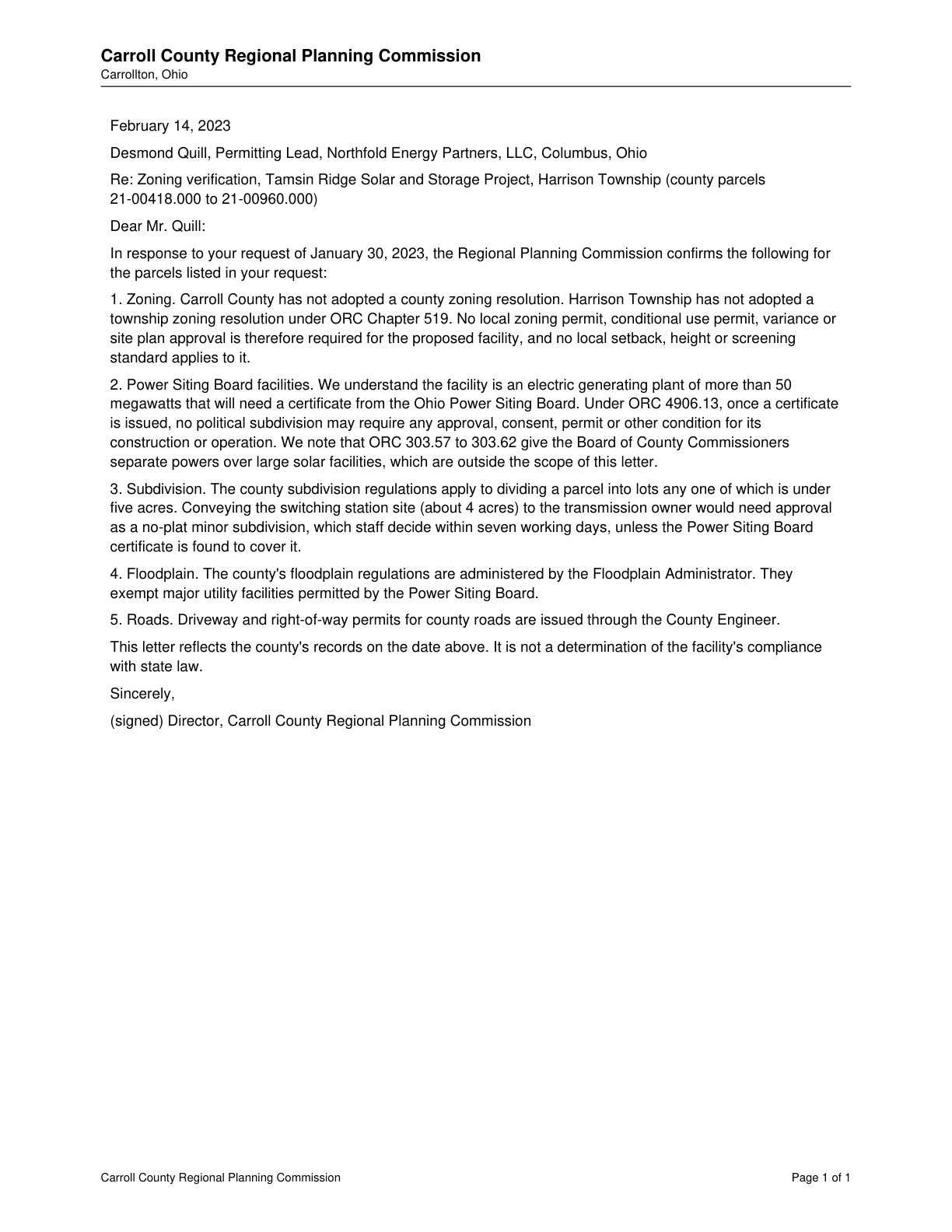
Carroll County has not adopted a county zoning resolution, and Harrison Township has not adopted a township zoning resolution under ORC Chapter 519.
Quote check Exact · Placed normalised · The quote matches the page once line breaks, hyphenation, case and punctuation are set aside, as the engine's matcher compares text. The marked words are the page's own. · Read as native
Carroll County Regional Planning Commission
Carrollton, Ohio
February 14, 2023
Desmond Quill, Permitting Lead, Northfold Energy Partners, LLC, Columbus, Ohio
Re: Zoning verification, Tamsin Ridge Solar and Storage Project, Harrison Township (county parcels
21-00418.000 to 21-00960.000)
Dear Mr. Quill:
In response to your request of January 30, 2023, the Regional Planning Commission confirms the following for
the parcels listed in your request:
1. Zoning. Quote starts. Carroll County has not adopted a county zoning resolution. Harrison Township has not adopted a
township zoning resolution under ORC Chapter 519. Quote ends. No local zoning permit, conditional use permit, variance or
site plan approval is therefore required for the proposed facility, and no local setback, height or screening
standard applies to it.
2. Power Siting Board facilities. We understand the facility is an electric generating plant of more than 50
megawatts that will need a certificate from the Ohio Power Siting Board. Under ORC 4906.13, once a certificate
is issued, no political subdivision may require any approval, consent, permit or other condition for its
construction or operation. We note that ORC 303.57 to 303.62 give the Board of County Commissioners
separate powers over large solar facilities, which are outside the scope of this letter.
3. Subdivision. The county subdivision regulations apply to dividing a parcel into lots any one of which is under
five acres. Conveying the switching station site (about 4 acres) to the transmission owner would need approval
as a no-plat minor subdivision, which staff decide within seven working days, unless the Power Siting Board
certificate is found to cover it.
4. Floodplain. The county's floodplain regulations are administered by the Floodplain Administrator. They
exempt major utility facilities permitted by the Power Siting Board.
5. Roads. Driveway and right-of-way permits for county roads are issued through the County Engineer.
This letter reflects the county's records on the date above. It is not a determination of the facility's compliance
with state law.
Sincerely,
(signed) Director, Carroll County Regional Planning Commission
Carroll County Regional Planning Commission Page 1 of 1
The outline marks where the quote begins on the page.
C-09acff9294
Carroll County has not adopted a county zoning resolution, and Harrison Township has not adopted a township zoning resolution under ORC Chapter 519.
Quoted from page 1
Carroll County has not adopted a county zoning resolution. Harrison Township has not adopted a township zoning resolution under ORC Chapter 519.
A petition signed by 212 residents asks commissioners to adopt a resolution prohibiting the facility and designate Harrison Township a restricted area for large solar.
Quoted from page 1
It asks the Board of County Commissioners to adopt a resolution under ORC 303.62 prohibiting the facility and to designate Harrison Township a restricted area for large solar facilities under ORC 303.58.
Within 90 days after the county public meeting, the Board of County Commissioners may adopt a resolution prohibiting the facility or limiting its boundaries (ORC 303.62).
Quoted from page 1
the Board of County Commissioners may adopt a resolution
prohibiting the facility or limiting its boundaries (ORC 303.62)
State siting law in force by the cut-off, as catalogued for OH: (1) Sub. S.B. 52 (134th General Assembly), uncodified Section 4(A), effective 2021-10-11: "SECTION 4. (A) The provisions of this act shall not apply to any application for a certificate, or material amendment to an existing certificate, from the power siting board for a large solar facility" (2) Sub. S.B. 52, uncodified Section 4(B), effective 2021-10-11: "(B) For any large solar facility that meets the requirements of division (A) of this section and has multiple positions in the PJM new services queue under the same legal entity as the applicant, all of the queue positions in effect as of the effective date of this section shall be exempt from the provisions of this act, subject to division (C) of this section" (3) Sub. S.B. 52, uncodified Section 4(C), effective 2021-10-11: "(C) If, after the effective date of this section, an applicant for a large solar facility files an additional new service request with PJM, pertaining to the same facility that is in the new services queue, the application shall be subject to review by the board of county commissioners of the county in which the utility facility is to be located" (4) Sub. S.B. 52, uncodified Section 4(D), effective 2021-10-11: "(D) If, after the effective date of this section, in order to participate in PJM's capacity market, a large solar facility submits a new queue position for an increase in its capacity interconnection rights, the change in capacity interconnection rights shall not subject the facility to the provisions of this act, provided that the change in rights occurs without increasing the facility's nameplat" (5) Sub. S.B. 52, uncodified Section 5; ORC 4906.02, 4906.021, 4906.022, effective 2021-10-11: "SECTION 5. For all power siting board proceedings under which an application for a certificate, or a material amendment to an existing certificate, for an economically significant wind farm, large wind farm, or a large solar facility that has not been found to be in compliance with division (A) of section 4906.06 of the Revised Code by the chairperson of the power siting board or the chairperson's" (6) ORC 303.58(E) (enacted by SB 52, effective 2021-10-11), effective 2021-10-11: "(E) A resolution adopted under this section shall not affect the construction of a utility facility that was presented to the board of county commissioners under section 303.61 of the Revised Code, and the board did not adopt a resolution prohibiting the facility within the time required under section 303.62 of the Revised Code" (7) ORC 303.58-303.60, 4906.101 (SB 52, effective 2021-10-11), effective 2021-10-11: "If a resolution described in this section is adopted and becomes effective under sections 303.58 and 303.59 of the Revised Code, no person shall file, and the power siting board shall not accept, an application for a certificate, or a material amendment to an existing certificate, to construct, operate, or maintain a utility facility in a restricted area where the construction of such a utility fa" (8) ORC 303.61, 303.62, 4906.30, 4906.102, 4906.103 (SB 52, effective 2021-10-11), effective 2021-10-11: "(A) At least ninety days, but not more than three hundred days, prior to applying for a certificate from the power siting board, or a material amendment to an existing certificate, for a utility facility, to be located in whole or in part in the unincorporated area of a county, the person intending to apply shall hold a public meeting in each county where the utility facility is to be located" (9) ORC 303.57(C) (SB 52, effective 2021-10-11), effective 2021-10-11: "(C)(1) "Material amendment" means an amendment to an existing power siting board certificate for the construction, operation, or maintenance of a utility facility that does any of the following: (a) For utility facilities: (i) Changes the facility's generation type from one type of utility facility to another; (ii) Increases the facility's nameplate capacity; (iii) Changes the boundaries of the fa"
Quoted from page 1
State siting law in force by the cut-off, as catalogued for OH: (1) Sub. S.B. 52 (134th General Assembly), uncodified Section 4(A), effective 2021-10-11: "SECTION 4. (A) The provisions of this act shall not apply to any application for a certificate, or material amendment to an existing certificate, from the power siting board for a large solar facility" (2) Sub. S.B. 52, uncodified Section 4(B), effective 2021-10-11: "(B) For any large solar facility that meets the requirements of division (A) of this section and has multiple positions in the PJM new services queue under the same legal entity as the applicant, all of the queue positions in effect as of the effective date of this section shall be exempt from the provisions of this act, subject to division (C) of this section" (3) Sub. S.B. 52, uncodified Section 4(C), effective 2021-10-11: "(C) If, after the effective date of this section, an applicant for a large solar facility files an additional new service request with PJM, pertaining to the same facility that is in the new services queue, the application shall be subject to review by the board of county commissioners of the county in which the utility facility is to be located" (4) Sub. S.B. 52, uncodified Section 4(D), effective 2021-10-11: "(D) If, after the effective date of this section, in order to participate in PJM's capacity market, a large solar facility submits a new queue position for an increase in its capacity interconnection rights, the change in capacity interconnection rights shall not subject the facility to the provisions of this act, provided that the change in rights occurs without increasing the facility's nameplat" (5) Sub. S.B. 52, uncodified Section 5; ORC 4906.02, 4906.021, 4906.022, effective 2021-10-11: "SECTION 5. For all power siting board proceedings under which an application for a certificate, or a material amendment to an existing certificate, for an economically significant wind farm, large wind farm, or a large solar facility that has not been found to be in compliance with division (A) of section 4906.06 of the Revised Code by the chairperson of the power siting board or the chairperson's" (6) ORC 303.58(E) (enacted by SB 52, effective 2021-10-11), effective 2021-10-11: "(E) A resolution adopted under this section shall not affect the construction of a utility facility that was presented to the board of county commissioners under section 303.61 of the Revised Code, and the board did not adopt a resolution prohibiting the facility within the time required under section 303.62 of the Revised Code" (7) ORC 303.58-303.60, 4906.101 (SB 52, effective 2021-10-11), effective 2021-10-11: "If a resolution described in this section is adopted and becomes effective under sections 303.58 and 303.59 of the Revised Code, no person shall file, and the power siting board shall not accept, an application for a certificate, or a material amendment to an existing certificate, to construct, operate, or maintain a utility facility in a restricted area where the construction of such a utility fa" (8) ORC 303.61, 303.62, 4906.30, 4906.102, 4906.103 (SB 52, effective 2021-10-11), effective 2021-10-11: "(A) At least ninety days, but not more than three hundred days, prior to applying for a certificate from the power siting board, or a material amendment to an existing certificate, for a utility facility, to be located in whole or in part in the unincorporated area of a county, the person intending to apply shall hold a public meeting in each county where the utility facility is to be located" (9) ORC 303.57(C) (SB 52, effective 2021-10-11), effective 2021-10-11: "(C)(1) "Material amendment" means an amendment to an existing power siting board certificate for the construction, operation, or maintenance of a utility facility that does any of the following: (a) For utility facilities: (i) Changes the facility's generation type from one type of utility facility to another; (ii) Increases the facility's nameplate capacity; (iii) Changes the boundaries of the fa"
ORC 303.57 to 303.62 give the Board of County Commissioners separate powers over large solar facilities, outside the scope of the letter.
Quoted from page 1
We note that ORC 303.57 to 303.62 give the Board of County Commissioners
separate powers over large solar facilities, which are outside the scope of this letter.
Under Ohio's SB 52 (effective 2021-10-11) the board of county commissioners may designate restricted areas that bar large solar facilities, and within 90 days of the required county public meeting may prohibit the facility or limit its boundaries; two voting ad hoc local members sit on the Power Siting Board. This power reaches the project: the SB 52 Section 4 PJM exemption does not apply, because position AH1-931 entered window AH1 (closed 2021-09-30); under the operator's published study timing its system impact study could not be complete before 2022-04-30.
Quoted from page 1
Under Ohio's SB 52 (effective 2021-10-11) the board of county commissioners may designate restricted areas that bar large solar facilities, and within 90 days of the required county public meeting may prohibit the facility or limit its boundaries; two voting ad hoc local members sit on the Power Siting Board. This power reaches the project: the SB 52 Section 4 PJM exemption does not apply, because position AH1-931 entered window AH1 (closed 2021-09-30); under the operator's published study timing its system impact study could not be complete before 2022-04-30.
The requirements the assessor tied to this row, by level. Each quote from dated law is shown with its source.
No requirement is tied to this row.
Information requests
IR-a4070979c7 · Medium priority
Provide the dated record of local and state siting decisions in the region (engine context check) for the project area, or confirm none exists.
Missing evidence
Dated record of local and state siting decisions in the region (engine context check)
Consequence
Regional Siting Climate is rated on partial evidence without it.
Blocks the decision
No
Raised by
completeness
Next steps
Re-check county records for any restricted-area or prohibition resolution after 2023-03-28 and track the Commissioners' 90-day decision.
Engage county commissioners directly.
Confirm adjacent-county and OPSB decisions on solar.
Agencies
Carroll County
OPSB
Cost and impact
Impact
C, S
Potential cost level
M-H
Why
Unprotected exposure to the county veto with the decision window open. Cost and schedule risk from engagement, possible boundary limits and a longer OPSB case; no use of the power is recorded.
Impact: C = cost, S = schedule. Potential cost level: L, L-M, M, M-H, H (relative to a utility-scale solar budget).
Comments
Ohio SB 52 county veto power reaches the project; the PJM exemption does not apply. Commissioners may prohibit the facility or limit its boundaries within 90 days of the county meeting. No restricted-area resolution for Harrison Township was found as of 2023-03-28. Commissioners took no action at the 2023-05-12 meeting. Sources are not exhaustive.