Up to3Resource is present, likely difficult to address
Evidence
Verified
Cited claims
16
Requirements
2
Requests
1
Rating
2Impacts likely but may be easily resolved
up to3Resource is present, likely difficult to address
The engine shows this rating as 2-3
The rule
Code computed the rating from the assessor's inputs:
impact_likely=yes -> 2
Set by the rule
Decision
Released with flags
The engine's reasons
Agencies not in the register or the evidence: OHPO
Evidence state
Verified · field study or agency determination
Worst case
If what is pending at the cut-off went badly, the same rule gives a higher rating.
Scenario
Radar confirms unmarked graves extending into planned array areas and 33-CR-0412 is found eligible, and a federal nexus triggers Section 106 adverse-effect resolution with data recovery or disinterment.
Step still pending
Ground-penetrating radar at the cemetery, SHPO review and Phase II testing of 33-CR-0412, plus tribal consultation
Phase I survey recorded four new sites (C-d3cd803c16), including 33-CR-0412, a lithic scatter with intact pit feature that may hold significant information (C-915bc9d3d5). Pettibone Family Cemetery adjoins Parcel 9 with possible unmarked graves outside the fence (C-973edd2bcd, C-75edf45e28, C-5aeb954b2a). Absence finding covers only three other sites needing no further work (C-3f34c70506); low potential in the mined part of the East Block (C-26b173c644) does not negate these.
Site 33-CR-0412 covers about 1.6 acres (C-257da2033f) and the 0.2-acre cemetery tract is excluded from the leased land (C-bb450a29a5), against 780 buildable acres. Both are small localized features; the cemetery is 120 feet from arrays (C-76863a3272).
Consultant states a shift of about 150 feet avoids 33-CR-0412 with its buffer (C-7041213fff); cemetery protection by buffer and fencing is recommended (C-1134e16733). Unmarked graves extent still unconfirmed but avoidance by layout is feasible.
OPSB application must map cultural resources and describe avoidance, with SHPO-standard surveys submitted to SHPO (C-37779bcd55, C-4892410817; OH-HIST). Cemetery buffer and discovery plan follow SHPO guidance (OH-CEM, C-4d507135cc). Section 106 applies only if a federal nexus arises (C-f5449d6a0d), not established.
Draft layout places array rows over the north half of 33-CR-0412 (C-7041213fff), and arrays sit near the cemetery where unmarked graves may lie outside the fence (C-75edf45e28); grading and pile driving may affect them unless layout changes.
Phase I survey recorded four new sites. Site 33-CR-0412 covers about 1.6 acres; draft layout places array rows over its north half, and a shift of about 150 feet would avoid it. Pettibone Family Cemetery lies 120 feet from arrays; unmarked graves may extend beyond its fence. No tribal consultation has taken place yet.
Critique
Verdict
upheld
Suggested direction for the rating
same
Summary
The assessment is mostly supported. Category 2 follows from the draft layout over 33-CR-0412 and the graves near the arrays. Two citations are misattributed (C-1134e16733, C-f5449d6a0d), and the worst case assumes a federal nexus no claim shows. All issues are minor.
Critic model
Luminol
Issues
Severity minor · Kind unsupported_statement
The avoidable rationale says buffer and fencing are recommended (C-1134e16733), but that quote only says moving a burial requires disinterment. The buffer and fencing guidance comes from the OH-CEM requirement, not from the consultant claim, and should be attributed to it.
The pathway rationale and worst case cite C-f5449d6a0d for 'Section 106 applies only if a federal nexus arises', but that quote only says no tribal consultation has taken place. The federal-nexus point comes from F-NHPA106 and should be cited to it. The worst case also assumes a federal nexus that no claim shows, and that nexus is not a pending step.
The assessment does not say that the graves outside the fence need geophysical survey and SHPO consultation to set the avoidance area if a 100-foot buffer is not possible. The 120-foot distance is measured to the cemetery, so it may not clear the depressions south of the fence. Extent 'peripheral' and avoidable 'yes' depend on that survey.
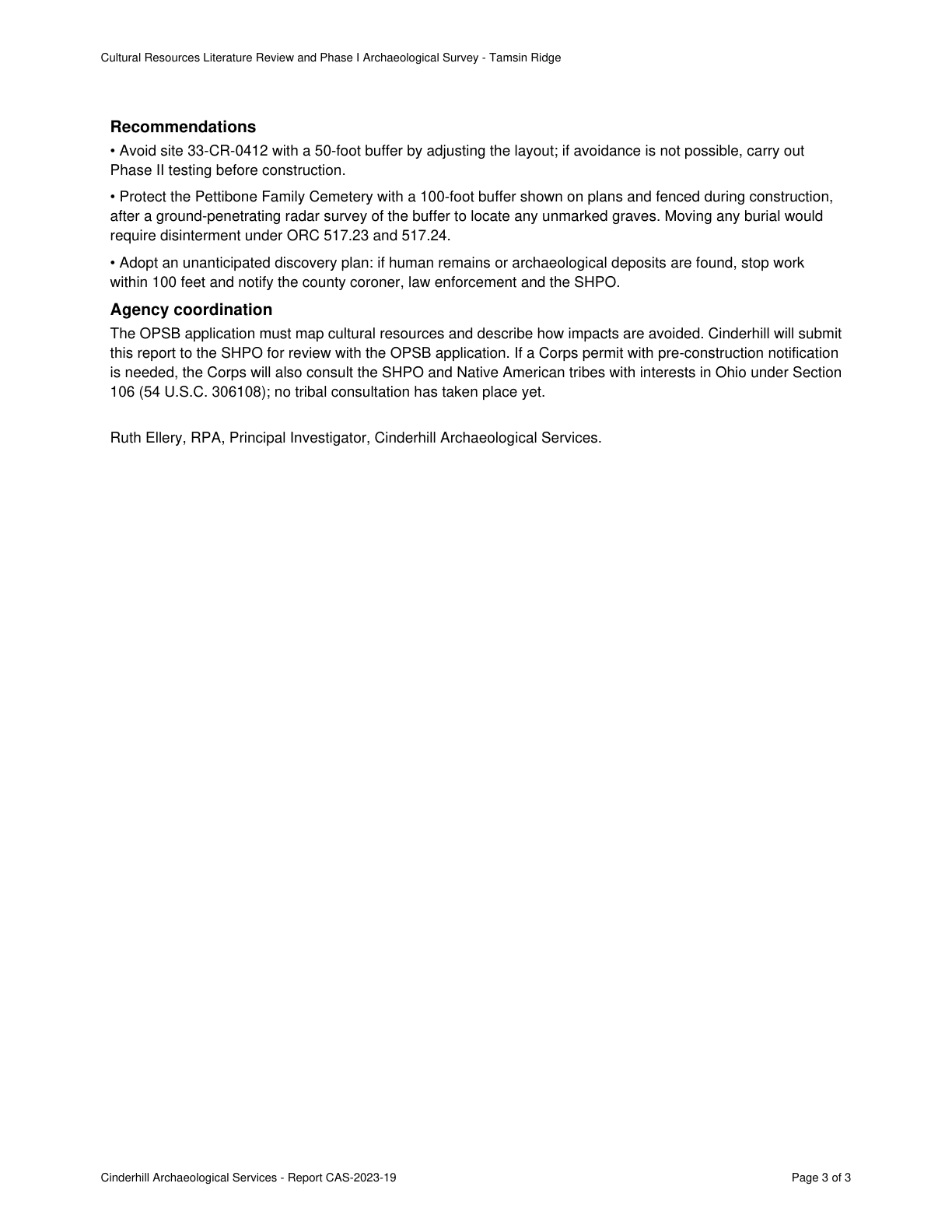
Protect the cemetery with a 100-foot buffer, fenced during construction, after a ground-penetrating radar survey; moving any burial requires disinterment under ORC 517.23 and 517.24.
Quote check Exact · Placed normalised · The quote matches the page once line breaks, hyphenation, case and punctuation are set aside, as the engine's matcher compares text. The marked words are the page's own. · Read as native
Cultural Resources Literature Review and Phase I Archaeological Survey - Tamsin Ridge
Recommendations
• Avoid site 33-CR-0412 with a 50-foot buffer by adjusting the layout; if avoidance is not possible, carry out
Phase II testing before construction.
• Protect the Pettibone Family Cemetery with a 100-foot buffer shown on plans and fenced during construction,
after a ground-penetrating radar survey of the buffer to locate any unmarked graves. Quote starts. Moving any burial would
require disinterment under ORC 517.23 and 517.24. Quote ends.
• Adopt an unanticipated discovery plan: if human remains or archaeological deposits are found, stop work
within 100 feet and notify the county coroner, law enforcement and the SHPO.
Agency coordination
The OPSB application must map cultural resources and describe how impacts are avoided. Cinderhill will submit
this report to the SHPO for review with the OPSB application. If a Corps permit with pre-construction notification
is needed, the Corps will also consult the SHPO and Native American tribes with interests in Ohio under Section
106 (54 U.S.C. 306108); no tribal consultation has taken place yet.
Ruth Ellery, RPA, Principal Investigator, Cinderhill Archaeological Services.
Cinderhill Archaeological Services - Report CAS-2023-19 Page 3 of 3
The outline marks where the quote begins on the page.
C-1134e16733
Protect the cemetery with a 100-foot buffer, fenced during construction, after a ground-penetrating radar survey; moving any burial requires disinterment under ORC 517.23 and 517.24.
Quoted from page 3
Moving any burial would
require disinterment under ORC 517.23 and 517.24.
Site 33-CR-0412, a prehistoric lithic scatter with intact pit feature on a terrace above Sallow Creek, may hold significant information and should be avoided or evaluated by Phase II testing.
Quoted from page 1
may hold significant information and should be
avoided or evaluated by Phase II testing.
If a Corps permit with pre-construction notification is needed, the Corps will consult the SHPO and tribes under Section 106; no tribal consultation has taken place yet.
The requirements the assessor tied to this row, by level. Each quote from dated law is shown with its source.
State
Cultural and archaeological resources information in the OPSB application, supported by SHPO-standard archaeology and history/architecture surveys and SHPO review
OH-HIST · Ohio Power Siting Board (OPSB) for the application content; Ohio History Connection, State Historic Preservation Office (SHPO), for survey standards and review
Applicability
Required
Instrument
OAC 4906-4-08(D) (effective 2018-04-26); ORC 149.53; SHPO Archaeology Guidelines (2022) and Guidelines for Conducting History/Architecture Surveys in Ohio (2014); National Historic Preservation Act Section 106 where a federal permit or approval applies
Trigger
An OPSB certificate application for a generating facility under OAC Chapter 4906-4 must include cultural and archaeological resources information, and SHPO review follows where a federal permit or approval (Section 106) or a state agency (ORC 149.53) is involved.
Description
An OPSB certificate application for a generating facility must map registered landmarks of historic, religious, archaeological or other cultural significance within ten miles of the project area, evaluate the facility's impact on them and describe plans to avoid or mitigate adverse impact (OAC 4906-4-08(D)). SHPO sets the survey standards it reviews: its archaeology guidelines prescribe report formats, and its history/architecture guidelines require a qualified principal investigator for compliance surveys. Section 106 review, in which SHPO takes part, is a routine part of planning for projects with federal funding, permits, licenses or approvals. ORC 149.53 provides, whenever practical, for archaeological and historic survey in planning, including before work on a public improvement begins; SHPO says there is no formal consultation process under it, though its phased approach is typically followed, and the sources do not say whether it reaches a private facility certificated by the OPSB.
Typical timeline
Under Section 106 the regulations give SHPO thirty days to respond to submissions that meet 36 CFR 800.11, and incomplete submissions may need further information and analysis (SHPO form instructions). The sources state no period for comment under ORC 149.53, for which SHPO says there is no formal process.
(1) Landmark mapping. The applicant shall indicate, on a map of at least 1:24,000 scale, any formally adopted land and water recreation areas, recreational trails, scenic rivers, scenic routes or byways, and registered landmarks of historic, religious, archaeological, scenic, natural, or other cultural significance within ten miles of the project area.
In force from 2018-04-26 to 2024-05-29, section 4906-4-08
4906-4-08: version effective 2018-04-26; first change after it 2024-05-30 (OPSB Case 21-902-GE-BRO (determination 2023-07-20)), from codes.ohio.gov version history in archive captures (confirmed_two_sources)
May be cited on the cut-off date.
Quoted from the law, page 29
(2) Impacts on landmarks. The applicant shall provide an evaluation of the impact of the proposed facility on the preservation and continued meaningfulness of these landmarks and describe plans to avoid or mitigate any adverse impact.
In force from 2018-04-26 to 2024-05-29, section 4906-4-08
4906-4-08: version effective 2018-04-26; first change after it 2024-05-30 (OPSB Case 21-902-GE-BRO (determination 2023-07-20)), from codes.ohio.gov version history in archive captures (confirmed_two_sources)
May be cited on the cut-off date.
Quoted from the law, page 3
and for such purposes shall, whenever practical, by contract or otherwise provide for archaeological and historic survey and salvage work during the planning phases, before work on a public improvement begins or at other appropriate times;
Source ORC 149.51 to 149.55 historic preservation · page 3 · version 2023-08-01
In force from 2015-09-29 to 2026-10-03, section 149.53
149.53: version effective 2015-09-29, still the current version when the page map was checked (2026-10-03)
May be cited on the cut-off date.
Quoted from the law, page 5
There is no formal process for consulting with SHPO under Ohio Revised Code (ORC) 149.53. However, the phased approach indicated above is typically followed.
The following report formats are required for all archaeology undertakings reviewed by the State Historic Preservation Office (SHPO) pursuant to 36 CFR Part 800, regulations implementing Section 106 of the National Historic Preservation Act; and Ohio Revised Code (ORC) section 149.53, Archaeological and Historic Survey and Salvage Work.
All surveys under taken for compliance projects and through Certified Local Governments (CLG s) Grants and History Fund Grants must be carried out under the professional direction of a Principal Investigator that meets the established professional qualifications set forth in the Secretary of the Interior’s Standards for Archeology and Historic Preservation for a Historian, Architectural Historian, or Historic Preservationist.
Source OHC SHPO guidelines for conducting history architecture surveys · page 11 · version 2014-11
May be cited on the cut-off date.
Quoted from the law, page 1
Section 106 is a routine part of the planning process for projects that receive federal funding, permits, licenses, or approvals, to ensure that preservation standards are factored into a project before work is authorized to begin.
Source OHC SHPO about section 106 page · page 1 · version 2023-08-01
May be cited on the cut-off date.
Quoted from the law, page 1
Following our review of the Project Summary Form and its associated documentation, SHPO may request additional information to help us understand your assessment of the project’s effect. The regulations give us thirty days to respond to project submissions that meet all the requirements found at 36 CFR 800.11. Incomplete submissions may require the preparation of additional information and analysis.
Source OHC SHPO section 106 project summary form instructions · page 1 · version 2022-06-21
May be cited on the cut-off date.
Avoidance of cemeteries and burial places (SHPO guidance); disinterment under ORC 517.23 and 517.24 if remains must be moved; stop work and notify if human remains are found
OH-CEM · Ohio History Connection, State Historic Preservation Office (SHPO), for burial-place guidance; cemetery officers and the court (disinterment); Ohio Department of Commerce, Division of Real Estate (cemetery registration)
Applicability
Conditional
Instrument
ORC 517.21 to 517.24; ORC Chapter 4767; ORC 2927.11; SHPO Archaeology Guidelines, Cemeteries, Burial Mounds, and Other Burial Places (November 2022)
Trigger
A cemetery, burial mound or other place of burial is known or suspected on or next to the project area, or human remains are found during survey or construction.
Description
The State Historic Preservation Office (SHPO) recommends preservation in place, with a 100-foot buffer shown on plans and fenced during construction; if 100 feet is not possible, geophysical survey and SHPO consultation set the avoidance area. Moving remains means disinterment. After an application is filed with the cemetery and costs are paid, it must follow within thirty days, subject to the statute's exceptions (ORC 517.23); a person not qualified to apply may obtain a court order (ORC 517.24(B)). Trustees or directors may order an abandoned cemetery discontinued and its remains removed (ORC 517.21). The sources do not say how these procedures apply to an isolated burial on private land. Purposely damaging a cemetery or Indian mound or earthwork without privilege is prohibited (ORC 2927.11). Cemetery registration (ORC 4767.02 to 4767.04) excludes family cemeteries and those with no interments in 25 years, so records may omit burial grounds.
Typical timeline
Disinterment: within thirty days after an application is filed with the cemetery and costs are paid, subject to the statute's exceptions (ORC 517.23(A)(1)). On an inadvertent discovery, all ground-disturbing activity within a 150-foot radius of the burial place must cease, and the discovery be reported to the county medical examiner or coroner, local law enforcement, the applicant, the landowner and SHPO (SHPO guidance).
Version of the law on the cut-off
ORC 517.23 and 517.24 as effective 2023-04-03 (the library text)
the board, trustees, or directors may order that the abandoned cemetery or the cemetery whose further use for burial purposes is believed to be detrimental to the public welfare or health be discontinued and provide for the removal of all remains buried in that cemetery,
In force from 1995-11-24 to 2026-10-03, section 517.21
517.21: version effective 1995-11-24, still the current version when the page map was checked (2026-10-03)
May be cited on the cut-off date.
Quoted from the law, page 3
shall disinter or grant permission to disinter any remains buried in the cemetery in either of the following circumstances: (1) Within thirty days after an application for disinterment is filed with the cemetery in accordance with division (A) of section 517.24 of the Revised Code and payment of the reasonable costs and expense of disinterment is made
In force from 2023-04-03 to 2024-10-23, section 517.23
517.23: version effective 2023-04-03; first change after it 2024-10-24 (H.B. 301, 135th GA), from codes.ohio.gov version history in archive captures (confirmed_two_sources)
May be cited on the cut-off date.
Quoted from the law, page 6
(B)(1) A person who is eighteen years of age or older and of sound mind and who is not qualified to file an application to disinter pursuant to division (A)(1) of section 517.23 of the Revised Code may obtain a court order under this division for the disinterment of the remains of the decedent.
In force from 2023-04-03 to 2026-10-03, section 517.24
517.24: version effective 2023-04-03, still the current version when the page map was checked (2026-10-03)
May be cited on the cut-off date.
Quoted from the law, page 18
No person, without privilege to do so, shall purposely deface, damage, pollute, or otherwise physically mistreat any of the following: (1) The flag of the United States or of this state; (2) Any public monument; (3) Any historical or commemorative marker, or any structure, Indian mound or earthwork, cemetery, thing, or site of great historical or archaeological interest;
In force from 1999-09-20 to 2026-10-03, section 2927.11
2927.11: version effective 1999-09-20, still the current version when the page map was checked (2026-10-03)
May be cited on the cut-off date.
Quoted from the law, page 22
(D) Sections 4767.02 to 4767.04 of the Revised Code do not apply to or affect a family cemetery or a cemetery in which there have been no interments during the previous twenty-five calendar years.
In force from 2018-10-29 to 2026-10-03, section 4767.02
4767.02: version effective 2018-10-29, still the current version when the page map was checked (2026-10-03)
May be cited on the cut-off date.
Quoted from the law, page 6
Regardless of whether or not a cemetery, burial mound, or other burial place is found eligible for listing in the NRHP, SHPO recommends preservation-in-place as the preferred treatment. The only exception is for cases where all parties, including lineal descendants and/or culturally affiliated groups or individuals, agree that removal/disinterment is the best option.
The buffer must be depicted on project construction plans and delineated by temporary fencing prior to and during construction. If a 100-foot buffer is not possible, geophysical investigations must be used to try and delineate the horizontal extent of the interments followed by consultation with the SHPO to determine the extent of the avoidance area
encountered during any phase of compliance-related activities and/or construction activities, all ground disturbing activities within a 150-foot radius of the burial place must cease and the human remains, burial facility and associated funerary objects must be covered and secured. The discovery must be reported to the county medical examiner/coroner, local law enforcement, the agency/applicant, landowner, and the SHPO.
Comments
Phase I survey recorded four new sites. Site 33-CR-0412 covers about 1.6 acres; draft layout places array rows over its north half, and a shift of about 150 feet would avoid it. Pettibone Family Cemetery lies 120 feet from arrays; unmarked graves may extend beyond its fence. No tribal consultation has taken place yet.